It was with a sense of pride that I took another look at my confidential orders. They confirmed my new assignment and officially declared me an OPS. I took the A95 and motored through Munich and Stuttgart. Then I picked up the A8 and finally B428.
I took in the beauty of Bavaria and other sites (though the autobahn is not the most scenic route). During the journey, I recalled some history of the last hundred years in this part of Germany. During my six-hour drive on the mostly no-speed-limit autobahn, cars flew by, trucks too, leaving the old Beetle that maxed out at 115kph.
I was happy to see Marty and the twins at our quarters in BK. She was impressed with my physique and anxious for us to have some time together. But it was not to be; I had just one day to spend. She was understandably stressed and could use some companionship and help with the girls.
We were still involved in field exercises with the well-known REFORGER (Return of Forces to Germany) training, I told her. “That’s the price we pay when on active duty in the U. S. Army. This is far from Ft Lewis, not just in distance. We are patrolling soldiers who are patrolling us. It’s a Soviet Bloc country that, with just one provocative move, would heat up the Cold War. I love you and the twins and will, hopefully, see you soon. For now, duty calls.”
Before leaving, I purchased a beige 1969 VW® Squareback with an automatic transmission. I left it with Marty, just in case she decided to get her International Driver’s license. She didn’t.
The Wonder Of You by Elvis played on AFNE radio as I motored NW from Bad Kreuznach in the old black Beetle. Why wasn’t I in that sterile and safe studio in Wiesbaden introducing the King of Rock ‘n’ Roll? I could be talking about Elvis’ recent meeting with President Nixon at the White House. Because I wanted something more exciting, something a little more hands-on in our effort to discourage East Germany from crossing the border into West Germany.
What had I gotten myself into? It became clearer after my final briefing in Frankfurt, when I was issued a “Do not Deter, Detain or Disarm Document.” It was signed by the Supreme Allied Commander Europe (SACEUR)* and authorized by NATO.
Facsimile of OPS Document (Unclassified version).

By order of NATO and Supreme Allied Commander Europe: The holder of this Document is on an assignment of great importance and shall not be Delayed, Deterred, or Disarmed. Individual is authorized to carry special weapons and other lethal devices and is entitled to special access up to and including TOP SECRET CRYPTO. If deceased, this Document is to remain with the corpse.
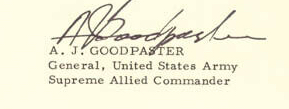
BY ORDER OF:
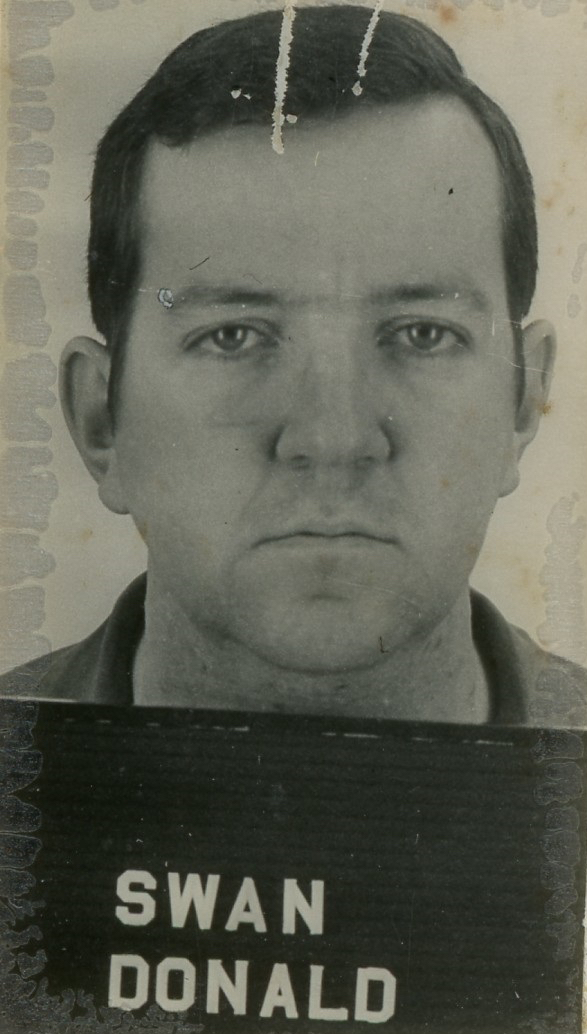
*DONALD SWAN, SACEUR OPS*
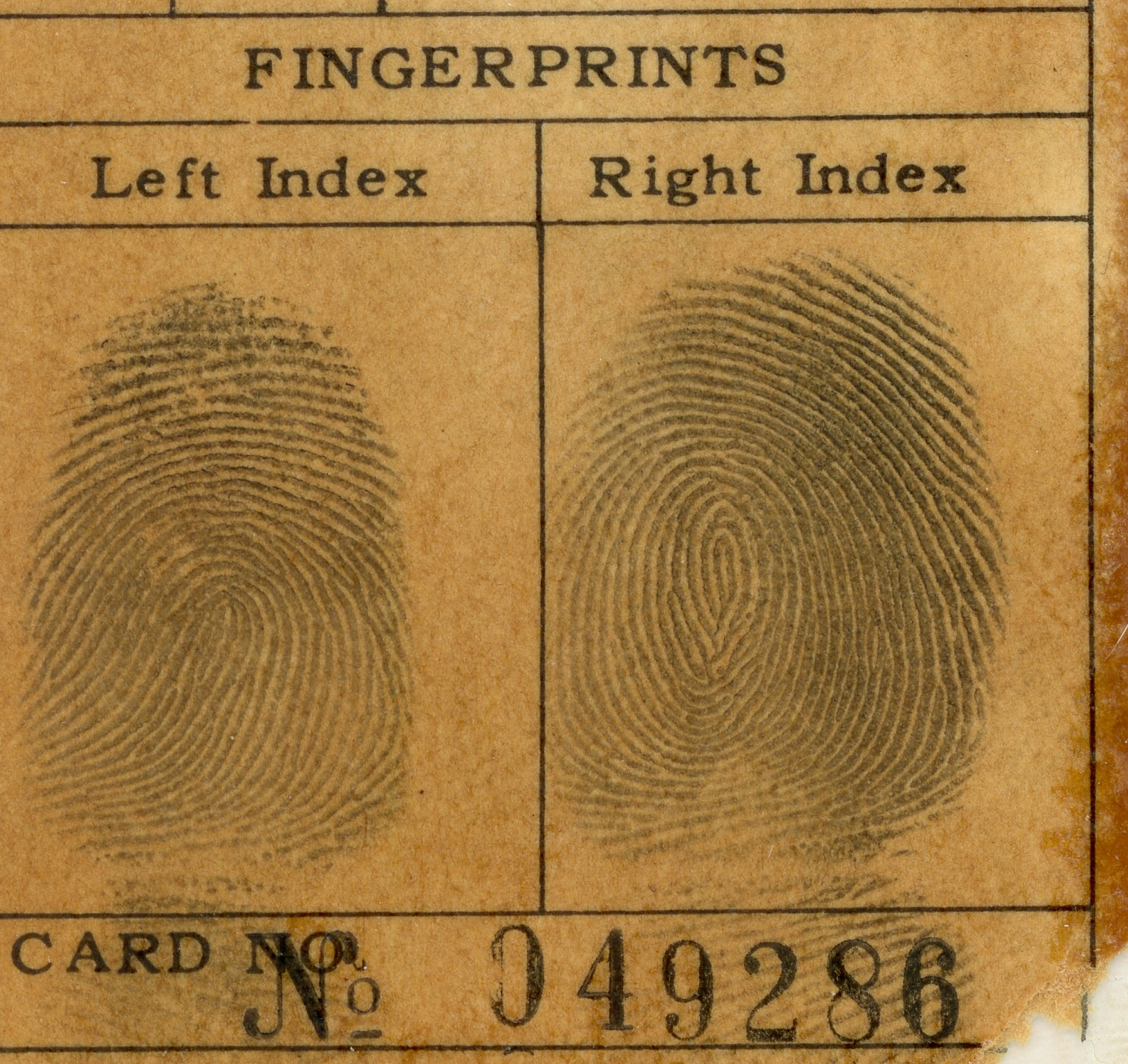

(I carried my Operative’s Credentials)
Unauthorized use of this document is a serious Federal Criminal Offense, 50 U.S.C. Sec. 38
DO NOT COPY
After my briefing at the I.G. Farben building, I was picked up by a driver from the Federal Republic of Germany (FRG) in a black 1970 Mercedes® 220. He recommended that I sit in the front passenger seat — not chauffeured — making me less of a target. Whoa, okay. In jest, I asked Karl if lying flat in the back seat would be even safer.
As we sped down the autobahn, I joked with him about a possible detour to Scotland, where the Rolling Stones were about to perform in Glasgow. He didn’t appreciate the juxtaposition and maintained his heading south on the A5. He kept the Merc at a steady 130kph on the way to meet my charge.
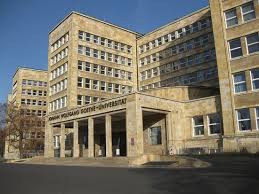 The Renown I.G. Farben building near Frankfurt is the headquarters of the Supreme Allied Commander Europe. Gen. Eisenhower occupied this building as Commander from April 1951 to May 1952. I was here on temporary duty several times in 1970-72 when Gen Andrew Goodpaster was Commander. (DOD)
When I tried conversing with Karl in just Deutsch, I did not do well. It was embarrassing, actually. Thankfully, the trip was soon complete, and I bid my “Chauffeur,” Auf Wiedersehen.
Awaiting me at my destination was a gray 1968 BMW® 1800 containing the very weapons I’d trained with in Bad Tolz. Also included was considerable ammo, a life-saving kit, and a TAR-224A crypto radio. Several hundred dollars in cash in three currencies were provided. Finally, there was a specially tailored 42L trench coat. It would conceal a twenty-four-inch weapon. And my charge?
I didn’t know the man I was to protect or for whom he worked. Unassuming, he looked like a manager of a carpet depot in Tacoma. We would collaborate over the next few weeks and rehearse enough stratagems that I realized he was — a spy.
He worked unarmed and had diplomatic cover; I carried his DIA credentials, and we wore German civilian attire. I thought he deserved protection just for the amount of cash he possessed in Deutsche Marks, French francs, and U.S. dollars.
Once operations began, there was no commingling. We communicated just enough that I was cognizant of his missions and that we were vigilant of each other’s whereabouts.
I had just one job: protect my asset, up to eliminating the threat, with extreme prejudice. As for who would protect me, I was on my own. My only contact other than the Operative was a source at SACEUR in the I.G. Farben building in Frankfurt. This was classic Cold War.
Armed with a D2 K-Bar,™ silenced H&K™ VP70z** with an 18-round magazine, and a subcompact SIG Sauer™ for backup. I stayed close and shadowed him everywhere, which seemed to be every club and brothel in the cities we worked.
By now, I knew my man (code name Hans) was a Defense Intelligence Agent (DIA). But I was no spy and never a part of any intelligence-gathering or recruiting. Eye on my Operator, concealing my hand cannon, ready to dispatch it in a split second, kept me occupied.


During the more than three months of shadowing my operator, I never fired either weapon in anger. But I could do a mean stare-down. A working girl feeling me up was tricky. And some other encounters had forced me into revealing one gun while at the ready with the backup.
My weapons were always at condition one, as neither had a manual safety. I honed my shooting skills off-duty and was fanatical about keeping my weapons at peak performance. Still, I worried about screwing up. I worried about my family. Sometimes I vacillated from being lax to getting jumpy and anxious.
If a suitable replacement were available, I could resign if not under investigation, since this was a volunteer, high-stress assignment. The Operative could relieve me at any time. Efficiency reports were straightforward; he rated his OPS to SACE as “Satisfactory.”
OPS was an engaging, exciting experience. My per diem was generous and without scrutiny. I stayed in good hotels, ate well, and visited fascinating cities and areas pivotal in the Second World War.
But 100 days were enough for me, and a replacement was available. I contacted my source at SACEUR and requested relief and permission to return to my previous assignment. (DIA began using its own resources in 1972, and active duty army involvement was discontinued.)
Several weeks later, I walked into the Public Affairs Office (where I was initially assigned) at Rose Barracks. Still buffed and back from TDY. I felt the presence of someone approaching my six.*** I swiftly swung toward him, about to execute a crushing elbow thrust to his neck and a quick and stiff knee to his groin. I realized, just in time, that it was the lieutenant colonel in charge of public affairs wanting to give me a hug from behind.
The reunion was nice, but I was looking for a way to get out of Germany. I had over a year left on my tour.
As for the joys of touring Germany, France, and other European countries, we did some (see photos). But my work, finances, and the twins prevented us from traveling more.

Two great opportunities arose after I returned to BK. The first was a message from Washington, D.C., for qualified enlisted personnel. It was a fully funded Environmental Science and Engineering program at Texas A&M University. Upon graduation, the member would become a commissioned officer.
I started my application immediately. It was a daunting and drawn-out procedure. The packet (needing to be perfect) contained about a dozen pages, including attachments. I received lots of encouragement, culminating in the Commanding General of the 8th Infantry Division endorsing the application with: “Highly Recommend Approval.” Off the packet went to D.C.
The second was an opportunity, a few weeks later, inviting qualified enlisted to apply for Recruiting Duty. It came with a choice of station. That meant we could go to North Carolina and be near Marty’s folks.
The other good news is that if selected, we could leave Germany presently, a year early. It wasn’t like becoming an officer, but it was a great opportunity with $75 a month in incentive pay and a chance for early promotion.
After Marty’s two years, mostly alone in Germany with the twins, I was willing to and did withdraw my application for the engineering program and give up my chance to become a commissioned officer.
My recruiting application was approved.
*Although DIA reports to the Secretary of Defense, SACEUR is the host and must be aware of activities within his domain.
**Just released and known as a Machine Pistol, it had a detachable 8″ stock and was capable of a 3-round burst.
***Six 6 o’clock is directly behind, and 12 o’clock is directly in front, commonly used by fighter pilots and others in the military
 Swan's Song Series