A light dusting of snow covered the Puget Sound just as Spring had arrived in March 1970. I was sitting on a single sheet atop a cold metal table. I was in a medical suite somewhere in Tacoma to get fixed, sniped, you know, a vasectomy. I figured a set of twins was enough. I didn’t think the U.S. Army would perform such a procedure, and I didn’t even ask. Today, they pay for sexual reassignment.
When I returned to my office the next morning, there was a call for me from a captain at Post HQ. “Congratulations, Sergeant Swan, you’ve been reassigned to Germany.”
Congratulations, eh? We didn’t quite see it that way. We were comfortable at Ft. Lewis. It was a major move, especially with two infants to tow. It required 2,861 miles just to get to the point of debarkation. And then another 3,857 over the North Atlantic to Frankfurt. Luckily, we were afforded concurrent travel which meant the entire family would be together for our trip to Germany.
There was a lot to be done before we left for Deutschland. We needed immunizations, passports, and briefings. We also needed to out-process, arrange for our household goods for pick-up and so forth. We also needed to liquidate the Mach 1. Ford™ bought it back at Kelley Blue Book® value. Since it wasn’t paid for, they didn’t allow the car to go overseas and out of their control.
We flew from Sea-Tac (SEA) to see my parents in Mississippi. I picked the 1966 VW that Dale had refurbished with parts from the one I had wrecked in 1964. This time I would buy it.
My parents thought the twins looked sickly, too skinny, and wondered why they cried so much. Of course, they were proud to see their first Grandchildren and gave us lots of advice.
From there, we headed to North Carolina in the noisy non-air conditioned Beetle to visit Marty’s folks. American Woman by the Guess Who droned from the small speaker and War by Edwin Starr was played often. It was no Mach 1 but there were no care payments either.
Marty’s parent’s patience was tested, as well, when these first-time Grandparents wondered why they cried so much. Lisa was way too skinny, were we feeding them properly? They worried about our trip abroad with the twins, and then we got lots of advice.
We picked-up 1-95 North for the ten-hour drive and soon were getting tired of Simon and Garfunkel’s Bridge Over Troubled Water, and Everything Is Beautiful by Ray Stevens. We rested overnight near Newark.
The next morning, we dropped off the little VW at the Bayonne port for its boat ride to Bremerhaven in Northern Germany. Later that day, we took off from Newark International (EWR). It was scheduled for a roughly nine-hour (non-stop) flight over the Atlantic.
As the 707 (300) ascended into thinner air, our eighteen-month-olds and other small children cried out as their eardrums popped. Then they cried on and off for the entire flight, I guess that’s what young children do on airplanes, eardrums popping or not.
We landed at Rhein-Main in Frankfurt. There, in our temporary lodging, Marty and I contracted food poisoning. In my opinion, that’s about as sick as one can get without dying. Caring for two small children when that ill, very challenging.

Intriguing medieval bridge houses in Bad Kreuznach,* built around 1300. The town itself, famous for its spas, dates back to the Stone Age. In the 5th Century BC, it was occupied by the Celts and Romans. Its population in 1970 was around 40,000, not including 8,000 U.S. troops. (Photo courtesy Wikipedia)
I was stationed with the 8th Infantry (Pathfinders) in the Public Affairs Office at Rose Barracks in Bad Kreuznach (BK) for a three-year tour. We were in Germany to discourage any over-the-border attack from the East, and the Soviet Block controlled East Germany. The Berlin Wall was a 96-mile zigzag border between East and West Germany. It included 27 miles that separated East and West Berlin and were fanatically controlled by the German Democratic Republic (GDR). Their definition of democratic is undoubtedly antithetical to most of the Western world.

The last time there were no U.S. troops in Germany, a World War broke out. Interestingly, as part of my job at the Public Affairs Office, I arranged Berlin Tours for U. S. military members. That included the Brandenburg Gate, the East-West checkpoint.
(Swan archives)
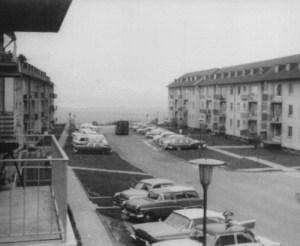
Our quarters at Bad Kreuznach were in an old five-story building circa 1935. Fortunately, we landed a 2nd-floor unit as there were no elevators.
The Armed Forces Network Europe (AFNE) did not broadcast TV to BK, just radio. Local phone calls were 25 cents.
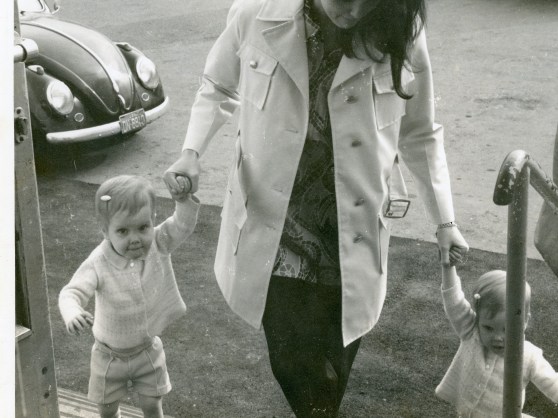
Marty didn’t bother to get an international driver’s license. She took a taxi to the commissary, PX, or taking the twins and herself to the dispensary. She was stuck in our dour apartment with two two-year-olds — All day. All night.
Marty soothed her loneliness somewhat by ordering lots of stuff from the Spiegel catalog, listening to AFNE radio, writing letters home, and seeing a psychiatrist. Taxi service — in a Mercedes diesel no less — to the hospital, commissary, post exchange, and around town was very reasonable.
I was part of a small Civil Affairs (G-5) team at my new post. It was the army liaison with local property owners. They were reimbursed for farmland we damaged and chickens we killed with our tanks on maneuvers.
I was also responsible for scouting locations for public affairs units around Baumholder. It was the main area where we trained with our Allies. As was the case in Vietnam, I was anxious to get out of the rear echelon Public Affairs Office. I wanted something more exciting here as well.
I requested and was accepted to attend the selective Seventh Army NCO Academy in Bad Tolz. It was the oldest and most highly regarded in the U.S. Army. Graduating from this intensive eight-week course was usually a ticket for a below-the-zone promotion. The 10th Special Forces Group stationed there was our advesary in war games. Little did I know it was a school within a school.
Upon arrival at the academy, the commandant congratulated us on our acceptance. Then he informed us that anyone who completed the course in the top ten percent would be eligible to apply for a special assignment. The candidate also needed a top-secret clearance and some language proficiency in Deutsche.
What was it? Those showing interest were told something none of us had heard of, Operative Protection Specialist (OPS). It was a solo assignment to shadow Operatives in the field. This undercover operation that came with $65 per month of extra pay, excitement, and special weapons.
It seems there was a shortage, and the DOD asked the Academy if they could recruit and train a few for these special missions. Those selected would attend a rigorous training regime. Throw down that gauntlet to a group that included some young, fearless, egotistical, combat-tested soldiers. You get volunteers. Ten, to be exact. One of whom was me.
Seventh Army Academy gained my release from Public Affairs back in Bad Kreuznach. They granted an open-ended Temporary Duty (TDY) assignment.
You may remember from an earlier chapter that I was wimpy shortly after returning from Vietnam. No more. After eight weeks of Special Forces-led rigorous physical, specialized, and firearms training. I graduated well enough to qualify for the three-week OPS course. And it was grueling; half of our group either withdrew, were injured, or failed. Unlike the Academy course, for those who didn’t finish, nothing negative was entered in the soldier’s 201 file.
Graduating from OPS was an amazing confidence-builder, and my 6′ 3” frame was buffed to a solid 229 lbs. I became a credentialed and sanctioned OPS and was sent to Frankfurt for orientation and assignment.
*On or about April 4, 1945, Lieutenant George S. Patton, upon leaving Frankfurt, stopped in Bad Kreuznach to find some American soldiers wounded. An Officer and some enlisted admitted their wounds were self-inflicted to get out of fighting. Unsurprisingly, the general was not happy and summarily chastised the soldiers while reminding them of those who bravely fought and died.
 Swan's Song Series
I wonder if you were already chosen as a potential candidate for the OPS before you left the U.S. You must have really had a gut liking for the service or else how could you go through the training on the other side of the world while you and your wife raised twins. Your wife must have been a saint with a strong will as 24/7 coverage of a couple of 2yr olds would be more stress than most could handle.
Two hundred and twenty lbs. I’m impressed. Why I’ll bet you could have whipped Woody Gregory’s butt at that time.
ps. Last time I saw Woody he was about 240 but not all muscle. Too bad he had a drinking problem, got a bleeding ulcer that could not be controlled and died weighing 95 lbs. , according to his brother Roy Gregory.
LikeLike