I slept through the night, I got through to the dawn
I flipped a switch, and the light went on
I got out of bed, and I put some clothes on
It’s a pretty good day so far
I turned the tap, there was cold, there was hot
I put on my coat to go to the shop
I stepped outside, and I didn’t get shot
It’s a pretty good day so far
I didn’t hear any sirens or explosions
No murders coming in form those heavy guns
No Army tanks, I didn’t see one
It’s a pretty good day so far
No snipers in windows, taking a peek
No people panic, running scared through the streets
I didn’t see any bodies without arms, legs, or feet
It’s a pretty good day
There was plasma bandages and electricity
Food, wood, and water, and the air was smoke-free
No camera crews from my TV
It was all such a strange sight to be home
Nobody was frightened, wounded, hungry, or cold
And the children seemed normal, they didn’t look old
It’s a pretty good day so far
I walked through a park, you would not believe it
There in the park, there were a few trees left
And on some branches, there were a few leaves
I slept through the night, got through to the dawn
I flipped the switch, and the light went on
I wrote down my dream, I wrote this song
It’s a pretty good day so far
Loudon Wainwright Pretty Good Day lyrics © Spirit Music Group
I had made it back to the Promised Land. Finally, I was on United States soil!
Judy In Disguise (With Glasses) played as I rushed through the corridors at SFO for a commercial jet that would get me to Wilmington, North Carolina, as soon as possible. With the unpleasant reception I had just encountered here, I’m not sure I would have worn my uniform on the flight had it not been required to get the substantial military discount.
When I called Marty from the airport, she didn’t recognize my voice; she hadn’t heard it in more than a year.
Knowing the date and scheduled time of my arrival, Marty’s family and local citizens (remembering I’d worked in Wilmington less than two years ago) assembled a group of one hundred or more at the airport. There, they gave me a hero’s welcome.
I awoke from that dream not long after I touched down. It was just Marty at the airport, and that was good enough for me; I could touch the girl I’d been dreaming of my entire time in Vietnam.
After more than a year apart, the girl who had waited for me was now standing in front of me. Even more beautiful than I had remembered. Marty was tall and thin, with sparkling blue-green eyes and short bleached-blond hair. And was in love with me. She was 18. I was 20.
We were wed the next afternoon, one day after my arrival. The ceremony would be held in a spare bedroom of the preacher’s house, who, in the eyes of God, was about to bind us in holy wedlock. There had been no bridal or wedding shower, no gifts of any kind, just advice. (Little did I know that Vietnam veterans suffered a divorce rate of more than 50%.) But it wouldn’t have mattered to me at that time.
All of three people attended. Unfortunately, one was Marty’s aunt Hill, who kept squawking in her shaky, 98-year-old-sounding voice, “Don’t forget to pay the preacher.” Then, in my ear one minute later, “Don’t forget . . . .” To get her to shut up, I palmed him a five-dollar bill before the vows.
Marty was not in a formal gown, but radiant. She had a nice yellow-gold wedding band for me. I had the small silver-gold ring to match the engagement diamond she had already lost. She said it was swept up by the surf on the Atlantic coast while playing with her little niece.
We headed south out of North Carolina and began our mini-honeymoon with our first stop at the new Holiday Inn® in Myrtle Beach, South Carolina. (The city had ways to go before becoming the trendy tourist attraction it is today.)
On the way to see my parents in Mississippi, we searched the airwaves for our songs now that we were together, not 9,304 miles apart. Hits like You’re My Soul and Inspiration, Happy Together, Wouldn’t it be Nice, and Dedicated to the One I Love.
After we rode through the rest of South Carolina, I sped up as we bypassed Augusta (Ft Gordon) and continued through Georgia. But we slowed in Alabama when we ran into an unexpected light dusting of snow in the little Mustang with well-worn tires.
No shower or wedding gifts in Mississippi, either, just advice. But we were given the use of Aunt Dara’s unoccupied house, sans indoor toilet. It was quite a way to make an impression on a new bride. But it was decent otherwise, and a free place to extend our honeymoon.
Seven days after leaving North Carolina, we had gone through Marty’s small amount and the $200 or so I had brought. For my one year in Vietnam (where my income was just over $3,000).
I spent money on my R & R, paying off Marty’s engagement ring, savings bond debit, a small allotment sent to my folks back home, and Marty. Still, I managed to save $300.00, which the bank sent me before our cross-country trip continued.
We extended our honeymoon, enjoying the benefits of sleeping together as husband and wife and resting in cheap motels along the 1,958.3-mile route to California for my next assignment.
We’d already driven 900 miles from North Carolina in Marty’s Springtime Yellow 1967 Mustang GT®, with little room for all our worldly belongings, no A/C, threadbare tires, and a broken gas gauge (we ran out of gas somewhere in Oklahoma).
It was a nice car, but somehow, she had managed to get saddled with a monthly payment of $105 (over $900 in 2025 money). This was on a car costing just less than $3,000! About 30 payments remained. I’ll bet that was a lot of undercoating and zero down.
Angel Of The Morning, Young Girl played as we motored through Arkansas, Kind Of A Drag, Magic Carpet Ride rang out in Oklahoma, Green Tambourine, I Wonder What She’s Doing Tonight in Texas. Itchycoo Park, Bend Me-Shape Me, Spooky, in New Mexico and Arizona. And all the hits from January 1968 played as we searched for stations that were playing our songs on the long trip west.
Much of our travel West on I-40 ran parallel to Route 66 in many places. We went through cities like Tulsa, Amarillo, and Albuquerque and towns like Shamrock, Tucumcari, and Needles. Our one tourist stop was just a 12-mile detour down old Route 66 to see the three-quarter-mile-wide Barringer meteor crater near Winslow, Arizona. Impressive.
Early in the evening, after three days of travel, we rolled into big LA. A spectacular sight, Los Angeles; by far more lights than Marty had ever seen and, indeed, as many as I’d seen in large cities like Saigon.
I’m surprised we found our way through the city, covering more than 4,000 square miles and incorporating some 80 municipalities. As soon as we hit city limits, now a passenger, I began celebrating with a 40oz can of cold Colt-45.™ We had to traverse most of LA to get to our destination, Marty frequently stopping at service station restrooms for me. Finally, had made it to San Pedro, near the Port of Los Angeles.
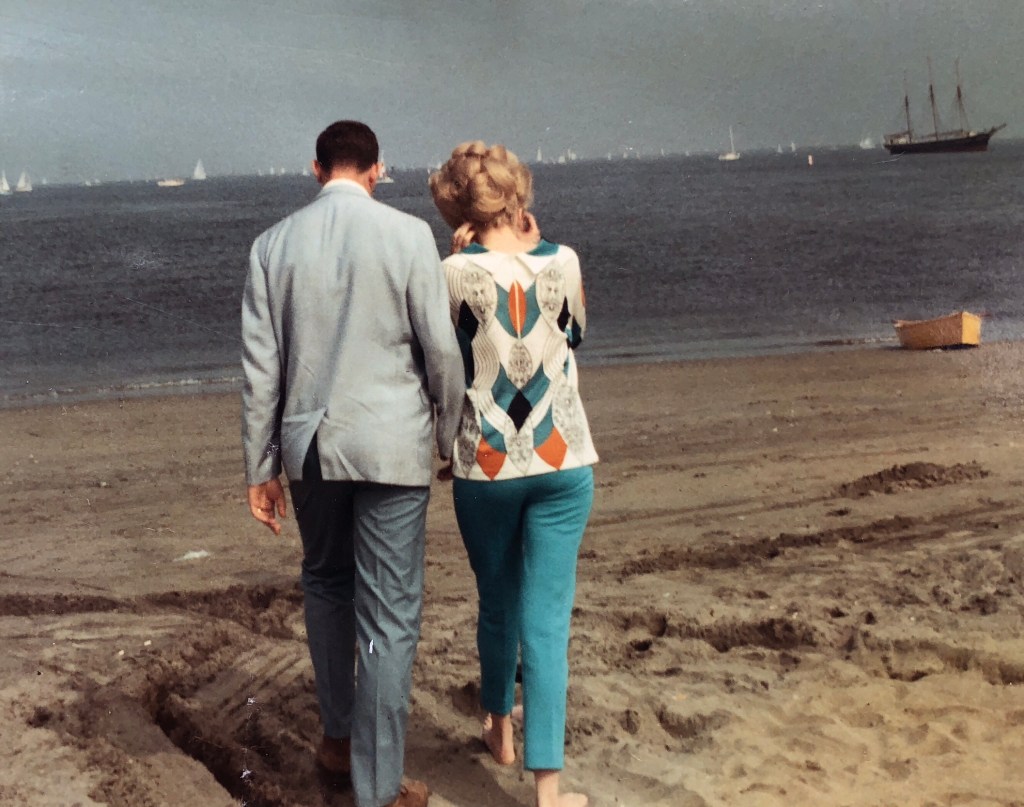
Newlyweds, Don & Marty, at Cabrillo Beach, San Pedro, California, in early 1968. (Swan Archives)
We settled into a “furnished” one-bedroom apartment across the street from the hospital at Ft. McArthur. We bought new tires, California coverage for the Mustang, some Melmac® dinnerware, and a 23″ B&W Emerson® TV. It came in a wheeled cart.
After getting my travel pay, we decided to celebrate a bit. After all, we had made it across the country, and I from Vietnam. Not to forget — marriage.
Peppy’s was a San Pedro restaurant with a reputation for excellent food. We had a great dinner there, including a good bottle of wine and dessert. The cost: $20, including the tip (about $186 in 2025 money).
There would be no more outings like that because, on day one, we were in trouble financially. My base pay was $226.20 monthly, plus a $105 housing allowance. (Average income for civilians was around $750.) So, after rent, car payment, insurance, and so forth, we had just over $100 to subsist on for 30 days.
The $300.00 we left Mississippi with and the travel pay were almost gone. I procured toilet paper from work. We made love as Love Is Blue played on KHJ. An hour later, we agonized over money. And she wondered why I wore no underwear. I told her it was to save money before I told her the real reason. GIs in the field typically ditched their shorts (going commando) to prevent chafing.
At Ft. MacArthur, a few weeks after I reported for duty at the 37th Command Information Detachment, the officer in charge handed me a tattered parcel. He smiled and said, “They must have really liked you.” Inside was the Army Commendation Medal
I was both pleased and also a bit disappointed. I’d heard from a friend in Vietnam that Lt. Blankenship, before his DEROS,* had told the sergeant responsible for enlisted awards, “No Bronze Star** for Swan.” I have no ill feelings for the man; Blankenship will self-destruct all by himself if he doesn’t get his insecurities under control. But as for myself, I’m disappointed to have even shared this story. Why?
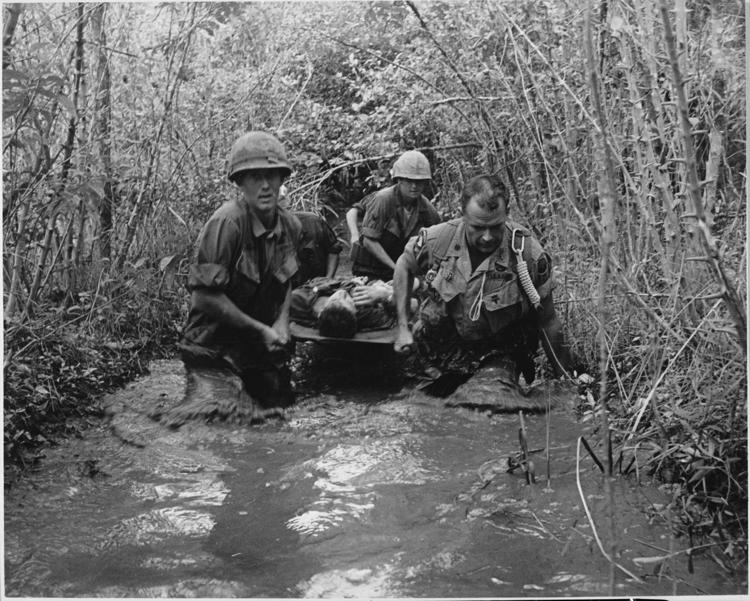

Soldiers doing the real work were the men in the bush, grunts walking point, pulling Listening Post duty in the middle of the night. They were under constant threat from snipers, ambushes, booby traps, and punji stakes. Then there was the not uncommon diarrhea, especially among troops in the field, the kind that ran down their legs.
Infantrymen in extreme heat or monsoons, in the on-again and off-again rain. Men who were lugging 90lbs or more in rice paddies, through elephant grass, mountainous terrain, and fording rivers and streams. This was their life day in and day out. And the most horrific face of war: holding a friend in your arms, severely injured or dying.

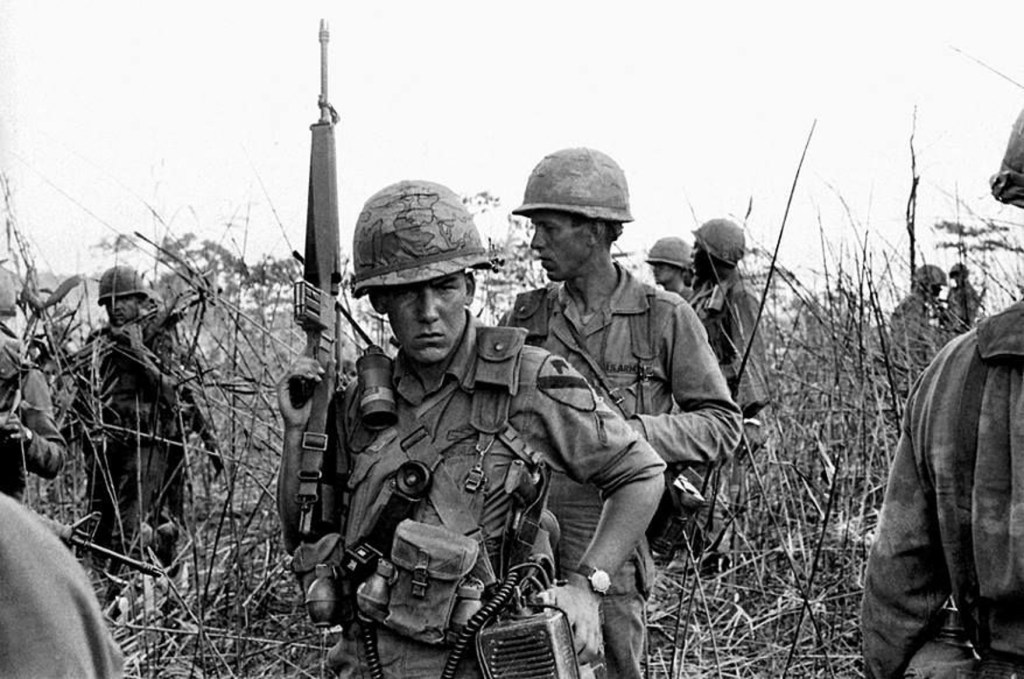
(Below) Unidentified 1st Cav RTO M-16 is “checked up” while moving cautiously with members of his qsuad somewhere in Binh Dinh province in 1967. (US Army photo)
Snakes, spiders, leeches, wild monkeys, tigers, and poisonous
creatures by the dozens. They suffered from jungle rot, infected sores, ulcers, lesions, and blisters on the feet, legs, underarms, and groin. Frequently they were thirsty and without enough food. Men who saw their friends injured and killed.


1st Cav trooprers srtrain to carry body of a dead comrade, 25 clicks north of Bong Son in 1966. (US Army Rick Merron)
Many of the soldiers who did the actual work — the men I honor above — didn’t get a medal recommendation at all.*** Most were sent home as E-4s, a rank lower than I achieved.
And I carp about not getting my Bronze Star!
A 1st Cavalry trooper stationed in Vietnam with the 7th Cav wrote about a common refrain used by many GIs, “Don’t mean Nothin’.”
We said it every miserable day of our miserable lives. It became our mantra. We said it in all kinds of situations for all sorts of reasons, and we said it a great deal, most often when we were miserable, which was pretty damn often . . . . We said it when it rained, and when it didn’t rain and when it was really hot and when it was even hotter. ‘It Don’t Mean Nothin’ was said a lot.’
We said it to keep from crying, we said it when we stopped moving and when the bloodsucking insects attacked in swarms, and our faces swelled and our hands swelled, and our lips swelled, and our ears swelled and when we thought we were getting malaria, (Should we quit taking our pills?) and we thought about how good that would be because you got out of the boonies if you got malaria unless you died from it. Dying from malaria sucked . . . but the prospect of staying inside the wire, sleeping on a cot off the ground, under a dry tent at the hospital, with hot chow, clean sheets, and nobody shooting at you made the risk of a slow, agonizing death from a deadly tropical disease seemed totally worth it. How bad could it be? We were kids. What did we know? ‘It don’t mean nothin.’
Something just don’t feel right. So shut up and saddle up Trooper. Your night on LP, your turn on point, but ‘It don’t mean nothin.’ Jack “Boz” Parente. (From Caviler,1st Cav newspaper, 1968)
*DEROS: Date Estimate for Return from Overseas.
** I was told I had been recommended for a Bronze Star just for actions in the field (chapters 17 & 18). Furthermore, most soldiers serving in a similar role to mine in PIO were awarded the Bronze Star, which is higher than the Army Commendation Medal I received.
***There were two medals (“Vietnam Service & Vietnam Campaign”) that were automatic for those who served in Vietnam, needing no recommendation. In addition to those medals, Infantry soldiers who spent the required time in the field as an Infantryman received the Combat Infantryman Badge, not an insignificant award.
~~
I had nightmares about Vietnam almost every night during our honeymoon and months after that.* And I had turned into a wimp, a side Marty had never seen, and a disposition I never had. One day, we were having a get-together with some of my buddies from the post; Marty was acting a little testy, and one of the guys turned toward her and said, “What’s the matter, you on the rag or something?” I laughed with them instead of telling him to knock it off and not to talk to my wife that way.
I was acting like a wuss (Marty called it cowardice), and she was very disappointed in me. It was a problem in our relationship. In a few years, I did an about-face, eventually to the point of wanting to rip off somebody’s face. (Marty called it backbone.)
Just back from Vietnam, I wasn’t trying to live high, but after the mess I’d been in over there, maybe dinner with drinks once in a while.
But that wasn’t to be. After the $20 outing when we first arrived in LA, the luxury of dinner and drinks was over. Der Wienerschnitzel™ once in a while, maybe.
By the 20th of most months, down to just a few dollars, we were looking for change in the sofa and between the car seats. One day, while leaving our apartment, I found a five-dollar bill lying flat on one of the steps. Nobody was around. With that five, I got three or four sacks of food from the commissary.
Then, a week or two later, I was on gate guard duty (graveyard shift) at a satellite location in Ft. Mac, (top side) primarily used for reserve training.
Listening to (Sittin’ On) The Dock Of the Bay on 93 KHJ. At about 0200, a carload of reservists, who had apparently taken advantage of being away from home, appeared at the gate. I was about to motion them in when the driver palmed me a twenty-dollar bill. I assume he thought I was overlooking a missed curfew or their possible intoxication, or both. My only orders were to determine that a vehicle and its occupants were authorized on the post.
Twenty dollars; that, for me, was a lot of money, especially when you’re broke. Did I feel guilty (no) or tell anyone? No. I splurged with a fifth of Canadian Club®. Marty got her hair done at a salon, and I still had money for groceries.
We had been in California for just a few months, and Marty kept saying she’d been out with girls and “Everybody’s Pregnant.”
I had a lovely stay-at-home Mom and no baby. Stay tuned.
We had work duty on Saturdays at Ft. MacArthur, though we were usually relieved at noon. We were also on constant alert because of the incendiary nature of 1968. Think of the assassinations of Martin Luther King Jr. and Bobby Kennedy, the Weathermen, the Black Panthers, Bobby Seale, Huey Newton, Eldridge Cleaver, SDS, and the Vietnam War protests; as is often said, “To name a few.”
There was a rotating on-call system for soldiers like me. Those living off base had to arrive at our assembly point within half an hour of notification. Even if not on ready alert, one could be called and told to stay in place for standby. The Army required you to be reachable at all times, unless on leave or pass; check in with the Command Post before going to a movie.
Not for those restrictions; I had a chance (after an audition) to be an on-air DJ covering two six-hour weekend graveyard shifts at the Number 1 Rock station in LA, 93 KHJ, and a $100 check for the weekend. With that gig, I’d have had a better chance of securing a prime-time slot — though still a long shot — in the highly competitive LA market, the third-largest in the U.S.**
I’d make it from AFVN An Khe to LA, just not to KHJ. It could have all ended right there.
*Still do sometimes.
**The LA market became the second-largest in 1984.
 Swan's Song Series