Graphic images of Death and Dying in this chapter.
This chapter is not supposed to be in all italics. Don’t ask.
                             Sunset, 20 March 1967, near the village of Tan An,
         Bong Son Plain, Binh Dinh Province, Central Highlands, South
                                                               Vietnam.                                                                                                                                                                                                                                                                                   .
Captivating orange and red hues painted the sky before us as we moved out onto the mostly open field. Another picturesque sunset and, in just hours, another day marked off our short-timer's calendar to get away from this (so-called) tropical paradise, half a world away from where we wanted to be. But the war dragged on.
Lying in Wait:
Over a hundred well-equipped battle-hardened NVA, supplemented by local VC, were huddled in dozens of concrete bunkers, awaiting our platoon of 27. And these anxious combatants were mustered just a few meters ahead on our right!
Fighters from the 22nd NVA Regiment couldn’t believe their luck; tactics, their leaders said. A US Army platoon from the fiercely hated 1st Cav was about to walk into an L-shaped ambush.
Weapons had been rechecked, and assignments were repeated. The Point Man would be first to fall, immediately followed by the RTO and the Leadership. Snipers were adjusting their sights from their perch in the tall palms adjacent to the bunkers.
They were dead set on preventing us from reaching our stranded company. They were determined to kill us all. Well, maybe not all. But a fate possibly worse, as there was a monetary reward for a captured 1st Cav combatant.
Suddenly, as we were moving out, our Point Man shouted AMB---! He took a bullet in the neck before he could finish the warning: AMBUSH!
Our Soldiers Screamed and Scattered. Blood Squirted. Bones Splintered. Abdomens Exploded, and Skin Burned.
The Pink mist of Brain matter sprayed from Skulls.AndMutilated body parts rebounded on the field in a ghastly spectacle.
Eighty-one-mm mortars with the force of small artillery hailed from above, sshhh, BOOM, BAM, SPLAT.Fragmentation grenades, Russian RGDs, landed with THUMP-BWOOM. Explosions unleashed shards of searing metal in a ruthless ring of enfilading fire. The earth shook.
The NVA owned the element of surprise and, for now, the night and our destiny. We were at a considerable disadvantage in being taken by surprise, caught off-guard, flat-footed, in an L-shaped ambush.
There was no doubt we were in grave peril — outnumbered and outgunned.
Near me lay a cluster of bodies — lacerated and degraded — cut down by supersonic, coruscating bullets and munitions. Blood-covered cigarettes near a Pall-Mall pack lay alongside one of the bodies with a severe groin injury. He looked like the trooper who was on the chopper with me on the way in from Bong Son.
My first experience in combat was Horrific beyond anything I could have imagined. Shocking and more Terrifying by the second, worse than I’m describing. To this day, no vocabulary exists to illustrate the Noise of battle. The Speed, the Blinding Flashes, the Blasts, the Smoke, the Smell, the Crack of Automatic Weapons, the Thump of Explosives, and the Shaking Earth.
Seeing my comrades, my fellow soldiers, in a death spiral was almost unbearable. Witnessing men taken down with a life-altering injury racked my brain and tormented my soul. All were at the random determinate of who lived and who died.
Nothing, not the military, not my psyche, nor religion, prepared me for this nightmare. In the moment’s hysteria, though, I cared only about my own survival. The barrage was about to strike me, as well.
Before I could react or grasp the melee and chaos that overwhelmed us, a concussion blast launched me into the air like an invisible club to a rag doll. I was thrown several meters before landing flat on my back in bloody sand, separated from my M-16, helmet, and other equipment. The upper part of my chest was stinging like a nest of pissed-off hornets was trapped under my fatigue shirt.
My ears rang incessantly.
There was the metallic taste of blood, bitter bug spray, and grainy sand. My nasal cavities were overwhelmed with suffocating acrid smoke. I knew I needed more but less tainted oxygen to regain my breath. I fanned much of the fetid smoke away and debris from my nostrils by coughing and blowing them clear. I slowly breathed air into my nose. Then, I steadily exhaled through my mouth.
I pulled up my knees, and finally, I extended the rest of my body. My hearing was shot, too, so I opened my mouth as wide as possible, with a couple of yawns, and worked my jaws.
It was then that I found the source of my stinging sensation — specks of flaming shrapnelthathad pitted my jungle fatigues and punctured the skin just under my neck. Though painful, the burns were minor and confined to a small area. I patted out the smoke and picked out tiny pieces of shrapnel.
I raised my chin toward the heavens, observed the darkening sky, and tried to take in untainted oxygen, only to inhale more acrid smoke.
Then, I squinted through sweat and sand, tried to clear my eyes, spat dirt, and checked my body parts. The warm liquid running down my thigh turned out not to be blood. (If you guessed piss, you’d be correct.)
Then, reality sank in. I was lucky to be alive.
I felt my heart throbbing in my throat, my veins bulging, my ears burning, my butt puckering. My mouth dried, my fear intensified.
But my senses were more acute, colors were brighter, and I could taste the gunpowder. Never before have I felt more alive, but so close to death.
For a brief moment —struck by fear and confusion — I couldn’t move. I was overcome with the emotional rupture of impending death. Ricocheting bullets and whining lead snapped all around and ripped at my sanity. It seemed hopeless. And we were less than tenseconds into the ambush. Except for my modest revolver, I was unarmed.
Staff Sgt. Joe Musial of 1st Batt. 8th Cav in ambush at Binh Dinh.. Note the boot of a fallen soldier (middle left) and the hand of another cavalryman in the foreground. (US. Army photo Robert Hodierne)
No one in attendance will likely forget this day. I will not forget this day. Not the faded green uniforms and kaki pith helmets of the NVA. Not the pungent Odor of sulfurous dioxide that overpowered our senses, the dreaded copper-metallic Scent of blood, and the sulfurous smell of Burning flesh. Not the despicable spectacle of Eviscerated Organs. We’ll not forget the Loud, Deep, Slapping sound of a Bullet hitting Flesh and Smacking into Bone.Not the sound of men Yelling-Screaming–Crying-Dying.
So this is what Hell’s like.
Only the Dead are out of War.
I lay still but observant, lucid enough to observe the tangerine tint of the sky as it dimmed toward darkness. But I was drawn to the carnage that surrounded me.
My mortality was in grave danger, and I thought death was imminent. Bullets exploded like wildfire. Guns popped, roared, and thundered. Ordinance was whizzing and whistling, faster than a T5 tornado. My chance of survival diminished by the second. And I had no rifle!
In a flash, I was slammed violently onto the scorched earth by a 7.62mm bullet that blasted into my chest at twice the speed of sound. The burning deep inside my chest was Inexpressible — Indescribable.
This much suffering shouldn’t be possible. It’s been said you can’t die from pain, no need for nuance now.
But massive blood loss and a sucking chest wound sure can, and they were stealing my life away. Adrenaline kept me alive long enough to know I’d be dead in about two seconds.
The quickness of the bullet is sometimes slower than the quickness of thought. In a nanosecond, I recalled special memories like Momma’s apple turnovers, catching my first fish, my ride in Tommie’s Tri-Power GTO, and my first radio show. All these beautiful memories, including my first kiss with Marty, would all melt away — disappear forever. Although just nineteen, I’d already aged far beyond that. Those memories seemed to be a lifetime ago.
I wasn’t going to go willingly, but no fight remained; I’d just lost my last battle. White light and heat were fading. I screamed, MEDIC!, but nothing came out, not even a whisper. Then I heard someone shouting — to me, I think — “Don’t die on me, Don’t fu–king die on me!”
Where would Momma be when the Army came? Working behind the house in the new ground, cooking, quilting, or coming home from church after visiting Hugh's grave. Would an olive-drab sedan be parked in the front yard —Soldiers admiring her flower garden?
It took a powerful concussion blast to forestall my rational, but epic nightmare above. My breath was momentarily taken when my sweat-soaked body landed, confused and groggy, just a meter or two away.
When it’s all said and done, I’d rather have my name carved in that Black Wall of granite than be one of the (est.) 60,000 cowards who fled to Canada, the 500,000 who successfully resisted, and the equal number who deserted!
I’m not much of a believer in Karma anymore. So, here’s my take on how these people fared. Most who choose Canada, or elsewhere, likely found good jobs, had a loving family, enjoyed good health, had no nightmares, and lived long.
And if someone were curious (if anyone cared) about one’s Vietnam service status, the person from the US would reply by saying they served at a top-secret outpost outside of Montreal or some city where they fled. Then everybody would high-five and laugh for several minutes.
Undoubtedly, most have perfected a good argument contrary to cowardice. And I would probably be accused of dispensing hate speech by calling them pusillanimous, disloyal ingrates, just what they were.
Some in the US and other countries considered the resisters heroes for making a stand. So, they are perfectly fine with their decision. Some Progressive Left-Wing pundits opined that the draft resisters’ actions were braver than most of us who served in Vietnam.
The dissenters would stand as the real patriots and go down in history for making a grand and noble gesture that would live on.
But that bravery thing lost a bit of its luster in that Jimmy Carter gave those who fled to Canada and all draft resisters a full and unconditional pardon. They suffered no consequences at all from the US Government. Thinking, “See, we were right along, ha, ha.” Bill Clinton (who did not go to Canada) said of Carter’s Pardon, ” I feel vindicated.”
A story in GQ in the early nineties, Bill Clinton (when at Oxford) said something to the effect that while contemplating and worrying about the draft, or how to get out of it, the stress of it all had been detrimental to his love life.
I think we can all agree that if that were the case, his libido rebounded just fine.
Approximately 570,000 citizens were draft evaders, using a number of schemes. Furthermore, an estimated 500,000 men in uniform deserted, for which there was no clemency. (These estimates vary, sometimes widely, among statisticians.)
We suffered casualties in the Vietnam War because we were typically undermanned. Draft resisters and deserters contributed to the problem, as there were not enough men to replenish the ranks.
Some have estimated that the US Army was short by 1 million because of the resistance. (Yeah, I know if all men had refused to serve, there would be no Vietnam War, and not much of a standing army, either.) But there was an army, and there was a war.
Do I wish resisters ill will? No. I do wish, however, that those who flipped their noses at the USA had an inkling of what the fallen, wounded, and survivors endured during the ambush of 20 March 1967 and the endless number of other battle deaths, while those who fled to Canada were safe and raising a Molson.®
Many gave some, some gave all, and many, like the men above, gave nothing.
“I was that which others cared not to be. I went where others feared to go and did what others failed to do. I asked nothing from those who gave nothing. And reluctantly accepted the thought of eternal loneliness — should I fail, I have seen the face of terror, felt the chill of fear, and warmed to the touch of love, hoped, and cried. But, foremost, lived in times others would say best forgotten. At the very least, in later days, I will be able to say with greatest pride that I was indeed a Soldier.”
George L. Spypeck, Dak To, 1968.
As smoke from the ordinance floated about, what little cover I had imagined was gone. Movement or remaining still seemed hopeless. Bullets kicked up dirt, rocks, and twigs. Sharp spines flew from the swaying palms. White-hot lead whistled and cracked all around me.
Just a few meters to my right, I spotted a helmet, ammo, and other gear near where a fellow soldier lay still, dead or dying. Desperate, I low-crawled, hugging the earth, and collected them as my own. Among the equipment was a rifle, the most beautiful sight ever, an M-16.
I placed the weapon at an angle under my chest, controlling it with all my strength. I wasn’t about to let this one go. Finding a different rifle may have been a blessing, as I hadn’t sighted my misplaced M-16. Although this one was harder to handle, a grenade launcher was attached beneath the rifle’s standard barrel.
The helmet was a different matter; I twisted and pulled down hard on the too-small steel pot, trying for a better fit and more protection, without success.
I tried to make myself invisible.
I hugged the earth, eating dirt and wanting to dig into the sand, but my hands were busy holding on tightly to the black plastic handguard of my M-16. To reach the grave mounds for any cover, I’d have to crawl several meters through the volley of fire. It was akin to suicide, I reasoned.
Combat is utterly Astonishing, Terrifying, and Intoxicating. Some combatants say you haven’t Lived until you’ve almost Died.
No one was coming for us, well, not in time. There was no way out except to shoot it out.
From our training, we knew the only way to survive an ambush was to charge the line, try to stay alive while returning fire immediately, and not run or try to escape. We had to do it aggressively and unhesitatingly with all we had. Easier said than done, as we would soon realize without a Platoon Leader or Platoon Sergeant.
I can describe how fear feels, but not courage; we needed a hero, a miracle. We didn’t have to wait long. It has been said that a cell of self-doubt lurks in the brains of even the bravest. It does not, however, apply to the man I’m about to introduce. He was tall and slim, with a handsome oval face and dark, closely cropped hair, and he was our Medic.
Dr.William Shucrat (battalion surgeon) treats a wounded soldier from the 1st Cav Division (note wedding band on injured soldier) during intense combat in Binh Dinh, similar to the heroics of our Medic, Spec. 4 Hagemeister, who was awarded the Medal of Honor for his superhuman efforts, near this site, March 20, 1967. (Photo by Kyoichi Sawada, Courtesy Lincoln-Star Journal. He was later killed while photographing the war.)
The Spc. 4 sprang into action immediately. He grabbed an M-16 from a severely wounded comrade, quickly and selectively returned fire into the ambush.
He snatched an M-60 from a dead gunner, gave it to a rifleman, and instructed him to use it for more firepower. The valiant soldier, now with the machine gun, remained in action through the long battle.
Without pause, our Medic dashed through withering fire to aid his wounded comrades; every move drew a hail of bullets.
Sometimes, he crawled, totally exposed, and repeatedly refused cover. Bullets struck the rolled-up poncho in the small of his back; streaking lead cracked all around him. He was barking orders to the platoon while answering calls of “Medic! Medic!”
With hand grenades from an abandoned pistol belt nearby, he straightened the pins on several. He lined them up for quick access and then rapidly grabbed one after another, pulling the pins, launching them swiftly, in unison around enemy machine gun emplacements to kill and shatter their resolve.
He spotted the sniper harassing us from a tree, aiming at the flash of the NVA’s gun, and took him out with one shot from his M-16.
Then he seized an M-79 grenade launcher and single-handedly smoked two machine gun positions! When the enemy tried to outflank the platoon, he commandeered another M-16. With his weapon on Rock ‘n’ Roll (automatic), he sprayed the enemy, killing two and putting down another, along the width of the seemingly endless ambush site!
It was then that he found his Platoon Leader with a gunshot wound to the head. As he was administering a shot of morphine, chunks of debris landed on them with the crack of more bullets. Hagemeister saw the shooter silhouetted by a burning village nearby. He quickly grabbed the lieutenant’s M-16, pivoted, aimed, and eliminated the shooter.
Then he turned his attention back to his Platoon Leader, whose breathing was ragged, shallow, and slow. Hagemeister did his best to comfort him in his last moments. But there was no time for reflection.
In war, death leaves no room for rest.
One of his two machine gunners was KIA, and his Platoon Sergeant, like many others, was severely wounded.
The lowly Spc. 4 assumed command. He was now Platoon Leader!
I expected we would already have been overrun by a frontal assault. But I believe the NVA, having witnessed our Medic, was caught off guard just long enough for us to seize the opportunity to press them harder.
They didn’t expect to see one of our men take out so many of their men. The enemy must have been thinking, Who is the crazy possessed SOB that’s charging and killing our men? There must be a much greater force somewhere, given how aggressively he’s charging us.
Without any stay in his life-saving mastery, Hagemeister found his RTO wounded near where his platoon leader lay dead or dying. After pulling him to a safer spot, he searched for his iliac artery and applied pressure to stop the bleeding.
Then, he grabbed the PRC-25 handset and succeeded in reaching his Company Commander. Our Medic informed the Captain of his Platoon Leader’s imminent demise and the grave injuries to his NCOs, and that he’d assumed command. Although they were in the shit too, the Captain said when he heard the din of battle (the ambush), he’d sent third platoon. But they couldn’t find us.
Where’s the platoon now, and what’s your grid location, he asked the Captain. I need to clear the area, contact arty support, and bring in some heat, 105s like now. The commander told him third platoon had returned to his location. But the Captain cautioned Hagemeister; he was on his own, bringing artillery close to his men.
“We have dead and wounded and are about to be overrun; we need help now! And your platoon couldn’t find us?” Astounded, Hagemeister shouted, “I’ll find them!” His face showed fierce determination.
Our platoon had alreadylost half of its mento death or serious injury, and the NVA continued closing in. He needed the big guns NOW! There would be no time for a second opinion or a valid reason, no time to adjust fire. It was Hagemeister’s responsibility alone as platoon leader (acting or not).
If his decision is correct, he might get an insignificant medal; wrong (if he survives), a court-martial, and agonizing guilt for life. Not to mention Fort Leavenworth.
He rechecked the grid calculations — he was about to relay to the FDC (Fire Direction Center) — and confirmed our location based on his RTO’s last reading.
Hagemeister warned his men, radioed the 1st Battalion, 77th Artillery (Red Team), supporting the 1st Cav, to stand by for a fire mission. Coordinates (grid location) were given to the FDC, and Danger Close was declared. Then Hagemeister ordered, “Bring Smoke.” He hit the deck, covered his head, and opened his mouth to protect his eardrums.
At 2,500 meters NW, the Fire command was shouted. Immediately, the 105 gunner gripped the lanyard and pulled it with vigor. A deep rumble, a whoosh, and a booming thud blasted the 35lb cannon our way faster than the speed of sound. In less than two seconds, the shell was here.
Where we lay, deafening thunder roared, the earth shook, heat enveloped us, and debris from the projectiles landed all around. Yes, that was Danger Close.
Again, Hagemeister made the right call as NVA guns were silenced near us where the 105s landed. Further strikes were ruled out. The enemy was too close; we were lucky once, but maybe not a second time.
Our Medic took a breath, tried wiping blood from his fatigues, flexed his jaw muscles, and rolled his neck. Then he pulled his hands down his face and promptly resumed his courageous fight to repel the NVA, to slow the tempo of the ambush that was annihilating us.
He told his wounded RTO that he would be OK and that he’d return. Then, Hagemeister secured his aid satchel, took the RTO’s radio, gathered more ammo, shoved a fresh magazine into his M-16, and cradled it in his arms. The medic pulled himself up on one knee, secured a foothold, and covered his advance with suppressing fire. Leading a volunteer, they ran a distance, weathering a storm of bullets, and quickly returned with men from third platoon who would help us repel the ambush.
Thanks to this one man’s heroism, other men were motivated to respond more aggressively, and they did so in his absence. Upon his return, they were even more inspired and continued their ruthless charge upon the ambushers with a vengeance. Even some of the barely able wounded joined in.
Author’s Note: Too important to be in footnotes.
I know the names of some of the men who bravely fought in the ambush. But I will not disclose any for fear of leaving some out or mischaracterizing their remarkable contributions to those of us who made it out. You know who you are, and you have my Eternal Gratitude!
Simply it is this: Many were Brave, one was Medal of Honor Brave
Trained Killer: Swan dispatches his M-16 somewhere in the Binh Dinh Province, similar to the action at Ambush on 20 March 67. (U.S. Army PIO photo)
Despite being hot, scared, thirsty, and under fire, our superhero encouraged me, too. I was hugging the earth, M-16 at the ready, helmet unsteady.
I had no advanced infantry training or a squad leader anymore; what could I do? Lie still and play dead? NO!
With a barrage of bullets whining around me, I lay as flat as imaginable and cautiously eased off my rucksack with my thumbs and placed it in front of my face.
Initially, I brought my M-16 up horizontally and, at the last second, placed it on my rucksack, toward the enemy. I raised my head slightly, flipped the lever to Rock ‘n’ Roll, aimed where I had seen two muzzle flashes, and gently squeezed the trigger. In hopes of hitting two targets, I shifted my direction of fire (side to side) about 10 degrees while keeping my aim level.
(Don’t laugh, I didn’t get the extra thirteen weeks of weapons training that Special Forces did.)
Unloading 18 rounds on automatic should keep the enemy occupied long enough for me to make a move, which I did. But it is usually not an efficient use of ammo.
Dragging my rucksack along and squeezing my rifle tightly, I performed two body rolls toward the grave mounds, shoved in a fresh magazine, and chambered a round. I dispatched another load of lead toward the ambushers, this time, on semi-auto. I continued my moves until I finally reached some cover.
(Don’t laugh at my tactics; I never claimed to be an Army Ranger.)
I didn’t keep my head up long enough to gauge the effectiveness of my M-16. But for the next civilian who asks how many I killed in Vietnam, I’m going with an estimate of 151. Though I fired just 36 rounds, I might have scared some to death. And how about those I shot at later? I’m going for 351 now. And the next civilian who asks me, “How many?” I can add him to my total, 352.
(For extra sensitive readers, please know that the last sentence, above, was written in jest.)
With the extra manpower and weapons from third platoon (brought by Hagemeister), there seemed to be adequate firepower on the enemy emplacements to our right. But that would leave our left flank unprotected. We would surely be overrun if the NVA attacked us from that direction, too.
Maybe there was something I could do to discourage the enemy from flanking us. I wasn’t exactly expecting a pincer movement, and this was no World War II. But dead is the same, no matter the war.
After quickly getting the go-ahead from a rifleman, I high-crawled a few feet and dropped to the prone position. I aimed my M-16 west and, on semi-auto, gently squeezed the trigger, firing three bursts.
Recoil pounded my shoulder, and a reverberating BRRRRRT, BRRRRRT, BRRRRRT rumbled as the magazine emptied.
With the ejection port on the right and me shooting left-handed, hot brass flew into my face like confetti. But it stung like Mississippi fire ants.
I loaded another magazine and disgorged 18 more rounds of 5.56 toward our left flank. The M-16 I’d found was an over-and-under with an attached grenade launcher (XM-148). It had a reputation as difficult to operate and slow to reload, but I knew it had exceptional punch. So, I gave it a try. On my knees, I tipped the grip forward and shoved a 40-mm round into the breach, pulled it back, activated the cocking handle, aimed at an arc through the quadrant sight, and gently squeezed the trigger. Shss-Dook-Thump echoed, and a fierce explosion erupted at 200 meters on our left flank in less than a second. With that much fire going down range, I took a moment while lying flat and adjusted the borrowed helmet to my satisfaction. Then, I continued firing both. It felt good.
Reinforcements from other platoons brought in by Hagemeister were united with our men. In a piercing but comforting clatter, at least five M-60s pigs sprayed 650 rounds per minute into the swarming NVA. Pith helmets bounced on the battlefield near them.
Hot barrels glowed orange on some of our guns as they kept the pressure on enemy redoubts. Some of the wounded gave up precious water to pour on the smoking machine gun barrels.
Rhythmic gunfire directed toward the enemy at supersonic speeds — with troopers helping to keep the M-60s fed — was non-stop. M-79 Bloopers were thumping 40mm grenades at 75 meters per second, wreaking havoc on everything in and around enemy concentrations. Could the cataclysm be turning in our favor?
Then I heard that beautiful sound: Hueys in the distance, Dustoffs, maybe gunships. The moon was out, but not providing much light in the bush jungle. Although the village of Tan An and the hamlet of Troung Son, near us, were afire, providing some illumination and a good reference point for the choppers.
That’s what I heard, alright. Hagemeister made sure “the tubes were empty” from our recent artillery barrage, making a clear route for 15th Med Dustoff.
The medevac pilots requested gunship support for both ingress and egress during the pickup of our casualties. So, Hagemeister secured an escort from the, not too far distant, 2nd Battalion, 20th Aerial Artillery (Blue Max).
The gunship kept the enemy occupied while the medics (on the Dustoff) triaged the wounded and tried to save lives. It also kept us on our toes as we were peppered by debris from the gunship. We realized they were a bit too close.
But the D-model Dustoff sped away with all of the wounded and most of the dead without trouble.
As for the survivors who gathered and loaded bodies and body parts of their dead friends and fellow soldiers: They would Never be the Same. Those who had built a wall around themselves in an attempt to avoid being caught up in the horrors of war were seeing cracks in that wall tonight.
I interviewed Hagemeister after the Medevac departed, and when there was a respite in the battle, in case we didn’t make it through the night. My recording might be found by friendly forces who would learn of our Medic’s unselfish bravery, the bravery that saved so many of us.
As I questioned Hagemeister, he echoed what many brave fighting men have said after superhuman feats on the battlefield. “You’re there to take care of your men; that’s what you’re supposed to do. I did it for the love of my fellow soldiers. I was just doing my job. I didn’t have time to be scared. But I’ve never seen so much fire in my life.” Then he added that the ambush had really pissed him off.
“Soldiers may fight for their country, but it’s the love for their comrades that keeps them going in the darkest of times.” Blaze of Glory
Few men are more lethal than an Air Cavalry trooper with sufficient weaponry. He was motivated and unstoppable against an enemy that was attacking and slaughtering his fellow soldiers. Hagemeister had charged and decimated the NVA like he was possessed — possessed in a good way.
Our incredible soldier, Spc. 4 Hagemeister, still too young to vote, saved at least seven of his fellow Skytroopers. He killed at least 10 of the enemy. He encouraged and directed his men, treated the wounded, called in the Medevacs, supervised the evacuation, and brought in the artillery! The twenty-year-old draftee fought for and led what was left of 1st Platoon (and the replacements) for six more hours.
Hagemeister was not about to let his guard down after his incredible feats during the ambush. He assumed the NVA would hit us again.
We were the Air Cavalry, and our Medic was bound to get us some serious air support.
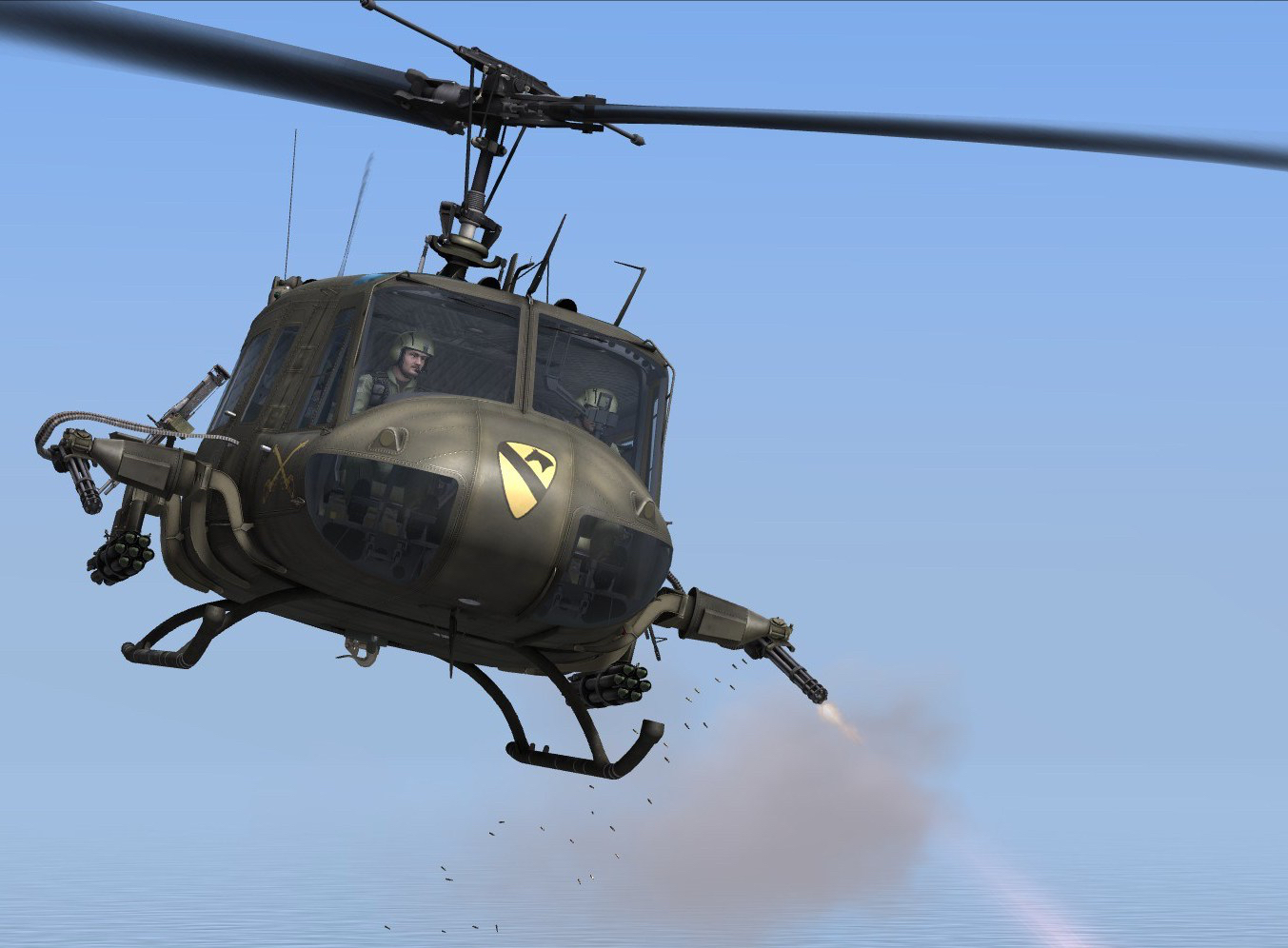
1st Cav Huey Gunship spraying lethal 7,62mm fire from M-134 minigun (note expended shells behind barrel). US. Army photo)
Hagemeister, a lowly Spc. 4 (although acting platoon leader), contacted Cav Air and persuaded them to support us with all available gunships. And sure enough, choppers were quickly mustered from the Cav’s vast arsenal of gunships and assigned to Hagemeister’s operation.
Not so far away, the sing-song of g–ks was louder than usual, if that were possible. Spoken in a panicked timbre I’d never heard. I may have imagined something that wasn’t real; it had been a long night.
Soon, a beautiful noise resonated from the east over the South China Sea. A sound I was sure of. An Air Cav Squadron, an Eagle Flight of gunships, including frogs and hogs, raced to the ambush site, landing lights defeated. The ACH-47 ascending from An Khe made up for the distance by speeding toward us at 322kp/h (nearly 200mph).
Now, six gunships were upon us, ready for an immediate assault. The attacking birds came in low, settling in an offensive battle formation on one of the first helicopter-only night assault missions of the Vietnam War.
These bad boys were members of the formidable 227th (Winged Warriors), 228th (Guns-a-Go-Go), and 229th (Winged Assault) Battalions. They were about to exact some payback on the enemy that remained in and around the ambush site.*
Suddenly, two recently activated Firefly choppers (below) broke formation. They approached opposite ends of the ambush site and flooded the fortifications with an estimated 64 million candlepower.
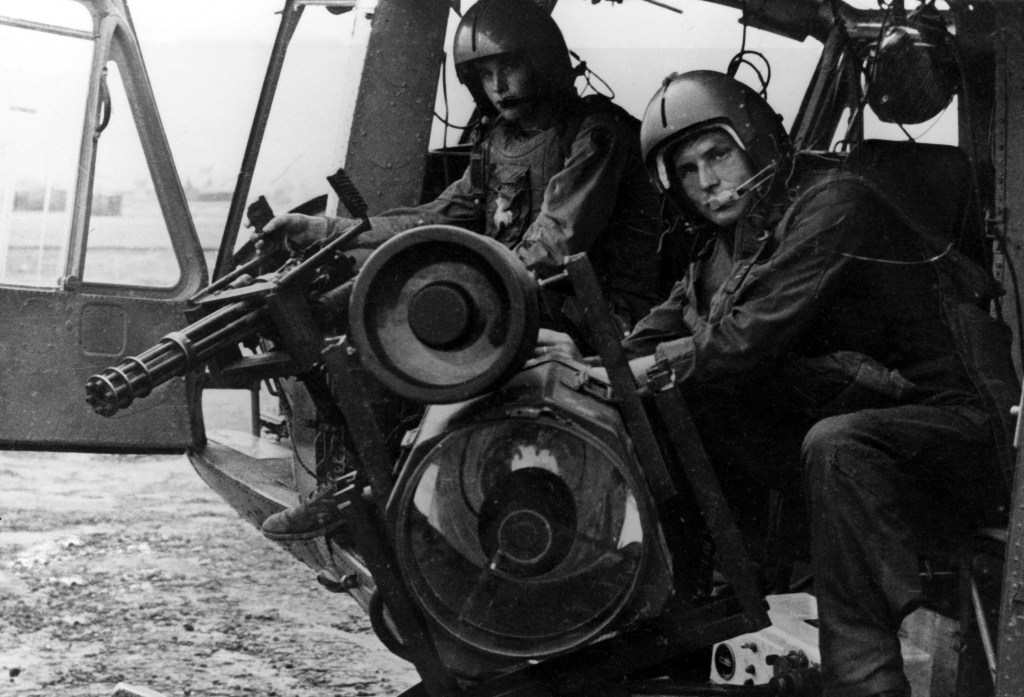
Early Firefly system, with M-143 rotary machine gun in the background, on UH-1M in Vietnam. US. Army)
Assault from hover is not typical due to its stationary position, making it an easy target. But our warriors were lined up for just that: a frontal assault on the bunkers while stationary and simultaneously. It can also be difficult for gunships to hover when fully loaded, but our guns were ready. They adjusted pitch with the stick, pointing the nose slightly toward the earth, and checked RPM. Then the guns settled into an offensive hover-fire position.
In a flash, three gunships unleashed a torrent of deadly firepower. At supersonic speeds, more than eighty-four-foot-long, twenty-pound rockets thumped from pods on the airships. About 200 chin-mounted 40-mm grenades blasted from each chopper’s nose. XM-140 auto cannon mini guns spewed 6,000 rounds per minute from UH-1Cs, generating an unforgettable burp and whine of doom. And eight 7.62mm machine guns blazed 800 rounds per minute, creating a resounding wall of fire.
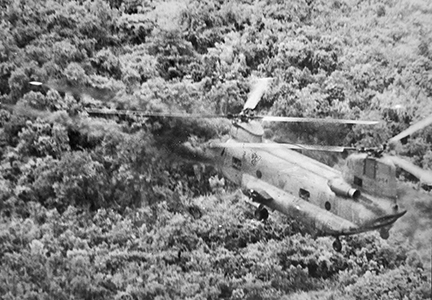
Observe (in front of chopper) where 2.75-inch rockets streak toward enemy concentrations near Binh Dinh from an ACH-47 Guns-A-Go-Go, similar to the one used to destroy ambush fortifications. These Gunships were 1st Air Cav-exclusive. US. Army PIO photo)
ACH-47 Gun-A-Go-Go “Easy Money” on standby at An Khe, created for 1st Cav missions, with 3 tons of armament; skull painted in front below the rotors. US. Army PIO photo)
The ACH-47 remained in action as other gunships took their turns. The twin-rotor 5,300 hp chopper flaunted another ton of munitions. In concert with the ACH-47, two turbine-powered gunships punched hundreds of twenty-pound rounds of rockets, each with 2,200 individual darts, repeating what the others had upended.
Several hundred more rounds of 7.62mm projectiles and scores of 20- and 30-mm cannons, along with dozens of 40mm chunker grenades, generated devastating chaos, annihilating enemy redoubts and bunkers. Blasts raised vast chunks of earth and shook the littered field. Hellish flames triggered small fires.
Dirt, rocks, and concrete danced around the site while knobby stems, fronds, and sharp spines flew from swaying palms. Troopers gathered to see the amazing early evening display, quickly fell back a few feet from the reverberating, ear-splitting thunder and intense heat generated by the ordinance.
Finally, only small pieces of concrete and smoking rubble remained on the shattered earth. No enemy resistance was observed during the two half-minute cannonades, just body parts.
A pair of UH-1Cs quickly followed with a parting shot. Faster and more nimble, these birds echoed loud burps from the chopper’s twin miniguns. Spraying 60 rounds per second of 7.62 and 30mm directly into the rubble of what were (before the Cavalry arrived) formidable enemy fortifications.
The display of firepower, lighting the night and thundering across the sky, was a sight to behold. What remained of our platoon roared with gratitude.
There were no enemy body counts, as most commanders insisted upon. But we considered our fight a success because we weren’t overrun after being ambushed by an enemy that outnumbered us 6 to 1.
Our fearless Medic, displaying incredible bravery, emboldened us, and we charged the enemy, fighting them with tenacity and fortitude, which allowed us to overcome the L-shaped ambush. I believe we gave more than they got. And the gunships, no doubt, made a lasting impression, taking out some in a dramatic fashion.
Still, less than half of our platoon escaped death or serious injury. The initial assault (at the ambush) resulted in heavy casualties, where seven of our troopers perished, and six were wounded, some seriously. Reinforcements from the platoon that assisted us also suffered casualties.
With the guns silent for now, no reflection was needed — there was no doubt — we were in the presence of an unequivocal hero. Proclaiming Charles C. Hagemeister: THE BADDEST ASS IN THE JUNGLE!
The skull just below the “Easy Money” Go-Go ship’s rotor was visible in the rocket’s hue. The unmistakable 1st Cav logo of yellow and black or unit patch was affixed to other gunships.
A cool bead of sweat ran down my neck, and a sense of pride swelled within. There was no question; the 1st Cavalry was indeed Airmobile and lethal. They had come to Vietnam with the right stuff and were determined to win the war. (Had I been serving in 1970 and with another unit, I might have had a different attitude about the war.)
We felt pretty good about ourselves and were impressed with the chopper’s display of weaponry. But the gunships were gone, and we would have been foolish not to believe that some may have escaped through the tunnels, while others may have blended into the hamlets. And those survivors, the enemy, might have some fight left.
Unfortunately, we had scarcely enough troops to sustain a traditional night defensive perimeter (NDP) and just three claymores. Hagemeister sought out troopers with experience in setting up NDPs, and they went to work.
An all-around defense, similar to a wagon wheel formation, was established, creating a tight perimeter, hopefully suitable for a single night. The claymore clackers, which held the firing wires, were given special instructions.
With the occasional sniper and the enemy periodically probing us with mortars, we were on heightened alert. It was a long night with little sleep. We were relieved by another regiment at daybreak.
~~
As the first rays of sunlight filtered through the tattered palms, the enormity of the ambush and the ensuing battle was unmistakable. It was a barren wasteland of sorrow where many of our men were cut down before they fired a single shot.
Yet, the sun rose, insects still buzzed, Mother Nature still called, distant guns still sounded, and all the misery that is Vietnam began a new day.
~~
Part II: The BaddestAss In The Jungle
Just after dawn, another helicopter came calling with Maj. Gen. John Norton, who was a former enlisted man. The 49-year-old commander of the 1st Air Cavalry Division was also an Army aviator.
He came to pay respects to the fallen. A heroic airborne trooper himself in WW II, Gen Norton was an early proponent of the air assault concept.
He stood six feet tall with a slender frame, had a ruggedly handsome face, a slightly bulbous nose, and closely cropped graying hair. The General holstered a Colt Commander .45 APC on his right hip. His customary slender cigar hung loosely between the index and middle fingers of his left hand.
Our memorial was on the battlefield where it went down. It was where our brothers in arms — our friends — had fought and fallen beside us.
Memorial similar to ours, the morning after the 20 March 1967 Ambush. (US Army)
As the battle-weary soldiers stood at rigid attention, some became emotional. The dead were honored with bayoneted weapons spiked into the soil, helmets atop, and boots in front. Heart in the throat, raw with solicitude and emotion — a ceremony that no one in attendance would likely forget.
The dead are out of war; The survivors never leave it.
The commemoration continued with the 1st Cavalry Division Commander. The general pinned the Silver Star (third-highest award for valor) on the left pocket of Spc. 4 Charles C. Hagemeister’s shoddy, blood-stained uniform. The award was for his ineffable courage, the previous evening serving as a medic with A Company, 1st Battalion of the 5th Cavalry Regiment (Black Knights).”I’m gonna’ put you in for the Medal of Honor, boy.” Maj. Gen. John Norton.
After at ease was called, and just as I was feeling a bit like an intruder, a couple of the foot soldiers approached and patted me on my back. One described the battle as sounding “Like the roar of a locomotive just over our heads.” He described Hagemeister’s actions as “The most courageous thing I’ve ever seen.”
I would not see these honorable soldiers again nor remember their names.
After a respectful pause at the end of the ceremony, I taped a quick interview with Gen. Norton and non-verbally determined it was okay to salute him (in a combat zone), which I did. Someone had opined earlier, “I don’t think too many g–ks want to show up this morning after the pounding they got last night.”
I approached Hagemeister once more. His oval-shaped face finally relaxed. I gestured to his Silver Star and rubbed it between my index finger and thumb.
The hero told me several of the men in the fight were new replacements who had never been in the field, let alone in a firefight. That included me.
As we examined bullet holes in his rolled-up poncho in the small of his back, we laughed nervously.
Earlier, Hagemeister had said there was no time for fear. Now, he admitted that some fear actually motivated his response to the ambush.
Someone said, “Courage is not the absence of fear; it’s acting in the face of fear.” That describes Hagemeister precisely. I call it his Blaze of Glory, except he didn’t go out. Unbelievably, Hagemeister had not been wounded during the battle!
He had danced with death and never missed a step.
A simple thank you for saving our lives didn’t seem nearly enough. But for now, that and a Silver Star were good enough for the man from Lincoln.
Thankfully, I was interrupted by Gen. Norton. He shook Hagemeister’s hand once more. Then, he saluted him. Finally, he said, “I’m about to rotate back to the States. I’m gonna’ put you in for the Medal of Honor, boy.” Smoke ’em if you got ’em. Indeed.
Swan interviewing Maj. Gen. John Norton, Commander of 1st Cav, the day after the ambush, near the village of Tan An. Note clip, locked and loaded on M-16 below Swan’s elbow. (US. Army PIO photo)
The whine of the turbines from the General’s helicopter brought me back to the reality of my job. It was time for me to move on to another story about the (quickly becoming famous) 1st Cavalry.
I bummed a ride back to An Khe with the General, who did a double-take when I hopped aboard carrying two M-16s (the one I had lost and the one I had found).
I was also on board with the biggest scoop I’d get during my 12-month tour.
The General’s pilot pulled the starter trigger, twisted the throttle to 6,600 rpm, pushed the cyclic forward, pulled up on the collective, and executed a vertical climb.
As we ascended from the erstwhile battlefield at 2gs, an olive-drab poncho liner fluttered among the dust and debris above the hallowed ground.
I kept my eyes on the men — what remained of 1st platoon — until they shrank, then disappeared in the distance. For the brave soldiers who fought and died there, I will revere and cherish for all time.
~~
EPILOGE
In about forty-eight hours, in cities and towns across the United States, teams were formed near the hometowns of the fallen. Casualty officers and chaplain would be notifying the next of kin.
They were triple-checking addresses before ringing the doorbells or knocking on doors where Mothers, Fathers, Wives, and others were about to get the worst news possible. “The Secretary of the Army has asked me to express his deepest regrets . . . ” That’s about all the next of kin would remember once their loved one’s name was uttered.
Outside of yesterday’s ambush and maybe graves registration in a battle zone, these officers were tasked with the worst duty in all of the US. Military.
It is sometimes said military service is the least “individual” undertaking. The individual must, of necessity, always remain “expendable,” to be sacrificed, if necessary, for the greater good — the mission must be accomplished for the nation to survive.
Over time, that principle of supreme sacrifice by the individual has been turned on its head. The Vietnam War greatly precipitated that reversal. (Partiality from What Remains by Sarah E. Wagner, Harvard University Press, with permission).
When the battles of the Vietnam War were written, this ambush would hardly merit a mention. It had no name. No hill was conquered.
We never reached the Cav company that was in trouble. However, they received reinforcements from other units. The company was not overrun. They made it out with fewer casualties than expected.
After my initial foray with an Infantry platoon, I would see action and adventure with different cavalry combat units, including combat assaults. Many skirmishes involved an enemy that we hardly saw. But nothing that rivaled the Ambush of 20 March 1967.
Those adventures, times when scores of NVA were intent on killing us all, don’t make me a foot soldier by a long shot. Next time, though, I won’t stutter when a ground pounder asks me, “You been out there, out there in the shit?” I won’t feel like an interloper, not like an intruder at all.
~~
Parts of “Baddest in the Jungle” are historical fiction*** for several reasons. Historical fiction allows authors to present their version of certain aspects of the battle, as they see it. It provides their perspective on the weapons employed. It clarifies the sequencing of events for enhancement. It also protects the privacy (when desired) of soldiers in the ambush. Archival scrutiny would not necessarily match the events exactly as I describe them. For sure, this is not an official after-action report.
However, the above chapter, “Baddest Ass in the Jungle,” is an event that occurred on the date, at the approximate time, and at the place described. And, Charles C. Hagemeister was awarded the Medal of Honor for his incredible valor, which I recounted in my description of the ambush. Indeed, I have written this chapter and the entire Vietnam narrative to honor Charles C. Hagemeister. Rest In Peace, my Comrade. I’m sorry I didn’t tell your story while you were alive to read it. But you would probably have said, “What I did during that bloody ambush was no big deal… just doing my job, for the love of my soldiers.” Indeed.
*Those who escaped into tunnels or blended back into the villages would live to fight another day, as so many did throughout the war.
**1st Battalion, 5th Cavalry Regiment, received the second award of the prestigious Presidential Unit Citation for actions that began on 20 March 1967 (described above) and other operations in the Soui Ca Valley of the Binh Dinh Province. An excerpt: “[1st Battalion, 5th Cavalry Regiment] distinguished itself by extraordinary heroism in action against a superior heavily armed enemy force . . . .”
***Historical Fiction is set in a real place during a culturally recognized time. The story’s details and actions can mix actual events and ones from the author’s imagination as they fill in the gaps. Characters can be pure fiction or based on real people (often both).

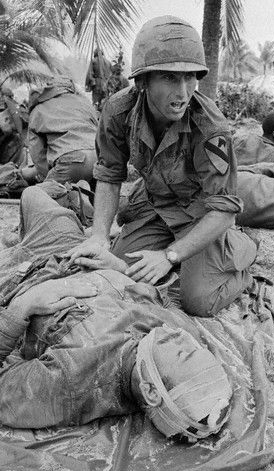
Trained Killer: Swan dispatches his M-16 somewhere in the Binh Dinh Province, similar to the action at Ambush on 20 March 67. (U.S. Army PIO photo)


 Swan's Song Series
You must be logged in to post a comment.