Chapter 30: My Diagnosis & KLAK Colorado Country 2,644
Life goeson, long after the thrill of living is gone. John Mellencamp
After two years of third-world type dysentery that was demoralizing and degrading my personal and professional life — my very being, I thought I was the one in need. But it was Marty back in Kansas City who was making the most noise, saying the twins were driving her crazy and that she needed a break. I guess I had been helping the children more than I realized.
About a month after I left home for the hospital in Denver, Marty did what any stressed but loving mother would do (I say sarcastically): She drove Lisa and Laura to Kansas City International (MCI) and purchased a one-way ticket. She informed the flight attendants they would be traveling alone, told them to behave on the plane, and sent them to my Mother in Mississippi.
As the twins wandered into the jetway, Marty turned away and — literally and metaphorically — never looked back. She had no intention of them returning and living with her again. They were five. Marty had no contact with her daughters, nor would she see them again for another twenty years.
Guess I needlessly worried about Marty becoming a single mother.
She was the woman who had written me almost every day when I was in Vietnam. Waited for my return, stood by me during difficult times, provided a good household for our family, and was alone with the twins for months while I served in the Army. She was the woman, I thought, who loved and cherished me and the girls.
I continued paying child support to Marty for a few months before I got the advice of a family attorney. I began sending the money to Momma instead. Marty was pissed. I went back to the attorney and filed for a divorce and for custody of the twins. Marty never responded, and I was granted sole custody. Now the twins were completely and legally, my responsibility, although they were still with my mother.
Nothing From Nothing was playing on KIMN.
There were not enough data, the doctors said, for a precise diagnosis. Maybe I had Irritable Bowel Syndrome (IBS), a spastic colon. This condition usually aligns with someone who is high-strung personally. I prefer to call it Type-A.
There were not enough data, the doctors said, for a precise diagnosis. Maybe I had Irritable Bowel Syndrome (IBS), a spastic colon. This condition usually aligns with someone who is high-strung personally. I prefer to call it Type-A.
With an illness, about the worst news is: “Can’t give you a definite diagnosis, don’t know what to tell you.” Except that I might want to stay near a restroom and continue with the Atropine. Very funny, huh?
When I was on a clear liquid or a minimal fiber-low residue diet, the cramping, frequent stools, and diarrhea were uncommon. Seems all that was required for me to do well was to rest in a hospital on a strict diet, always near a restroom.
I had just received the sequence number for my upcoming promotion (about three months away). That’s when the Medical Board informed me that I had been declared physically unfit to serve. My Army career was over.
Fitzsimons Army Medical, Denver, where I was confined until diagnosed. (Public Domain)
After several months at Fitzsimons, the doctors settled on a diagnosis for me: “Crohn’s disease.” It’s an incurable disorder that features abdominal cramping, fever, diarrhea, blood in stools, and drainage from the anus. There’s more: Inflammation of the liver, skin, joints, and eyes, fatigue, immune system degradation, and sores in the mouth. (Veterans are more prone to get Crohn’s disease, concluded a recent study, than the population at large.)
Thankfully, I never had all the symptoms occur at the same time; that is rare. But three of four are enough to knock you down hard. And knowing the others are possible is stressful enough.
The side effects of early drug treatment for Crohn’s were sometimes more detrimental to my health than any benefit it provided. Prednisone, which I took, off and on, for the disease, was especially precarious for long-term usage. It’s a steroid that comes with about a dozen warnings. Frequent use is known to cause heart failure, liver damage, and diabetes.
This disease is no “You have eight months to live” cancer diagnosis. Indeed, it’s possible to die from complications of Crohn’s. But it’s more likely one will just suffer from its symptoms for a few decades and then die.
Today, it is not unusual to see an ad for Crohn’s. But in 1973, most physicians were unfamiliar with the disease or had not seen or treated anyone with it. (Count me as an early experiment, I suppose.) All my colonoscopies without sedation had shown non-specific inflammation of the small intestine and some granuloma. However, I had no ulcers in the intestinal mucosa resembling “cobblestones,” which are consistent with Crohn’s disease.
Before being officially medically retired in February 1975, I visited the hospital commander for advice. Should I try to just tough it out, request a medical waiver, stay on active duty, and get my promotion to Sergeant First Class? No.
I was surviving on six to eight Atropine tablets a day (a narcotic and controlled drug). Some of the best years of my life were made possible by those tiny white pills. They kept my diarrhea manageable and my life functioning with some normalcy. (Eventually, while on the move, I could swallow two or three pills without any liquid.)
But there were downsides to Atropine: Blurred vision, euphoria, headache, fever, confusion, stultification, and depression. There’s more: drowsiness, dry mouth, numbing of hands and feet, and so forth. I had some of those symptoms, but thankfully, no more than a few at a time.
My medical retirement income was $421.00 a month, a pay cut of almost 50%. I was unable to work any demanding job, or perhaps any job at all. That is, unless I was allowed unlimited restroom breaks and could get frequent sick days.
Ill, divorced, and now bankrupt, my possessions included a 1966 Ford Fairlane® showing 212 thousand miles, a 13” color TV, and my clothes were mostly army uniforms. Unsurprisingly, this was not one of the better times in my 27 years.*
But That’s Alright, Mama, because:
I didn’t have a crop rotting in a Mississippi field, too ill to harvest and lose it all. Nor was I in Miss. racked with polio, like some my age had been, and unable to farm at all.
Neither was I in Mississippi working a dead-end job and living with a guilty conscience (ten years after), avoiding the draft, as a few did.
Nor was I sitting on a cold, rough slab in the outhouse on the old farm in Mississippi. Having given up on my quest for employment at WAMY, I let my dreams die.
Shortly after, I moved into the Lido (a high-rise apartment building near downtown Denver), wondering what to do with my life. I was befriended by an older man who lived there. He was Sam Trott, a waist gunner on a B-17 in WWII and presently a TV salesman.
We had practically nothing in common except that we were veterans and divorced. Sam told me of the constant stress of flying over the skies of Europe during World War II.
As a machine gunner on hazardous missions in a B-17, he worried that he might not survive long enough to complete enough sorties to allow him to go home.
Sgt. S.E. Trott Nov. 4, 1944. (Swan archives
Sam made it back, only to lose his family because of his drinking and gambling. He warned me, whatever my demons, not to succumb to those evils. He died many years ago, but I will remember him for a long time. I’ve finally written my book, and as promised, Sam, you’re in it.
After settling into my studio apartment in Denver, I enrolled in a program to earn an FCC 1st Class license, sometimes called a First Phone. It was known to be a challenging exam, especially for those like me who had not done well in high school math.
Having this license was a real plus for getting a job in radio. It was a requirement for stations with 10,000 watts or more that were broadcasting directionally to have an operator with a 1st Class License on duty at all times. And with the First Phone, one could be called an engineer at a radio station. Wow, that sounded pretty impressive. Don Swan, an engineer? Mr. Pete Vaughn (HS math teacher) would be stunned.
Not so fast, I don’t have the license just yet.
After completing a four-week training course, I reviewed the course material for several days, studying trigonometry, calculus, and geometry needed to complete the test successfully. (About 40% fail the exam on the first attempt.)
The extra work and dedication paid off. Under the tutelage of a stern FCC proctor in downtown Denver, I passed the two-hour exam on my first try and obtained my First Phone. It was a significant boost to my morale and confidence. (Five years later, it would be worthless. The FCC deregulated many of its rules for radio stations, including the requirement for a 1st Class licensed engineer.)
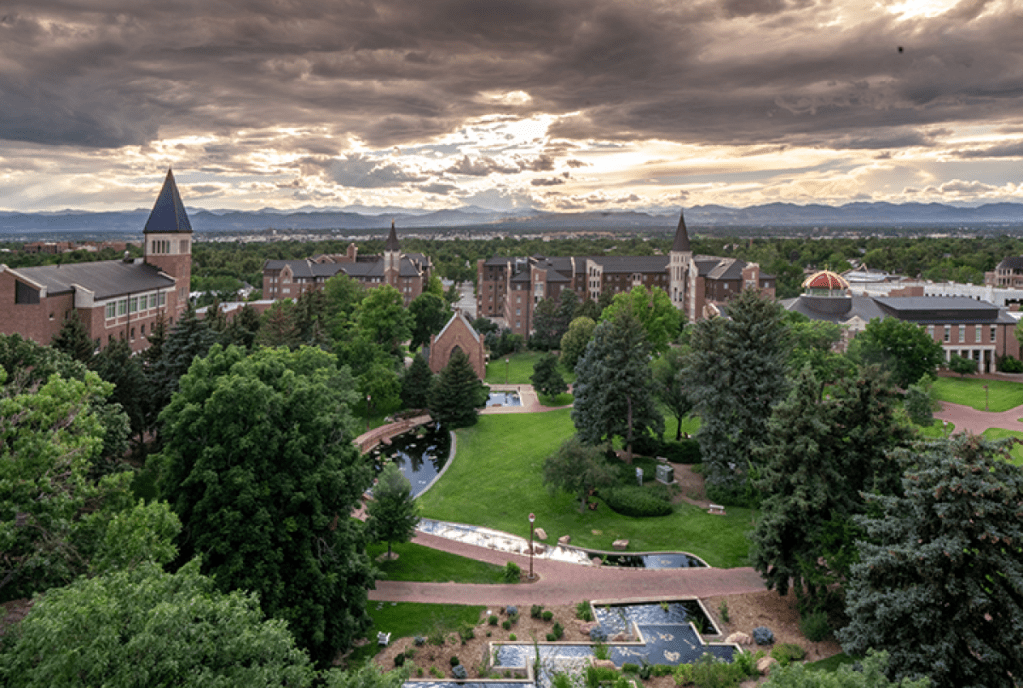
University of Denver campus. (from Princeton Review)
I can’t complain, but sometimes I still do. Joe Walsh.
Eight months after being discharged from Fitzsimons — sick, broke, divorced, and bankrupt — I was a sophomore at the University of Denver (DU). Thanks to my First Phone, mellow voice, and great personality, I was also a Denver DJ.
And during that period, the Veterans Administration gave me a 100% rating for Crohn’s Disease and service-connected injuries that resulted in $684 monthly compensation. A nice raise from my army medical retirement income, but I couldn’t get both.
DU is a private, competitive, and selective school where more than 30% of applicants are rejected. Despite my high school transcript (White-Out, please), I was admitted to DU. Undoubtedly helped by an honorable military record, my General Technical score, credit for many military schools, and my UMKC transcript. I would study Speech and Mass Communication. DU was no easy ride; I had graduated from high school in Mississippi, where I was an unremarkable student.
I would be a full-time student and a D.J.
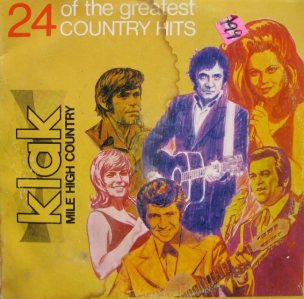
KLAK was the number one Country music station in Denver, the eighteenth-largest market in the U.S. We broadcast on 1600 AM at 10,000 watts and on 107.5 FM at 50,000 watts. The manager hired me on the spot while I was meeting with him about doing voice-overs for commercials. I was offered the 7 pm to Midnight shift Mon-Fri at $150 a week, which increased to $250 (about $1875 in 2025 dollars) after my show’s ratings and popularity were validated.
Rock ‘n’ Roll was my first choice, but I probably had a larger audience at KLAK because there were so many Rock stations competing for listeners. Just one other station was broadcasting the C&W format.
It didn’t exactly suck. There were lots of lonely and horny Cowgirls who deserved a deep-voiced, sexy-sounding DJ like me. And hear from them, I did.
I did the 7pm to Midnite show. (Swan archives)
At KLAK, we had a modern country format. I was playing Blue Crying In The Rain, I Will Always Love You, Don’t It Make My Brown Eyes Blue, Have You Never Been Mellow, Goodhearted Woman, Rhinestone Cowboy, lots of Elvis, of course, and Rocky Mountain High.
I had a fan club that was always sending me stuff. On air, I became known as Don “Mother” Swan, a moniker that stuck after a Denver Post article (in Chpt. 33) on my volunteer work for The Mothers March Of Dimes. The non-profit that worked to prevent birth defects made me an honorary Mother.
At KLAK, I was a popular on-air personality and became the station’s entertainment director. I hosted Country Music performers like Waylon Jennings, Willie Nelson, Merle Haggard, Crystal Gayle, and others. I opened (as opposed to emceeing) a show for Jim Stafford (My Girl Bill) and Kenny Rogers (The Gambler) at the Complex in Denver, with a comedic bit. It was my first and last gig as a comic, despite being voted the wittiest at Hatley High School. But:
Hard to read sentences; bottom line, my “Night Life” show increased ratings by 38%.
(From KLAK memos in 1976. Ratings from Jul/Aug 1976 ARB Seven County Central Audience Zone, Quarter Hour Audience Estimate)
At KLAK, I was putting in about 35 hours a week and filled in for other DJs, including the most important shift: Morning Drive. For me, hosting the 6-10 a.m. show in a top twenty market was heady stuff, with an estimated audience of 70,000. Notably, the show’s regular Morning Drive DJ was pulling in some serious money, about $500 a week, a bit over $2,800 in 2025 dollars, and was soon on to WJJD in Chicago, making even more. (Great money, but if your ratings tank, you’re out the door.)
Some of the most popular Country songs I was playing: Convoy–C. W. McCall; Before The Last Teardrop Falls–Freddy Fender; Chevy Van–Sammy Johns; (Hey, Won’t You Play) Another Someone Done Somebody Wrong Song–B. J. Thomas; Thank God I’m A Country Boy–John Denver; I’m Not Lisa–Jessi Colter; Please Mister Please–Olivia Newton-John. The Dolly Parton version and the song she wrote, I Will Always Love You, is the best, in my opinion (approx. 13 million views on YouTube!™
Outside the station, I was a one-person advertising agency, did voice-overs for some major advertisers, and was a full-time student at DU. A performative documentary I narrated won a bronze medal at the New York Film Festival. In addition, I played Col. Forsyth and the off-stage voices in Arthur Kopit’s Indians (for graduate credit) at the DU theater, a play that ran for several weeks and received good reviews.
More top Country hits I was playing on 16AM KLAK: Torn Between Two Lovers–Mary MacGregor; Faster Horses–Tom T. Hal; Don’t The Girls Get Pretty At Closing Time–Mickley Gilley; You’ve Been Talking In Your Sleep–Crystal Gale; Mama’s Don’t Let Your Babies Grow Up To Be Cowboys–Waylon & Willie; Lucille–Kenny Rogers; You Light Up My Life–Debbie Boone; Snowbird–Anne Murray and Luckenbach, Texas–Waylon Jennings.
Disc Jockeys from around the Country were looking to come to Denver. I got calls from DJs in Philadelphia and other markets larger than Denver, wanting to work in the Mile-High City.
The mid to late 70s were a great time to be in Colorado, as the state saw a surge in popularity. You may remember John Denver; he touted Colorado (think: Rocky Mountain High). People were flocking to the Mile-High City and the even higher Rocky Mountains to the west.
I happened to be on-air (March 1976) when the news broke that Andy Williams’s wife (Claudine Longet) fired several .22 rounds into the belly of Olympic ski star Spider Sabich in an Aspen Ski Chalet bathroom. (He died in the ambulance on the way to the hospital.) Williams (Can’t Get Used To Losing You, Moon River) was an immensely popular singer who had his own TV show and Christmas special.
He wasn’t in the rotation of music we typically played on KLAK, but for some reason, news outlets from around the world were calling our station for news about the sensational event. I was quoted in the foreign press, especially in Australia, about the shooting death (I had no insight into the case; I just verified the story). I joked on my radio show that the next Andy Williams Christmas special would probably be held in Cañon City (home of Colorado State Penitentiary).
*It is unintentional if any of my writing ever sounds like I’m feeling sorry for myself or seeking pity from my readers. Others had money problems more significant than I had. As for sickness, So many also had it worse, like small children with incurable cancer or young girls with incontinence and all the other perils of incurable Crohn’s disease
 Fitzsimons Army Medical, Denver, where I was confined until diagnosed. (Public Domain)



 Swan's Song Series