Twelve months had passed, just a year, since the horrific ambush at Binh Dinh — 7,800 miles away from LA.
An hour of sunshine remained on this beautiful March afternoon in SoCal as I eased Marty’s springtime yellow Mustang GT off the post from another tedious day at Ft. MacArthur. I took a right on S. Pacific Avenue and headed to our tiny apartment in San Pedro. Marty would have a Swansons® TV dinner and a Tom Collins ready. She would be bored and happy to see me. Same here. I’d have something for her as well. We could catch the sunset at Cabrillo Beach another time.
Life was pretty good.
But, after Vietnam, my expectations may have been a little high. Life would not be perfect, nor close to perfect. The ice cream I’d dreamed of for a year didn’t taste as good as I remembered.
Although I intend to remain faithful to my promise to write honestly and give you the unvarnished version of how I was feeling, reacting, or coping at any given time. I believe I complained a bit too much in the previous chapter.
Rather than sniveling, I should have said: “I’m out of Vietnam, back in the World with no worry of being shot by a Kalashnikov, no booby traps — no incoming. I have no field expedition requirements, and despite my on-call status, I’ve not been apart from my pretty blond wife for more than 24 hours. And I sleep beside her warm body in a comfortable bed every night.”
SoCal is a Hip-Laid Back megalopolis, and we had already visited Disneyland. Ft. McArthur was a beautiful and historical post, named after one of our most famous generals. It was a great assignment.
I was working in the HQ building (at Ft. Mac) on the second floor in the Awards and Decoration section one day in April 1968. I heard raised voices from downstairs, a slight commotion. Someone was yelling, “Where the f–k’s personnel?”
It was a young man in civilian clothes, a bit scruffy with an attitude, standing near the Sergeant Major’s office. With no authority over someone he didn’t know to be in the military and not in uniform, the senior NCO was in no position to dress him down, but he was doing so anyway. The man had walked into the HQ of an active army post using profanity, after all; what gives? He was looking for the personnel office to pick up his . . .
WAIT FOR IT . . .
WAIT FOR IT . . .
. . . Medal of Honor!
We were astounded when we found it to be true. At least I was, the Senior NCO, a bit more, after chewing out a recipient of the military’s highest award for bravery. Uttering the F-bomb on Post, had the NCO known, might have been excused.
While the Sergeant Major stood with his mouth agape, I began chatting with the Vietnam veteran. He wanted no ceremony, no publicity. I asked him if he had considered staying in the Army, as the Medal Of Honor (MOH) would surely be a boon to his career. "F--k no, are you dinky dau?" he snapped, "I'm hanging drywall, making five dollars an hour."*
I considered telling him about President Truman, a combat veteran, who, upon presenting a soldier the Medal of Honor in the White House, remarked: “I’d rather have [earned] that medal than be President.”
Oh, well. This superhero, presumably, returned to his apartment in Downey, tossed his MOH in a drawer, got up the next morning, and went to work — hanging more drywall.
On the subject of work, I wondered what plum assignment a warrant officer in our section had. He would come into the office early in the morning, looking sharp in his Class-A uniform, stay a few minutes, and be gone the rest of the day.
Then I found out. Our warrant officer was occupied with notifying the LA area next of kin (NOK) of those killed in Vietnam. When a family is informed, the military member must be at least equal in rank to the KIA. Most helicopter pilots in Vietnam were warrant officers.
Our soldier of that rank, outside of bloody combat, or Graves Registration in a combat zone, was fulfilling the worst duty in the military — ringing those doorbells. This dreadful detail would not only continue but also increase. The deadliest year for US troops in Vietnam was this year, 1968, and that included lots of helicopter pilots.
I can imagine him wheeling a big olive drab ’65 Ford Custom 500 staff car, without A/C or power steering, around the streets of LA. The yellow three-inch tall lettering on the front doors read: “U.S. Army For Official Use Only.”
He was an excellent target for citizens, who occasionally gave him the finger. It may have come from those active in protest movements, or people who just hated the US Army for what it did to them or their families.
With likely outdated paper maps, he crept slowly through neighborhoods looking for that address. Spotted by service member wives, daughters, sons, or parents, they pointlessly retreated to the back of their houses. They were trying to hide from their front doors, but listening still, for that knock and praying that it never came.
A team member notifying NOK told me a story about arriving at the home of a KIA and finding a 3-year-old boy running toward him, thinking he might be his dad. The excited child jumped into his arms, sat in his lap, and, through tears, begged him to “Go over there and bring back my Daddy.”
~~
Medal of Honor recipient Charles C. Hagemeiester, a medic with the 1st Cavalry Division (Airmobile) earned for actions during an ambush in Binh Dinh Province March 20, 1967. (U.S. Army photos)
Charles C. Hagemeister Aug 21, 1946 – May 19, 2021

Back in the States, away from the war, I hasn't thought much about General Nortons declaration. That's until May 1968. I was out with four or five friends from the post. The TV was playing in the background, when the news came on.
I saw President Johnson at the White House place the Medal Of Honor around Hagemeister’s neck!
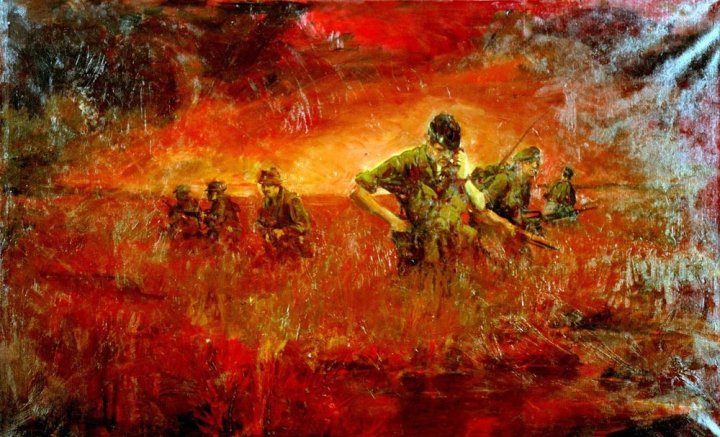
Excited and surprised, I raised my voice over the din of the club, “Hey, I know this guy, I was out there with him. That’s Chuck Hagemeister!” The guys were twisting their faces, “OK, Swan, OK, sure, all right then,” they protested — never looking up from their game of pool. I tried once more, “No, really,” and then just gave up.
Imagine earning the most venerated medal for bravery in all the military — The Medal of Honor — in what was, for most, an atrocious and despicable war. That’s what we have here. But it’s not antithetical to Hate the War while also saluting and celebrating our Warrior.
A
I often think of that day in 1967, about Hagemeister, about the brave men who got no medal at all, and about those who gave it all. Now I live secluded near the ocean, counting my blessings every night in a comfortable bed. I’m no longer worried about taunts from my fellow citizens — like those at the airport the day I arrived from Vietnam — or incoming from the enemy we fought for so long, so long ago, so far away.
As for those who may have said, “People who served in Vietnam were Suckers.” I disagree. “No Thank you for your Service Suckers” lacks a speaker’s natural, sincere, and smooth delivery; it doesn’t flow well.
Instead, we should be saying to the “leaders” who sent us there: “The only dominoes that fell were on the 58 thousand plus souls sacrificed and the survivors, many of whom are still suffering.”
This concludes my In-Country chapters on Vietnam. However, it will be a source of reflection and discussion in the following chapters: How We Could Have Won In Vietnam & The 1st Team In Vietnam, and others.
~~
*(about $45 in 2024 dollars.)
I stayed in the US Army for a few more years until I was diagnosed with Crohn’s disease. I had a particularly nasty case and endured several surgeries, one of which resulted in a colostomy. I squeezed every bit of my GI Bill and obtained an undergraduate and a Master’s from the University of Denver. In that city, I was a popular DJ, worked in Public Relations, and dated scores of beautiful women.


Thanks for sharing your story with us, looking forward to what comes next.
LikeLike
Mike Thanks again for reading and your feedback. It keeps me motivated to contiinue wriring. Don
LikeLiked by 1 person
Mike, I am unable to see any comment you made on Bonus chapter: How We Could Have Won In Vietnam. Thanks, Don
Try resending if you want.
LikeLike