“Darkness comes, and the clouds turn black with threatening rain. An eerie feeling creeps into your whole being as the beautiful trees of daytime turn into laughing demons from the cold night wind.” A Pawn in the Game: A Vietnam Diary.
Sgt. Bruce F. Anello, Killed in Action, May 31, 1968
But today, it’s hot — hotter than usual in the high eighties, and we’re not even in the hottest season. The sun bore down on me; my fatigue shirt stuck to my back as if it were part of my skin. My neck stung from the burning sun, and the straps of my heavy rucksack dug painfully into my shoulders.
The ingrown toenails I’d experienced for a year had returned, only worse, with the sharp nails piercing into soft and wet skin around my big toes. The stabbing and burning sensation was even more painful in these hot and sweaty, ill-fitting jungle boots.*
A slight whirlwind of red dust followed me on the narrow, hard dirt path. That subtle breeze would be the last I’d encounter for a long while.
Thankfully, it was just a short walk from the airstrip where I had just landed to the tent city at LZ English, the forward outpost of the 1st Cav. I was here for a new assignment. I had volunteered to go where the action was.
As I got closer, I picked up the bustle of what sounded like a large wilderness camp. There were jeeps, generators, a bulldozer or two, and people moving about.
I vacated that fantasy immediately when 155 mm (penny nickel-nickel) cannons began popping. And gunships in the distance were letting loose with M-60s, 20mm miniguns, and 2.75-in rocket artillery.
Near the edge of the outpost, I spotted a GP medium (18′ x 36′ tent) next to a sign shaped like a cross stuck in the dirt. The white horizontal strip was neatly hand-painted in black lettering: “Bong Son PIO.”
When I raised the flap, I was immediately hit with the unmistakable musty-mold smell typical of these fifty-year-old relics. Despite the sides rolled up on the OD tent, it radiated heat, lots of it.
Inside stood a few soldiers in jungle fatigues, most of whom wore no visible rank insignia. Their uniforms were already soaked through with sweat in the usual places.
They were gathered in front of a map showing the Central Highlands. On a board to the right, grease pencil markings on acetate read: “CBS SF, WTOP, ABC Net, Baltimore Sun, and Stringers.” It looked like they could use some help.
TA 312 crank field phones rested on makeshift desks of empty ammo crates. Wires were strung on the dirt floor, and a flickering light bulb hung from the tent’s apex.
A few men in military-type clothing, whom I assumed to be reporters, were loungin in the tent chatting. Several were puffing on filterless cigarettes.
I felt a bit awkward with my heavy load and tape recorder competing for a natural resting spot with my gas mask. I hunched down and dropped my butt onto a stack of empty ammo crates.
I stood when I saw a tall, thin man in his mid-twenties with a side-wall haircut (hair shaved short on each side) coming my way. He was in jungle fatigues with a 1st Cav patch on the shoulder of his left sleeve.
It was 1st Lt. Blankenship (pseudonym), the officer in charge (OIC) of the 1st Cav’s small PIO detachment here. I would keep him apprised of my actions while operating out of Bong Son.
The Village of Bong Son was situated approximately 113 kilometers northeast of An Khe in Binh Dinh Province. It was 18 clicks (kilometers) west of the South China Sea in the Central Highlands of South Vietnam. Located along Hwy. 1, several acres were dedicated to LZ English (aka Bong Son).
It was the forward outpost for the 1st Air Cav. A substantial perimeter surrounded the tent city. An artillery battery and some of the Cav’s most lethal helicopters were supporting line units or on standby here.
The outpost was busy with several hundred troops coming and going, using it as a strategic base to launch combat operations closer to the enemy.
The mission in and around Bong Son was straightforward: Search out the enemy, kill him, destroy his matériel, and keep a count of enemy fatalities. Now that’s more like it, until you are in the field and do encounter the enemy.
Still, I’d rather be out with the men in the bush, the ground pounders, and I volunteered for those assignments.
Although there was a mess hall and outdoor shitters at English, I never got stuck with either duty. I had a full-time job with PIO, but I didn’t escape details completely.
I assisted the engineers in building bunkers and filling sandbags. I helped in the digging of slit latrines and pounding spent Aerial Rocket Artillery tubes into the dirt for us to piss in.
For me, a 14-16-hour day was typical, seven days a week, naturally.
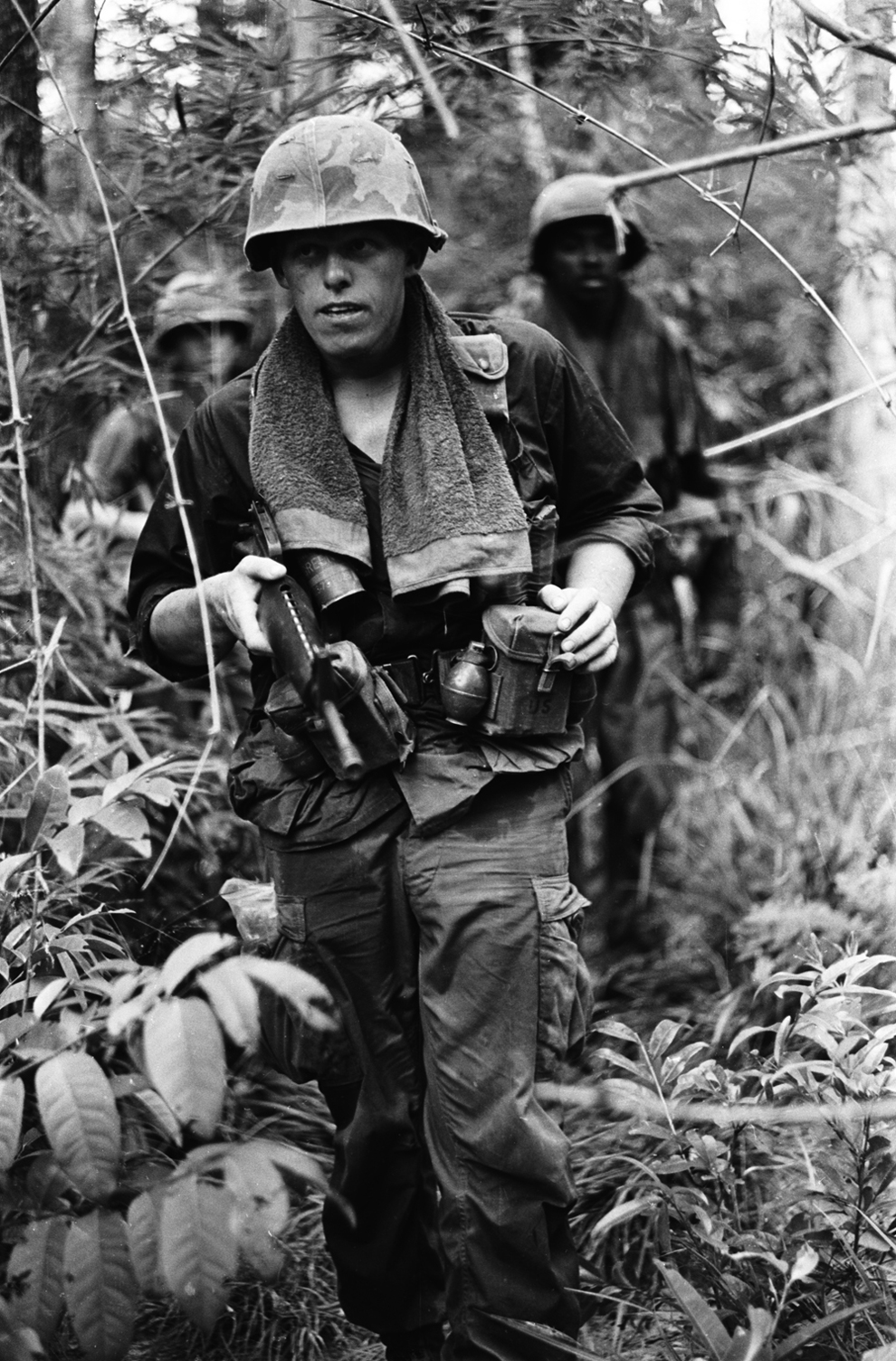
An unidentified Skytrooper, his M-16 in low ready position. Bush towel around his neck is to help keep him cool and insects from his collar. (U.S. Army-Charlie Haughty)
In Vietnam, there were no front lines per se. If there were a firefight, ambush, or a specific operation with likely enemy contact, it could be considered a front line while it lasted.
Even the Base Camp back at An Khe could become a frontline if the enemy gained significant access, as happened in February 1966.
It’s safe to say that the vast Binh Dinh Province, where we operated, was one of the Cav’s most active areas of operation, if not the war’s.
My first field assignment would be my most significant. That is, considering the eventual publicity and culminating at the highest level: The White House.
Blankenship, the OIC, knew me from nothing. I was a Private First Class with no field experience.
I had no record of anything and had been In-Country for two months.
He undoubtedly saw me as just another soul sent from HQ (at the member’s request) for whom he’d be somewhat responsible.
Days of the week didn’t mean much to the troops out here. But today was Monday, around 0800-hundred, 20 March 1967. AFVN Saigon was playing Happy Together by the Turtles.
Back in D.C., fourteen hours behind us, LBJ wasn’t to be briefed on the situation in Vietnam for several hours unless Hanoi surrendered.** Or he could buzz over and see for himself. He, McNamara, Rusk, and Westmoreland were in Guam meeting with the President of South Vietnam and other Vietnamese officials on 20 and 22 March.
I was in the PIO tent, daydreaming about the world and girls, answering phones, sweating, and taking in the scent of a letter from Marty,*** when I got a message from G-2.
Several clicks farther north, one of our Cav companies was in trouble. Members of the 1st Brigade involved in Operation Pershing were in jeopardy of being overrun by a superior enemy force. Requests for reinforcements had just been flashed messaged Z.
I rushed to my tent, gathered most of my gear, and volunteered to go to the scene to document 1st Cav activities in the field and for AFVN news. I would try to chopper in with some of the reinforcements.
My Lieutenant — no doubt, thinking I was incapable of getting a lift — did not object. Ten minutes later, I was about to mount a Huey for my first ride in an Air Cav chopper.
I rushed to the helipad and made my case to the pilot in the left seat (usually the Pilot in Command) under the fluttering chopper blades. Halfway through my appeal, he pointed a thumb toward an open door.
With one foot on a skid, I hopped aboard with my gear, pivoted backward, grasped a D-ring cargo tie-down, and slid my butt on the grey metal-reinforced floor (but incapable of stopping a bullet).
Surprisingly, I remembered my Webley .455 Mk V sidearm in the holster around my waist. I quickly secured in a safer spot before losing it in the bush, where we were headed.
Once airborne, I’d need both hands to hold on to this giant bird.
A first-timer like me inadvertently tumbling through a wide-open door at height would be detrimental to the mission. The battalion commander would undoubtedly have some tough questions for the pilots.
Finally, an unlucky clerk would be tasked to explain my “non-combat death” diplomatically— for the commander’s signature — in a letter to my next of kin.
As the rotors gained RPM, a trooper made room for me, where he was sitting at an open door. We pointed our M-16s straight and rested the weapon under our crocth (safety on). We swung our legs just outside the open door, above the skids.
At about 6,000 pounds, loaded with us and the equipment, the pilot pulled pitch, and with 1,100 horsepower, the UH-1D had no problem lifting us above the palms.
In less than a minute, we were airmobile and cruising at 100 knots in a 1st Cav slick. (Without side-mounted weapons, a logistics ship; although some had door gunners, ours did not.)
After gaining altitude, the pilots pushed the cyclic completely forward and pulled way up on the collective. And with the nose slightly down, they were rushing us to our destination, wherever that was.
On our left, an elongated shadow of the chopper followed us, and hues of green farther west flickered from the picturesque Annamite mountain range (2,819 meters at its peak).
To the east, waves from the South China Sea crawled gently onto the sugar-white beaches. Our flight seemed more like a sightseeing expedition than a military operation.
Upon closer observation, the landscape below was dotted with bomb craters. Some were recent, while others reflected bright sunshine from the still rainwater.
Finally, the air at our altitude was cool. We would meet up with other Skytroopers and be ready for what awaited us.
The pilots were on ass-and-trash duty (non-combat passengers and supplies) when they were diverted to Bong Son (LZ English) to pick up troopers needed to assist the Cav company farther north.
On board was a squad of six infantrymen. They were laden with M-16s, M-79s, fragmentation grenades, and an M-60 with several bandoliers of ammo (about 45 lbs alone). One carried a PRC-25 radio with extra batteries. They were loaded with more than usual: munitions, extra canteens of water, C-rations, and a bunch of other stuff. It was a heavy load, for sure.
The men appeared anxious. Just minutes ago, one of the troopers was probably sleeping. Another might have been listening to a tape from home. Some perhaps played poker and had to fold a good hand when told to grab their gear NOW and move out to the helipad.
Sitting atop his helmet near me, one of the older-looking soldiers (like 21) raised his voice over the din of our vibrating, amped-up bird. “There must be beaucoup g–ks out there if a Cav company is in trouble.”
Another trooper on the canvas seat looked my way and said, “Who the f–k are you?” I was tempted to say (with no rank displayed), “I’m your new Platoon Leader.”
Then he asked, “You been out there, out there in the shit?” “Yes, No, I mean, No,” I stuttered. He shook his head and went back to adjusting stuff.
I would have felt even more out of place had my jungle fatigues and boots not been broken in. That’s a quick tip-off for being a FNG (F–king New Guy).
Another trooper dangled a Pall Mall® from his lips, unsure if he was allowed to smoke. Or if he could light it, even with his Zippo at this altitude with the doors open.
Our unarmed chopper would not fly near a suspected NVA battalion. Nor near where the feared .51 caliber or 12.7mm anti-aircraft guns were thought to be, to insert the seven of us. But it would get us closer.
After about fifteen minutes, in flight, I felt the chopper bleeding off speed as they pulled back on the cyclic and lowered the collective, decreasing altitude.
As we neared the ground, rotor wash swayed the vegetation at low hurricane speed.
The uneven ground was too rugged for the chopper to land.
The pilots flared the Huey and maintained a slight nose-up hover, about eight feet above the irregular terrain. I was new to helicopter flight, but thought we were a bit high to un-ass. I barely cleared the rails as I followed the others to the ground in an awkward knees-bent landing, shoulder-high in Elephant Grass.
We had hardly hit the hard ground and were struggling to get a foothold when the pilots pulled power back to 6,600 rpm. Now 1,700lbs lighter, the Lycoming T-53 turboshaft jet engine ingested all 1,100 horsepower, belched JP-4, combined collective and pitch, and quickly made altitude and 130 knots.
They disappeared way too soon for my comfort.
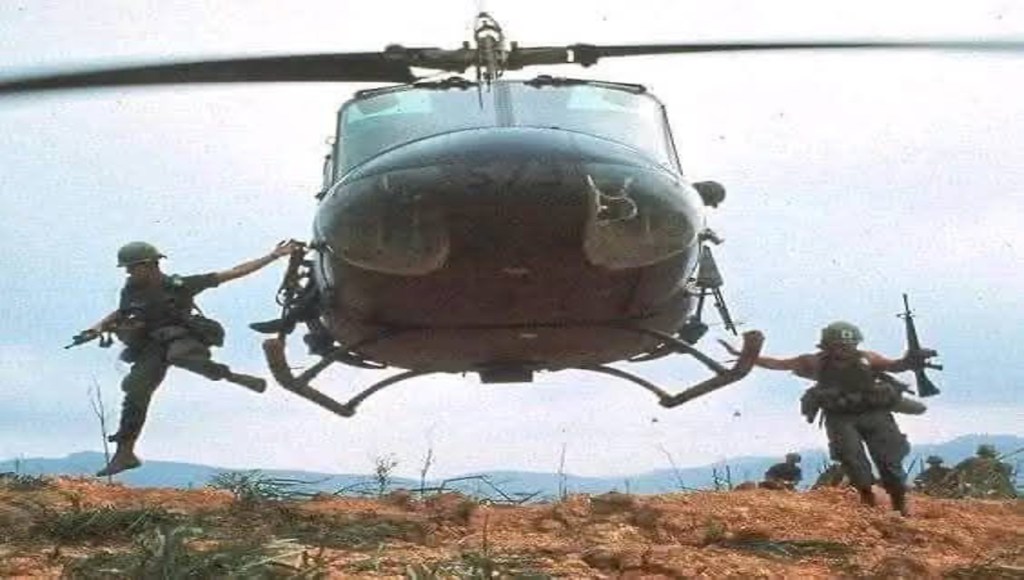
With nowhere to land, 1/9th Blues quickly dismount on the run, well above the bush jungle. (US Army PIO).
I thought about the popular and prudent military truism, “Never Volunteer for Anything.”
In a few months, the Cav would get the new H model with 300 more horsepower, which was easily felt when I flew in it. The new model was well-loved by the crews and became a mainstay in our units, especially for Dustoff, with significant improvements in patient transport.
The seven of us had just been inserted into the Plains, about 20 clicks Northeast of Bong Son, and alone. With the departing chopper barely audible, it was quiet except for the whir and buzz of swarming insects and a monkey or two sounding off in the distance.
Now, we were getting a taste of what it must be like for the elite Long Range Reconnaissance Patrol (LRRP). (Arguably one of the most dangerous postings for a soldier in Vietnam.) They are dropped off in small numbers and on their own for several days. We weren’t expecting to be out that long. But, still.
We were in the Central Highlands, of rugged mountains, high plains, bamboo forests, and dense jungle. And it had a reputation: Troopers dead or dying, daylight patrols, nighttime ambushes. It was also known for Air Assaults into hot LZs, body bags, body counts, grunts shitting blood — SNAFU, Situation Normal — All F–ked Up.
The weather in the Central Highlands was about to change from dry to monsoon. Although rain could come quickly in the jungle, it could disappear just as fast. We didn’t receive any precipitation today; instead, we were rewarded with high humidity and unseasonably warm temperatures.
The weather in Vietnam can be described as follows: Extremely hot with high humidity. Muggy Rainy-Hot, Muggy Monsoon-Hot. And Chilly many nights. I’d still be here in July, when a record temperature in South Vietnam was 120 degrees.
Today, we were directly under the sun, in the hottest part of the day, where the sun’s full intensity is felt, and we had little protection from the sparse vegetation. Chalky-white residue bordered the wettest spots on our uniforms.
There were no known friendlies except for the Cav platoon we would reconnoiter (meet with). Where? We didn’t know exactly. Our best intel from G-2 and our long-gone pilots) indicated several clicks farther to the Northeast, closer to the South China Sea.
We would begin our journey on rugged terrain with minimal cover and few concealment possibilities. We hydrated.
The point man had a round in the chamber, safety off his M-15 at low-ready. (Not all carry positions are uniform in name.)
The rest of us chambered a round, safety on, and moved out in a single file. About 20 meters of spacing was maintained with the almost 9 lb (loaded) M-16A1 in a collapsed low-ready position.
Close to the difficulty of the Point man was the Drag man, who had the difficulty of mostly walking backwards, looking for the enemy from behind.
When the terrain began closing on us, which would be soon enough, we shifted to a squad file, now with about ten-meter spacing. Our sergeant kept reminding us not to bunch up.
We had a compass, maps, a prick twenty-five (PRC-25), impressive armament, and aid kits. There was enough water and C-rats for about a day and a buck sergeant to lead us.
If we met enemy resistance larger than a platoon, well, I tried not to think like that.
I had no input, nor should I, in planning our route or tactics. My responsibilities would entail scanning the terrain, remaining in the prescribed formation, and taking orders from the squad leader. And do nothing stupid, like shooting one another. Sounds easy enough.
The standing joke was, don’t worry about the bullet with your name on it so much as the one that reads: “To whom it may concern.” Soldiers duck involuntary, never mind the one you hear — really — never hits you. Some would say, “There’s nothing more exhilarating than being shot at and missed.” It hadn’t happened to me yet and I doubt I’d call it exhilarating
I lathered up after pulling my bottle of army-issue bug juice, 100% DEET, from the band on my helmet. It was somewhat effective for insects but excellent for removing the dreaded leeches. A lit cigarette works, too.
I was told to be careful of swatting insects, as the enemy knew only GIs did that. I would also learn that the injection stem often remains embedded in the skin when insects are slapped, especially the dreaded misquotes.
Before taking a break, our sergeant chose an appropriate spot that would afford each of us a good field of fire as we rested. We feasted on C-rats, where I got affirmation of what I’d heard all along: few GIs are fond of the ham-and-lima-beans entrée. I loved them. I could trade almost anything (even crackers, coffee, salt, or sugar) for a can of that nourishing mix.
But what I really wanted was a Snickers® bar. Had one been available, I’d smack down 20 MPC dollars (military pay currency and several days’ wages) without hesitation. I’d savor until the milk-chocolate covering the nougat, caramel, and peanuts had melted, in my hand; then I’d lick it.
One in Vietnam must keep things in perspective. On another day, I might be satisfied just to have something dry to wipe my ass. Smoke ’em if you got ’em.
In the distance to the West, purplish black clouds formed above the dark green mountains as we slowed near a grassy knoll. Had I not been color-blind, I would have been more descriptive.
But it was certainly dark and dreary around those mountains, looking foreboding. Seagrass swayed around us in a light breeze.
Everyone in the patrol exchanged glances as we continued through green fronds of cinnamon ferns, carefully looking for any signs of disturbance.
A web of jungle lay ahead. Even though it slowed our advance, we stayed off paths that were well-traveled,
By the time we had covered a couple more clicks, we heard sporadic clack, clack, clack in the distance, indicative of AK-47 small arms fire. We took a few sips of water and moved out toward the gunfire in case it was the platoon we were to join that might be the recipient of the AK-47 fire.
Some grunts had their magazines taped together, one up and one down, for a quicker change (and less noise). However, it was a challenge to carry it in that configuration.
My inflamed and infected ingrown toenails throbbed with burning pain. With each step, the tops of my snug jungle boots pressed down hard, digging the sharp toenails into the soft, sweat-soaked skin in and around the big toes of both feet.
I’d already found open blisters elsewhere on my feet during our last break. So here I was, trying to keep up with foot soldiers and having foot trouble.
Of course, I wouldn’t complain to the men in the squad. But, soon enough, I’d see pain from a different perspective.
After a cautious and calculated advance for another half hour, the jungle began to clear. And from our elevated position, we spotted unidentified troops at about 3,000 meters
We quickly moved into an area that provided better concealment. Unfortunately, no one had field glasses, and our RTO was still unable to reach any friendlies.
We became whisper-quiet, communicating with hand signals and not smoking. We checked our gear to determine if any equipment was making noise as we walked. (Dog tags were already taped together or secured in the tops of our jungle boots.)
When we were within about 300 meters of the troops we had spotted earlier, our squad leader determined they might be friendlies.
Nevertheless, we spread out, crouched in the vegetation, and began to high-crawl, weapons at high-ready.
Finally, our RTO made contact. Our squad leader popped smoke to ensure they knew our location and the direction we were coming from. We moved out to join the men.
We found the haggard foot soldiers in a sandy field lined with palm trees and dotted with ant hills and grave mounds of dirt. Some were over a meter tall.
We had made it to our objective: Find some 1st Cav troopers and join them in search for the beleaguered Cav company.
The soldiers were in 1st platoon (A Company, 1st of the 5th Cav), down 15 men and far from fresh troops.
The seven of us shared one canteen of water, enough for a few sips for each.

Haggard Trooper, (unidentified) in the Binh Dinh area, near the ambush site in March 1967. (licensed from Almay)
Meanwhile, the NVA was finalizing its plan to ensure that no Americans reached its objective.
Hot and tired, I backed away from the group of soldiers and stood alone watching. I wondered whether I would have a story to file, and how and when I would return to Bong Son. Let alone An Khe, where I could get a hot meal and maybe some new, better-fitting jungle boots.
Today, I’d made my first aerial sortie and trekked about five kilometers through plausible enemy territory (it all is) with an infantry squad.
We had finally caught up with a platoon from the 1st Cav we’d been searching for; it was down to almost half-strength. There were seven more compliments of our arrival, now all of 27.
Several soldiers sat atop their steel pots, field-stripping their weapons on poncho liners. With both hands busy, smokers squinted as their cigarettes burned short. Others stirred on the sandy field, eating, complaining about, and trading C-rats.
A few, wearing unzipped, sleeveless flack jackets, were posted around the perimeter, M-16s close by.
But none were horsing around, joking, cursing, or name-calling as GIs typically do. It was unseemly, I thought. If they were on edge, should I be worried? Hopefully, it meant they were alert and ready, like the Green Berets I encountered on their way to Bong Son.
It was still plenty hot (about 90 degrees) as the late afternoon sun neared the horizon directly ahead. Soon, I would realize the true meaning of heat.
No salutes were exchanged when our squad leader reported to the tall, slim 1st Lt., who was the leader of 1st Platoon. His weathered face belied his age of 24.
An army-issued Benrus hack-capable watch hung from the left pocket of his jungle fatigues. A shiny black leather holster encased his standard-issue M-1911A1 .45 caliber pistol on his right hip. He held a laminated map and checked his compass.
The Lieutenant (who had just minutes to live) was scheduled to rotate back to An Khe the next day. Now he met with his platoon sergeant and squad leaders. The plan was simple: his platoon would find and consolidate with other troopers thought to be in the vicinity.
For now, we will proceed a few meters and look for a suitable area to establish a night defensive perimeter for a RON (rest overnight). And probably dig in.
I didn’t expect to have any watch requirements, and I’d wake up (hopefully) rested after sleeping on the ground for a few hours.
We would rise at 0500, down some C-rats, have someone cover us while we took a crap, and be ready to move out at first light. We’d saddle up and head NE toward the hamlet of Truong Son near the Village of Tan An.
In the group of soldiers, unknown to me at the time, was the platoon’s young medic. He was from the Midwest, the youngest of four children, and the only boy. His mother struggled to take care of the family of five after his father died when he was just three.
After a year at the University of Nebraska, he ran out of funds and was working at a warehouse in his hometown of Lincoln.
The local draft board took an interest in him. Soon, Uncle Sam came calling and welcomed him into the fold of the U. S. Army on May 19, 1966.
His Expert rating on the rifle range during his basic training just a few months ago at Ft. Polk, Louisiana, would soon serve him and the rest of us well.
There would be a calamity that would cause me to remember him forever.
*Some readers may be thinking, what’s the big deal with ingrown toenails (with all the other shit going on)? Consider this, they hurt like hell, and on many occasions, in Vietnam, they were infected, discharging pus. In the hot confines of Vietnam, with too small jungle boots made it worse. Because the toenails have been removed so many times, the deformity of the nail plate caused my big toes to become dystrophic. They resemble rough and uneven redwood burl splitting, are that color, and don't extend to an unusual length, unless I stub my toe; it’s no big deal, aside from their appearance. Women who see them often are  like, “Whoa, what happened to your toes!?”

**The frequent letters from Marty, my girlfriend in NC were a life saver.

***That's the White House version; he micro-managed the war, and some days, he required multiple updates.
 Swan's Song Series
So far you have not mentioned any close friendships that you made while in the army. Maybe that was intentional.
LikeLike