TRAGEDY AND TRIUMPH FROM THE VIETNAM WAR AND THE INTRIGUING STORY OF OUR MEDIC AND HIS MEDAL OF HONOR
Donald SwAN MA.
"Reading Swan's book triggered my PTSD. The ambush scene was that intense. But if you want to know what it's like in combat, this is your book. I give it an A+."
Gene Womack, Distinguished Flying Cross recipient , Vietnam War,
Given the choice of experiencing Pain or Nothing, I would choose Pain.
William Faulkner
While 125,000 celebratedthe Summer of Love in San Francisco in 1967, I was in Vietnam trying to stay alive. As a combat correspondent with the renowned 1st Cavalry Division (Airmobile), I followed soldiers in and out of battle. Twelve months in a Third World with so much death and depravity was an unforgettable experience. For those in the thick of it, it was horrendous. Some left it behind, many did not. This story is based on actual events. It’s my firsthand accounts of the men who were in the worst of it.
What this Book is Not: I promise that I won’t belabor my readers with: All Hell Broke Loose, eighteen times.
No superfluous assessment of how we got into the war, no history, no discussion of the draft, no tearful goodbyes from family, and none of me playing Army as a kid.No letters home asking about Aunt Martha’s gout.
There is no rhetoric at all. I waste no time in manifesting the anxiety and danger of walking point, inundated with the sucking mud of the monsoons, stifling heat, snakes, and punji stakes. Then, running out of water, food, and ammunition.
And the most horrificface of war: Holding a fellow soldier or a dying friend, you can do nothing for — except try to comfort. Then, continue the fight or move on to another battle.
My Vietnam narrative is a story of young men and some boys who volunteered or were drafted. They were a generation defiled of their youth. Yet, when called upon, they fought and died for each other with extraordinary acts of courage.
Our men, the Infantry, fought a savage, barbarous, and ruthless enemy. The adversary bolted from camouflaged spider holes, AK-47s blazing, and then disappeared into tunnels.
Snipers, hit-and-run tactics were common, booby traps, and punji pits seemed to be everywhere. The enemy shot at our men from friendly villages to lure the GIs into returning fire and killing civilians.
Our wounded who survived a battle were murdered, then our bodies were stripped and desecrated. And if it were to their benefit, a fate, possibly worse — capture for a ransom. As for the Geneva Conventions, they knew nothing about them.
Our soldiers could not distinguish between the enemy and civilians and were saddled with ridiculous rules of engagement. Many, if not most, combatants quickly became weary and bewildered.
That our fighting men sometimes called the enemy g- -ks. I am not going to judge.
Imagine earning the most venerated medal for bravery in all the military — The Medal of Honor — in what the majority of Americans believed to be an atrocious and despicable war. Draftees and volunteers didn’t choose this war. But when the battle came, it was theirs. And they were fighting for their lives and those of their fellow soldiers.
So, it’s okay to hate the war without demeaning the warrior.
As I recount the book’s most significant battle, the horrific ambush, you’ll need to keep up with just one character. Why? Because he almost single-handedly repelled the initial ambush. Hagemeister was the catalyst for others who became warriors for our cause. He was rewarded with the Medal of Honor for his courage and intrepidity during the bloody ambush.
At least seven men could witness his heroism because he saved their lives. I was one of those. And I watched in awe as Charles C. Hagemeister, our medic, fought the enemy with ineffable gallantry and resolve. (Regrettably, he died in 2021 at age 74.) But, finally, albeit after death, he’s getting the recognition he deserves through this book.
Men like Chuck Hagemeister came home to a hostile or indifferent nation at best. They faced many challenges in the country that some soldiers believed they were defending.
As the conflict dragged on, the notion of “Fighting in Vietnam to Defend one’s Country” was passionately challenged. They came home from war to a nation that didn’t care and they died for a nation that didn’t care.
But, despite or because of that, I believe their stories need to be told. Those in the military who have seen combat and lived to tell about it often don’t; It makes the accounts of those who do mean so much more.
These young soldiers were challenged in ways most will never know. What they faced, most could never imagine. Their stories should be passed on to future generations. I will put these men — and (women) the nurses who dedicated their lives to comfort and save us — up against any generation. Although there are scores of books on the Vietnam War, none are about Chuck Hagemeister, the bloody ambush — none about his valiant acts that earned him the Congressional Medal of Honor.
And the probability of me being there to witness and survive it — was the providence of a lifetime — an incredible honor.
~~
These pages contain Eighteen compelling chapters on Vietnam. (Four in Book II). All such chapters are so marked in the table of contents. Many riveting photos accompany these stories. The remaining Twenty-Six Chapters in Book I constitute the rest of my momentous Life At The Limit. They include Elvis, Rock ‘n’ Roll, Romance, PTSD, Disease, Single Parenting, and Auto Racing.
There are also Two Chapters with stories from WW II veterans in Book II. I will end the entirety of my writing (in Book II) with What I’ve Learned, and leave you refreshed with Don Swan’s Greatest Hits in the last two chapters.
Two chapters in the book are designated as Historical Fiction. However,my narrative is based on actual events as I remember from fifty-five years ago in Vietnam. All people, places, and battles are real unless otherwise noted.
The Vietnam stories in this book were written to Honor Charles C. Hagemeister.
If you’re interested in just the Vietnam and WW II stories, see the Index where those chapters are identified.
READER DISCRETION ADVISED
There were also periods without enemy contact. Troopers were lulled into boredom and became complacent, only to be suddenly interrupted by terror. (The VC/NVA typically fought only when they believed they had a tactical advantage.)
They came home from war to a nation that didn’t care and they died for a nation that didn’t care.
United States Veterans of all Wars, especially those who were KIA. The Vietnam helicopter crews, the nurses, and all my 1st Cavalry Division (Airmobile) brothers in arms. To the junior enlisted U.S. Army Infantry, quietly doing their duty, who deserved but got no recognition. And those who died fighting (as) a hero that no one survived to witness.
Charles C. Hagemeister Lt. Col. U. S. Army, Retired (former enlisted) and Medal of Honor recipient, Vietnam. Medic 1st Battalion, 5th Cav 1st Cavalry Division (Airmobile) 1967.
I regret to announce that he died on 5/19/21 at age 74 in Leavenworth, Kansas.
George K. Mullins Staff Sgt. U.S. Army, World War II, Utah Beach, Bastogne. 327th GIR, 101st Airborne Division, Combat Infantry Badge, Purple Heart, Valor awards.
Thankfully still going strong at age 100!
Thomas L. Kirkham, Sr. Col. USAF Retired, Operative in Laos & Vietnam.
Thankfully still living at 89.
Jay M. Strayer Col. USAF Retired, South & North Vietnam. Helicopter pilot in Son Tay raid. Silver Star.
Prelude Deadly salvos of flaming steel were decimating our platoon faster than the speed of soundlike all the NVA in Vietnam was out for us, and not relenting until no American invader remained. We would be overrun, our throats cut, our weapons seized, our body’s desecrated, and our blood used to enrich the red on their NVA flag.
Chapter 1: Training to Kill
A carpet of luxuriant rye grass snaked through the forest floor around dogwood, peach, cherry, magnolia, and Azaleas. Pearly white sand and small coruscating ponds surrounded greens of bent grass, manicured to perfection. Such was Augusta National, a Garden of Eden for golfers.
A few miles away, I stood at attention, a guest of Uncle Sam, sweat pouring off my brow. I wasn’t here for the golf.
“I’ve seen some pathetic sons of bitches, but you low-life maggots are the worst, turning you losers into soldiers, gonna’ take a goddamn miracle. You’re so dumb, even the Marines wouldn’t take you,” shouted our Drill Sergeant.
It was 1966 when U. S. Army Drill Sergeants (DSs) in Basic Combat Training (BCT) could and did treat trainees virtually any way they pleased: Loud, Vulgar, and occasionally Physical.
I was counting on the heat, humidity, and farm labor I endured in Mississippi to give me an edge in U.S. Army Basic Combat Training. It was a sweltering summer at Ft. Gordon, near Augusta, Georgia.
During the eight weeks of intense training at the 56,000-acre post, some GIs were seriously injured. Two recruits from our Battalion died from heatstroke. Around the time of these deaths (July 25, 1966), the officially recorded temperature in Augusta was 98 degrees. The humidity was 100 percent!
There was absolutely no pause in our training, no break (just extra salt tablets) from the stifling heat and humidity. The drill sergeants said if you think this is hot, wait until you get to Vietnam.
Our training company was made up of draftees and volunteers. About half of our group were so-called minorities from the poorer areas in and around New York City.
The rest of the recruits were primarily Caucasian and came from rural and poor regions of the South. A few recruits had advanced degrees, lawyers, etc. From the first two groups, a few had chosen the Army over jail after a judge gave them two options.
In the best of circumstances, this aggregation wasn’t likely to blend very well; with the shock and anxiety of BCT, it was volatile.
There were taunts and insults, along with plenty of pushing and shoving. When it elevated to fists and blood, most were not within sight of a Drill Sergeant. Even the lamest in the groups knew they could end up in the stockade with the possibility of a Bad Conduct Discharge or worse.
Although I was in good shape, I quickly learned that BCT required more than brawn. I also had to appease and maneuver in the virtual minefield around Staff Sgt. Hicks, one of my snarky and callous Drill Sergeants.
The Vietnam veteran, so designated by the large, distinctive 1st Cavalry Division patch — yellow with a small horse’s head and a diagonal black stripe — was worn at shoulder level on his right sleeve. A noteworthy Combat Infantryman Badge (white crest around a rifle in blue) was sewn above his left pocket.
He appeared to be in his late twenties and stood wiry and weathered at about 5’7.” His heavily starched fatigues sported perfectly ironed creases, and the tips of his spit-shined jump boots sparkled black in the bright Georgia sun. Hicks wore his Smoky Bear hat slightly tilted — just above his right eye.
He stood with conviction and authority, and the sergeant’s raspy voice spat out invectives faster than a jacked-up Carnival Barker. “When I get done with you sorry sissies, y’all wished you’d took the Marines,”* Hicks shouted, ’cause I’m as tough as any Drill Instructor in [Marine] Boot Camp. No, I’ll be tougher, ’cause turning you pathetic sons of bitches into soldiers gonna take a Goddamn miracle!”
Calling Staff Sgt. Hicks’s management style InYour Face would be an understated insult to the man once you saw him in action. He intimidated the candidates of war up close, personal, vulgar, and unrelenting. If we didn’t perform to his satisfaction, which was the usual, Hicks would hurl his favorite insult, “You f– king worthless trainees look like the aftermath of a Chinese g-ng b-ng.”
One didn’t have to screw up to feel the heat; we ran everywhere, dropped for seemingly endless push-ups. Then, we double-timed with our ten-pound M-14s, stiff-armed high over our heads, taunted by Drill Sergeants.
There were endless push-ups, and lots of marching to cadences like:
Ain’t no use in calling home
Jody’s got your girl and gone
Your left, Your left,
Your left, right, left.
Ain’t no use in going back
Jody’s got your Cadillac
Sound off; one-two
three-four;
Ain’t no use in going home
Jody’s got your girl and gone
Sound off; one-two
three-four;
Ain’t no use in feeling blue
Jody’s got your sister, too
Sound off; on-two
three-four;
Ain’t no use in looking down
Ain’t no discharge on the ground
Your left, Your left.
Your left, right, left.
Sound off . . .
A typical day began with a rude awakening at 4:30 in the morning. A band of Drill Sergeants was banging garbage can lids while ordering us to “shit, shave, and shower.”
Then, we fell into formation for inspection, followed by robust physical training (PT) that included running, calisthenics, and close-order drills. Then we had breakfast at 0600-hundered.**
Indoctrination and training ramped up as we met the heat of the day. And we could hardly wait until noon chow to get a break. But we wouldn’t get all the hot food we could eat until we satisfactorily mastered the 12-foot-high horizontal “monkey bars.”
We were required to advance from one bar to another using grip and momentum. Then, there was a required recitation of the 11 General Orders, totaling 65 words about Guard Duty. Last but certainly not least was the low crawl.
By the book, military low crawl is designed for stealthy movement in battlefield conditions. The purpose: Make your body a smaller target for the enemy while moving swiftly, flat on the ground, while keeping your head down.
A 30-foot-long, four-foot-wide course with a three-inch furrow dug into the hard Georgia dirt was the obstacle. Here we had to crawl in it fast and low.
The mercury lingered in the high 90s, and we had been humping since 0430. Now there was the added pressure of a rarely seen officer observing us; our platoon leader, 2nd Lt. Harris.
The officer stood like a soldier in a recruiting poster, about six feet tall, with a square jaw and a solid build, wearing gold bars on his collar and cap. His olive drab fatigues were starched and creased to the point that I believe his uniform would stand erect without him (in it). The tips of his Cochran® jump boots glistened like black water reflecting from a Georgia swamp.
The lieutenant wanted to see how his troops were progressing. Naturally, first in line for the low crawl was the biggest screw-up in our Company, a tall buzz-cut kid from West Virginia.
The recruit dropped into the dirt and crawled, but he wasn’t flat to the ground and moving too slowly. The Drill Sergeants yelled, “Get your butt down, soldier, you’re gonna’ get it shot off.”
The officer was not amused. Harris waved our boy out of the dirt, spun off his cap, and dropped into the pit hard.
Then, while perfectly flat, he pulled himself forward with quick twists of his arms and elbows and pushed with swift kicks of his knees and feet. He plowed through the soil like an International-Harvester ® and slithered in the clumps of dirt faster than an alligator in Georgia’s Okefenokee Swamp.
When Lt. Harris stood, gathered his cap from the dirt, and brushed himself off, three buttons on his fatigue jacket hung by a single thread.
Drop and give me 20 and get back in the dirt is what we were expecting. Instead, Harris, about two inches from the recruit’s face, unleashed in a low growl, “Five good men die in Vietnam every day,” then he let loose with his loud commanding voice, “because of f–k-ups like you, get outta my sight, you worthless piece of shit.”
Without any prompting, the remainder of our platoon and I immediately fell in line. We dropped into the dirt and low crawled with sufficient motivation.
After the low crawl wake-up call from our platoon leader, Lieutenant, there were still miles to go before we slept.
There was more PT, followed by marksmanship training with live ammo, hand-to-hand combat, and combat tactics. By now, we had a fresh set of Drill Instructors.
We marched five miles in full gear, then trained in mortars, hand grenades, and again with our M-14s.
Daily indoctrination continued until 1900-hundred. Our day was longer during night maneuvers — and one was subject to details until 2200-hundred when lights-out was called.
The hammer over our heads was the real threat of combat. If we could withstand the rigors of Basic and hone some combat tactics, we would have a better chance of survival in the jungles of Southeast Asia.
The intent of BCT was to break down the recruit to the lowest form of life. Then, slowly build him back up while indoctrinating the candidate to obey orders — immediately and unquestionably.
BCT taught the skills the U.S. Army had determined would best serve the soldier in combat; it was intense, rote, and rigorous. If the soldier’s skills were sufficient and so ingrained, his training would kick in automatically in a combat scenario — practically without thinking. That’s the theory, and there is some evidence to support it.
As desperate as the U.S. Army was for soldiers, a few days later, we saw the guy who couldn’t crawl. It was “Goober” (wise like a fox?), boarding a Greyhound.™ He was allowed to keep his khakis and low quarters and was dressed in them on his way back to West Virginia.
I’m thinking, oh boy, one less screw-up in the company, making it more likely that the DSs would have more time to harass us average trainees.
Now, some recruits were saying, “I can screw up real good; let them bus me out.” But what about those who had been told, “Jail or the Army?” Others were saying, “Go ahead and ship me to Vietnam now, away from these sadistic Drill Sergeants.”
The U. S. Army had managed to turn Georgia, U.S.A., into its own combat zone.
Our training was hard, fast, and ruthless; the sergeants pushed us to exhaustion, made it unbearable, and sought to find our breaking point. Our training may not have been Green Beret or Ranger-tough, but our Drill Sergeants were no pussies.
The sergeants taunted us unmercifully, causing a few men to break. Those were recycled, sent to the shrink, or, in rare cases, back home. Better to have a meltdown in BCT than in combat. The theory: “The more you sweat in training, the less you bleed in battle.”
There was a brief rest period during mail call, late in the afternoon, while we were on field exercises. The frequent letters from Marty (my girl in NC) and Momma were a significant morale boost. After the command to fall out, our Drill Sergeants announced in a loud but friendly voice: Smoke ’em if you got ’em.***
During one of the smoke breaks, a Drill Sergeant asked where I was from. When I replied “Mississippi,” he said to a fellow DS, “He’s a 20-year man…. never had two pairs of shoes.”
During the same respite, a trainee was laughing loudly. The same DS asked him, what was so damn funny? Then the sergeant, without waiting for a reply from the soldier, quipped for everyone to hear, “I’ve been in the Army 20 years, and I haven’t heard one damn thing that was funny.”
With a fresh set of Drill Sergeants, we headed to chow at 1600-hundred; the same rules applied as with the other meals; a recruit couldn’t get into the mess hall until successful completion of the low crawl, monkey bars, and recitation of General Orders.
If a trainee failed any of these exercises, he had to start over by going to the back of the line. Undoubtedly, some never mastered all the tasks in time to get fed. When we feasted on C-Rations in the field, those rules were waived, but there was less “food” and calories in those cans.
After the early evening feed, we were seated in classrooms for lectures on tactics and to review combat films from Vietnam; anyone falling asleep, and several did, would get 20 push-ups or more.
Finally, we remained in the buildings where we began taking apart, cleaning, and reassembling our M-14s. In the final evaluation, we were required to perform those tasks while blindfolded. Failing any major exercise like this would get the trainee recycled, or, as the Drill Sergeants said, “Start basic all over again.”
Our next stop was at the chemical compound, where we were locked in chambers filled with tear gas and remained there for at least a minute to gauge our reaction. Now with masks around our waists, we were sent in the gas again and got no relief until our protective gear was fitted correctly.
Then we double-timed to the range for a special live-fire exercise, which all were required to experience during BCT. Conducted under darkness, coincidentally, while low crawling under razor wire, M-60 machine-gun bullets blazed 10-12 inches over our heads at 2,800 feet per second.
Panic during this exercise, and you’re unlikely to worry about any more training or Vietnam. As bad as the Drill Sergeants were and as hard as the training was, heat prostration notwithstanding, one was unlikely to die from it. Getting burned with a 7.62-mm projectile traveling four times the speed of sound was a decidedly different matter.
By about 2100 hundred, we had marched or double-timed back to the barracks or tents for inspection of our footlockers, latrine, and living areas.
Ft. Gordon ran out of barracks as training had ramped up with Vietnam in full swing. Our platoon was quartered in a smelly and musty WWII-type tent. If we passed inspection, lights were out by 2200-hundred.
Except for allowing us to attend an occasional religious service and free time on some Sunday afternoons, we trained for 60 straight days and nights.
Those lucky enough to avoid injury, recycle, or worse, finally met all the requirements and completed US Army Basic Combat Training. Despite Sgt. Hicks — I graduated from BCT in the upper third of my company of 150 — or maybe because of him.
Had my Mississippi work ethic given me an edge? Maybe, but the real test would inaugurate some 9,200 miles from Georgia.
Next move: Advanced Individual Training (AIT) weeks or even months, depending upon one’s Military Occupational Specialty (MOS). Like Infantry, Artillery, Special Forces, Engineers, Cooks, Native-language speakers, Aviation, Chaplain’s assistants, Divers, Veterinary food inspectors, Cryptologic linguists, and many others, most headed to Vietnam.
Most of us would get leave before our advanced individual training. After successfully completing AIT, we would be prepared — and hopefully ready — for WAR.
1
*Some GIs were drafted into the Marines, and others “volunteered” for the Corps at the reception station.
**It’s not 0600 hours, it’s simply 0600-hundred. Yet many writers present it that way. to make it sound more authentic, I suppose. But this is incorrect and redundant; replace “hours” with “hundred”. (0430 is just that) 2400-hundred is midnight, and 0600-hundred is six hours before.
***Smoke ’em if you gotta ’em, is obviously an opportunity for a cigarette. Furthermore, the military meaning implies you deserve this break, and who knows when you’ll get another.
How to read My Life at the Limit
When a chapter ends,and you can go no further,click “Older Posts”or “Previous Article” to bring up the next chapter. Don’t ask. At the end of some chapters, however, there is a specific chapter that you can bring up simply by highlighting.
I am inconsistent in how I post-dates; e.g., when I’m writing about a strictly military event, it’s 20 March, and in other stories it’s March 20. I started using meters, kilometers, knots, etc., when I got to Vietnam.
Finally, Enjoy.
If you’re reading the Vietnam Only portion of this Book, scroll to Chapter 12.
Chapter 2:
A Dream Realized
Where I Come From, People had Dirt under their Fingernails; Farmers Touched their Soil.
Popping and creaking in the unrelenting July sun, heat waves were shimmering and rising from the rusty tin roof of our old farmhouse. It was no mirage. It was Mississippi, hot-humid-hard-time Mississippi.
In 1955, at age eight, just out of the first grade, I knew there had to be life beyond farming and backcountry living. I was already thinking of and looking for a way out. Dreaming was more like it because I was short on specifics.
Our unpainted dogtrot-style dwelling (circa 1898) in rural Northeast Mississippi featured two fireplaces and a breezeway but lacked electricity, running water, or indoor plumbing.
Up the two front steps, the six-foot-deep front porch spanned the 36-foot width of the house. A swing hung from a rafter on the right side of the porch, an Adirondack chair, and a straight-back chair sat on the floor nearby. The 10-foot-wide hall ran through the middle.
Still standing, as seen in 2011, built circa 1898. Note original stone foundation. (Swan archives)
Our back porch was a continuation of the hallway, except it was open on the left. On the wall to the right hung a two-gallon galvanized bucket with an aluminum dipper. It was our access to drinking water. To the left, on the back porch, a one-gallon aluminum pan sat on a board about four feet above the floor. It served as our washbasin.
Access to our 13 x 13-foot kitchen, to the right of the back porch, had light-blue walls and a dark linoleum floor. Daddy’s straight-backed chair sat at the head of the “eating table,” and a long bench on one side, and a few upright chairs surrounded the rest. There was a window on the wall behind the bench that provided a view north to the gravel road. Three hutches served as cupboards. One featured a built-in flour sifter. Anchored in a corner, near the entry door, rested the main attraction — a large black (no brand name) cast-iron wood-burning cook stove (circa 1930) with its four burners, baking oven, and two warming closets.
A 13 x 13-foot living-sleeping room was on each side, midway through the breezeway. Momma and Daddies were on the right. The original wood plank flooring was worn smooth from decades of foot traffic. Oval-framed pictures of relatives long past hung on the unpainted walls. A rustic black iron bedstead supported a feather bed on its frame, and a couple of straight-back hickory chairs with bulrush seats rested nearby.
A fireplace with a small hearth and brick surround stood in the center of the outer wall. A pair of blackened andirons, embellished with the image of a dog, was used to lift the logs off the hearth and prevent them from falling forward. Two tall translucent vases filled with noteworthy papers sat on the mantel. An old dresser, missing its mirror, was stationed in the corner near the fireplace. Momma’s foot-peddled Honeymoon (brand) sewing machine (circa 1910) rested nearby.
A window five feet tall and three feet wide, composed of 8 x 10-inch sheets of glass, was located to the right of the fireplace and provided a view north toward the gravel road. Some panes were held in place with dressmaker pins and needles pushed into their wooden frames. A similar window on the right side wall provided a view of the front porch and beyond.
The room across the hall was identical and similarly furnished, except for an additional bed and walls painted a light blue.
Two kerosene lamps provided lighting for all rooms, with dark orange fonts, flat cotton wicks, and 8-inch-high chimney globes. Each lamp’s 10 to 15-lumen output provided about the same brightness as one medium-sized candle.
Indoor living space amounted to about 700 square feet, including the “side rooms” on opposite ends of the hall that stored canned goods and clothing. In one of those rooms, we were storing for someone, an old ornate organ (circa 1930) with a built-in mirror; surely the most valuable item in the house. While pumping the well-worn pedals, striking the keys, and experimenting with the draw knobs, I eventually learned to play Rock of Ages.
A fabricated windlass using a short sweet-gum log with a handle, a rope-and-pulley system, and a galvanized bucket was used to draw water from a 20-foot-deep well.
In the summer, when we needed it most, it was barely adequate. Covered by an open tin shed, the well was just a few feet to the right of the front porch, beside a sweet shrub.
The two-seater outhouse that Momma built was situated on a gentle slope about 150 feet behind and just to the right of the back porch. Supported on one end by a mulberry tree and the other by a cedar post, the floor was dirt. It was framed similarly to our chicken coop across the road, which Momma also built.
The scrap-plank theme of the privy had the weathered look of the outside of our house and the same sloping roof. The entryway on the left had no door, but it faced the woods. The two taking care of business holes were cut, octagon style, again, rough plank. There was no lighting or water, of course, but a Sears, Roebuck & Company catalog was there for clean-up and an excellent chance for me to fantasize while exploring the foundation section.
In the large backyard, apple, peach, pecan, walnut, and fig trees grew along with Scuppernong and other grape varieties. Farther behind the house, our 8 x 15-foot smokehouse, with its high ceiling, abutted a grove of long-leaf pines. Our pigpen was to the left, about 200 feet away, usually downwind.
A portion of the front yard, from the porch to the gravel road, looked like the infield of a baseball diamond, as an alternative to grass (not uncommon at the time). Momma scraped the area clear of vegetation with a hoe and kept it that way.
Just to the left was Momma’s impressive 20 x 20-foot varietal flower garden. She planted, nurtured, and cared for that beautiful plot–envied by those who had the fortune to walk into Momma’s version of peace and tranquility — with her fragrant magnolias, dahlias, snowballs, hydrangeas, black-eyed susans, and other beauties.
A sharecropper’s shack, with its roof collapsing, sat 50 feet to the north, making our dogtrot look pretty good; a reminder that our family may have had even more challenging times. Still, most of my clothes and shoes were hand-me-downs from my older cousin Frankie. Having footwear in the summer months was not an issue; my brother and I went barefoot.
Across the road, some large sweet gum trees stood beside a few small cedars. Slightly to the right, two 10 x 12 x 15-foot tall structures served as corn and cotton cribs. A small chicken coop was attached to one.
Still farther to the right stood our 20 x 30-foot barn, its roof and sides covered with corrugated tin; behind it was a corral large enough to hold a few livestock.
Not far to the right of the barn was a half-acre field, our nearest cotton patch.
The narrow gravel road that ran past our house, just thirty feet from our doorsteps, was seldom traveled, led to pretty much nowhere, and didn’t hit pavement for miles.
For me, a passing vehicle was an event. Six days a week, I could expect about three: the mail carrier, a farm truck, or a tractor.
Sitting on the edge of the front porch facing south toward the pigpen in my Big Buck overalls, I was swinging my legs and trying to reach the shaded grass to cool my heels when I remembered a chore I’d forgotten.
I dropped my feet into the six-inch-tall Johnson grass, made a sharp turn right, and raced 40 feet or so toward the backyard, and stopped under a scrawny crab apple tree. Its fruit fell too early for good eating; however, it was suitable for hogs.
I was tossing the sad apples into a bushel basket when I heard the sound of a vehicle, fast approaching from the north, blocked from my sight by the house.
With my toes planted in the grass, I sprinted toward the road. I made it in time to get a perfect view.
Not more than 20 feet directly in front of me was a speeding car kicking up rocks and dust. But it was no farmer hauling hay, nor a local heading to a fishing hole.
My barefoot sprint from the backyard, through the Johnson grass, was paying dividends. No farmer or fisherman in sight, but a big blue Cadillac, a baby blue convertible, passing on the gravel road just 20 feet in front of me. The Caddy sported white tags like those from Tennessee.
My eyes focused on the two men in the front seat, and with the top down, I got a good look. The driver had slicked-backed-black hair and long sideburns. I ran after them along the road until they disappeared into a cloud of dust at about 20 mph.
I had seen enough. At age eight, my world had just changed. Because the driver of that Caddy, with the slick-backed-black hair and long sideburns, was ELVIS! You know, Elvis Presley. I’d seen pictures of him, of course, and it sure looked like the man behind the steering wheel of that convertible. Everybody knew Elvis owned Cadillacs, and one had just roared by our house, kicking up gravel.
Naturally, I was anxious to tell everybody, and on that first day, there was just one: my Momma.
As I looked for her, a warm summer shower moistened the dusty, dry dirt. The air was filled with that pleasant, unmistakable, earthy smell.
I found Momma walking toward the back porch, raindrops rolling off her bonnet, and a hoe resting on her shoulder like she was carrying a rifle. She’d been working and sweating in the truck patch about 15 yards behind our house. The fertile soil was near a small stream, down a slight grade, bordered by a grove of oaks.
Momma said she had heard nothing, let alone seen a Cadillac. She thought it was best we keep the story just between ourselves.
So, there was no use in pressing my Elvis sighting story. I had lots of chores to tend to, like feeding the chickens and bringing in “stowood.” (used to heat the stove Mamma cooked on.) If I wanted any dinner, that is. (Noon meal in the South is dinner, not lunch, and the evening meal is supper.) And don’t forget to add those crab apples to the hog slop, Momma reminded me.
It wasn’t inconceivable that Elvis had driven by our house.* Elvis was born in Tupelo, Mississippi,** less than an hour’s drive north of us. His was a shotgun house, a narrow rectangular structure about 15 feet wide and 30 feet long. Rooms were arranged one behind the other with doors at each end. It was a symbol of how the poor lived in the mid-20th-century South, and although painted, their house was no better than ours. By now (1955), Elvis had lived in Memphis for seven years.
Elvis’ birthplace in Tupelo, Mississippi
My future boss, Charlie Boren (above). The show was actually performed in 1955. (Amory Advertiser Courtesy Loyd Pearson)
There was a rumor that he would do a show at the National Guard Armory in Amory, Mississippi, in a few months. The venue was less than a half-hour drive from where I stood. On car radios, I heard Elvis’ music on WHBQ in Memphis, the first station to play his records. They rightly got the credit for introducing him to the public.
That momentous show with Elvis, Johnny Cash, and Carl Perkins was on Dec. 12, 1955, in Amory. Perkins wrote and performed “Blue Suede Shoes,” a hit for both him and Elvis. Unsurprisingly, I didn’t make the show.
“I went into Sun Records, and there was a guy in there took down my name told me he might call me sometime. So he called me about a year and a half later, and I went in and recorded my first record, That’s Alright,” Elvis said in early 1953. (First commercial release by Elvis, a regional hit, 1954.)
The leader of a popular Memphis band, where Elvis had failed an audition, told him he should “stick to driving a truck” (his job at the time). A year later, in 1956, Elvis had four #1 songs on Billboard’s Top 40, two of which were the year’s top two!
Big dreamer that I was, I wasn’t thinking of being like Elvis, although we had a few things in common. We were born nearby, very close to our Mothers, who thought we might be preachers, and had a deceased sibling. We made early visits to a radio station, grew up poor in substandard housing, and influenced by church attendance. We both went on to serve in the US Army in Germany and to wear size 11 shoes. Finally, we were unpopular in high school until we started performing. Like Elvis, I was looking for an exciting career.
I just wanted a job like those disc jockeys on WAMY in Amory, “working” in an air-conditioned studio. I could do that, introduce Elvis, and play his records. Momma told me that I was a good performer. I had practiced-preached for her many times, using two empty five-gallon lard cans stacked one atop another as my pulpit. Momma, a very religious woman, was pleased by my “sermons” and hoped that one day I might be a minister for the Lord.
My eight-year-old brother, Dale, had a makeshift oil change rack just across the road (from our house) at the crest of a knoll; he secured blocks on the ground and then placed two narrow boards atop for a car to drive onto. I would stand on the rack looking down a gentle slope toward a small apple orchard just before dusk.
I imagined an amphitheater filled with lost souls. I stood tall for a six-year-old. Some of my best sermons, I believe, were delivered with no one listening. After just a few nights of preaching, I switched to a parody of the introduction of artists and singers. I would have a large audience on the radio, as I had hoped to one day.
Maybe Momma was on to something. Spreading the word might work for me through music rather than preaching.
I was sincere in my plan because I loved music, not just the dream that it would get me off the farm.
Interestingly, one of my favorite songs was “Rock Around the Clock” by Bill Haley & His Comets; it would become the Nation’s first Rock ‘n’ Roll hit. Guess who once opened for Bill Haley? Yep, Elvis. I was also drawn to The Four Lads, Dean Martin, Fats Domino, and others. I wanted to introduce those stars and their music to the masses via radio. Deep down, though, I dreaded the day when someone would tell me to stick to Farming.
My brother’s artistic rendering of our Mississippi farmhouse. Built circa 1898. (Dale Swan)
There would be plenty of time for me to daydream in the coming years. I would fantasize about my aspirations while working on the farm, in church, or at school. And especially when riding the bus to and from Hatley school for 90 minutes daily.
When school started in August, students were dismissed early in the first few weeks for the cotton harvest. Great, out of school early — to pick cotton!
The cotton stalk is around three feet tall, with about 50 bolls open when ready for harvest. Unfortunately, at the first picking in mid-August, it’s still hot, dry, and dirty, and in late September or early October, it’s chilly and wet in the morning for the second harvest.
Cotton as far as the eye can see
In the mid to late 1950s, one could earn $2.00 for picking 150 pounds of cotton. The very best pickers were good for about 200 pounds, bustling from “can to can’t or sun to sun” (sun-up to sun-down). Your fingers hurt from constant contact with the prickly stems; you had an aching back, and your knees were sore. But you might have almost two dollars in your pocket at the end of the day. The minimum wage of $1.00 an hour (in the late 1950s) was not paid to casual farm workers.
Sometimes, we had enough watermelons, cantaloupes, tomatoes, corn, peas, and beans left over for Daddy to take to town. He sold them from the bed of his pickup. Except for those vegetables and our acre of cotton, we were subsistence farmers.
We also nurtured a couple of milk cows and a few Aberdeen Angus beef cattle.
We nurtured a couple of milk cows, a few Aberdeen Angus beef cattle, several hogs, scores of chickens, and a couple of colorful guineas. Our hand-me-down dog, Old Jim, and Fuzzy Sue, the cat, were our domesticated animals.
On the remainder of our spread, where crops once grew, stood oak, poplar, cedar, spruce pine, holly, pecan, walnut, and sweet gum trees. Ten-foot wide Weaver’s Creeks flowed year-round through our proverbial back forty, yielding small fish and water moccasin. It also had some excellent swimming holes, especially when the beavers had been at work.
Two aging mules, Momma and Daddy, my older brother Dale, and I provided all the labor for our enterprise. Walking behind Sam and Kate, who pulled the plow attached to wooden stocks, was mainly done by Dale and Daddy.
Sam was undoubtedly the dumbest and laziest mule in the state of Mississippi, or wise like a fox. About twice a day, Sam would stop in the midst of pulling the plows for several minutes for no apparent reason. There he would stay until he was good and ready to move.
Tilling the soil with two mules when many farmers had tractors or at least horses seemed ridiculous. But we had a small allotment for planting cotton, and therefore a small margin for profit.
My contribution to the crops included picking up cotton squares containing boll-weevil eggs and hoeing (and the aforementioned) picking. For the corn crop, I was hoeing, harvesting, shucking, and finally, pulling fodder from the dried-up stalks.
I cut, split, stacked, and delivered wood for the stove and fireplace. I weeded the garden, picked fruits and vegetables, and shelled beans and peas. There’s more: I pulled up, cleaned, and shelled dry peanuts, churned butter, removed deposits from the outhouse, and so on. Momma helped me with many of these chores when she was not otherwise occupied with her countless domestic duties. Momma spent hours preparing three meals daily.
My daily chores included herding the cattle for feeding, milking the cows, attending to the mules, and slopping the hogs. I fed the chickens, gathered eggs, and drew water. Also, I was responsible for the kerosene lamps, ensuring they were filled and the wicks were trimmed and in good working order.
Not daily, but frequently, I had other responsibilities. That included cleaning out stables and mending barbed-wire fences that enclosed about 10 acres of pasture.
During the school year, I had homework in addition to chores. Some of my fellow students were complaining about a rule at their house. They were required to finish their after-school work before they could watch Gunsmoke, the wildly popular western. I didn’t have that problem. No electricity, No TV!***
Only occasionally were there children my age to play with, and none lived within walking distance or a reasonable bicycle ride, not that I had one. So when I complained to Momma, as I frequently did, about being bored. She suggested I try to perfect the playing and singing of “Rock of Ages” on the old organ. Or, better yet, learn another gospel tune.
If you’re bored, Momma said, get your chores for later in the day done early, and we’ll have more Bible study time. A dystopian existence? Not exactly. I had plenty of good food and a loving family. Nevertheless, I was dreaming of a way to get out of Here.
Don “Preaching” at age four. (Swan collection)
3
Author’s note. My writings about fleeing the farm are in no way meant to disparage the profession of Farming. On the contrary, they are necessary for our very survival.
*I would learn later, the day before he passed our house, Elvis did a show in Belden, Miss., just 37 miles northwest of our home.
**Virginia Waynette Pugh (Tammy Waynette) was born in Itawamba County, near Elvis’ birthplace in Tupelo, adjacent to Lee County. Like Elvis, she eventually moved to Memphis to pursue her singing career.
***I was occasionally allowed to visit an elderly friend of the family, who lived about a mile from us, “Miss Trudy” Hathcock, who had a TV. (TV ownership, circa 1957, was a rarity in this part of the world.) The only station available, WCBI (from nearby Columbus), aired shows from all the networks, but primarily it was a CBS affiliate that broadcast Gunsmoke, and I saw it on her TV for the first time. Momma finally realized why I was always begging to visit her.
Chapter 4: Cotton Picking’ Monroe County, Mississippi
I was awakened by our crowing roster, chickens clucking, and our tin roof slowly popping as it expanded in the morning heat. It was going to be another hot one. The smell of the sausage Momma was frying motivated me to ease out of the feather bed and start a new day. But there were chores to complete before breakfast.
Our farm lay in the hilly lands of Northeast Mississippi’s Monroe County, about 100 miles east of the well-known Mississippi Delta, and 40 more miles near the Mississippi River, is Clarksdale, the birthplace of the Blues.
The nutrient-rich-loamy soil was great for farming, especially cotton. This area of the state is also known for its red clay, which is good for keeping nutrients in the soil but bad for getting stuck when wet.
Also common was the kudzu vine. It is very bad for just about everybody. However, it can be useful if the plant is confined within a pasture for continuous grazing or needed for erosion control. Confined is the operative word. It is known to grow a foot per night. It ultimately envelopes structures, large and small. The vine also smothers other plants and hogs the sunshine.
We lived just a few miles east of Hatley, population 302. The Tombigbee River, the area’s water navigation route, flowed southward through Amory. It’s about eight miles west of us and has 5,280 residents. Aberdeen is 18 miles southwest. It is the next largest city and county seat, with 6,450 people.
It’s safe to say that Northeast Mississippi ranks as one of the hottest and most humid regions in the U.S. Summer temps are regularly in the high-90-degree range, and it is not unusual to see 100-degree days. It’s hot and humid June-September, chilly and sometimes dreary the remainder of the year, including episodes of frost and freezing temperatures, yet snow is a rarity. Rain falls every month, dropping about 55 inches yearly, about the third highest in the continental U.S.
Adverse weather is not uncommon. This area of Mississippi is an active tornado zone. It is among the worst in the U.S., averaging 43 per year! (Weather data from Mississippi State University.) As for commerce, which is farming, Cotton reigned king in Monroe County. However, other crops like corn, soybeans, and wheat were not far behind.
However, for a couple of years, in the mid-1950s, the county became known as the Bentonite Capital of the World. That bentonite is found worldwide, I could not substantiate the claim, but that was the declaration nonetheless.
Although the operation employed just a handful when compared to farming. Volcanic ash deposits from open pit mines produced enough 30 lb clay-like chunks to keep double-axel dump trucks busy six days a week. They were harvested from a mine near the Spunge community. After dumping their loads at the nearby rail yards, the bentonite was shipped south to New Orleans.
Not long after the bentonite ran out, Monroe County got an even more significant windfall: Textile manufacturing. The county attracted five plants, all making pants and employing about 600, primarily women, most at minimum wage. Elvis’ mother, Glayds, worked in such a plant in Lee County. Everyone knew someone working at “the factory,” including Dale’s wife, Elaine.
Sewing was a hot, dirty, and monotonous endeavor, and we were happy for the opportunity. It was steady work and more reliable than farming. In 1959, Mississippi was rated dead last among the 50 states, with a median family income of $2,884 annually.
Non-farming jobs, except sawmilling came and went. But, Monroe and the Magnolia State would not lose their standing in the Bible Belt. They boasted the most churches per capita in all the United States. Local ministers were fond of saying we had more churches than bars.
Number crunching was unnecessary. There were no bars. Monroe County was dry, as was the entire state until some counties became wet the in 1966. In 2001, Mississippi became the last state in the Union to overturn prohibition
Don’s Momma, Ruby Lee, in her front yard flower garden, Circa 1959. (Swan collection)
Momma or Mother, I never called her mom, was short and slightly heavyset. Miss Ruby (by friends) or Sister Ruby (among church members) had a wonderful smile, beautiful teeth, and shoulder-length brown hair, although she usually wore it in a bun. Despite minimal formal schooling, she used good grammar, was industrious, and had abundant common sense.
My Daddy Roscoe was a big man, a stout six-footer. He was a strict, no-nonsense man with few words except when he entertained company by performing tricks, dressing like an old lady, and wearing a bonnet. Daddy was very good at math and possessed lots of common sense.
Unsurprisingly, like others in our community, neither he nor Momma came close to finishing high school. But the two were hard workers, especially Momma. Daddy had put his entire life into farming. Although, in the off-season, he usually worked at local sawmills, as a block setter.
She met Hugh Roscoe (six years her senior) at a Revival; they married and made their home where Daddy was already living with his momma (Nancy Jane Swan) and three of his seven siblings (the other four had already moved on). His momma purchased the house and farm with the proceeds from her husband’s (Benjamin Franklin Swan’s) life insurance policy after he died in 1915, at age 45, from Bright’s disease.
When Grandma died in 1949, her remaining children mainly had moved out and gone their own way. Roscoe’s sisters and brothers agreed that he would likely fail without the farm. By 1952, Daddy and Momma were the sole owners of the house, and 58 acres, which included the farm land.
Daddy was unconventional even for mid-1950s Mississippi. There was no life, health, auto, or homeowners insurance. No regular medical,* dental, or vision care for any of the family. There were absolutely no unnecessary items, and he was stubborn about it.
There was no radio** or access to a newspaper, and I’ve already spoken about the absence of a telephone, electricity,*** running water, and indoor plumbing. There was no motorized vehicle until 1949. Daddy refused offers from benevolent church members for assistance obtaining what most people considered essential needs.
When the subject of the Depression came up, as it often did, and lamented by those who had been more fortunate than we, Daddy was fond of saying, “What Depression, that’s the way we lived normally?” Imagine what it might have been like had he not inherited the house and farm.
When I was about five or six, Daddy got a seasonal job (October to March) with Miss. Dept. of Forestry as a fire lookout. Atop the twelve-story-high tower, he occupied the 7 x 7-foot enclosed platform. He used binoculars for spotting smoke and determined coordinates by employing a D-type alidade atop his large round map. He reported the location of smoke he spotted to dispatch (who informed the fire crews) via his two-way Motorola,™ call sign KKD-774.
Remembering the hours upon hours he used to sit on the front porch, not moving except to pee off the porch, I knew this was the perfect job for Daddy. In the tower, though, he relieved himself in a chamber pot, like the ones we used at home in the evening.
He sat atop that tower for eight hours or more, seven days a week during the fire season — for 20 years!
My brother Dale, eight years older than me, was a great companion who allowed me to lead a more “normal” childhood. He drove me to school functions, the dentist, and the like and paid the fees.
Fortunately, some aunts and uncles saw our lifestyle for what it was and gave us gifts to make up for things we would never get from Momma and Daddy.
Thanks, Aunts Dara and Bertie (two of Momma’s sisters) and their husbands for a watch, clothing, toys, BB-gun, etc. Aunt Dena (Daddy’s oldest sister) was another special relative; she was a former school teacher who visited often, brought us gifts, and encouraged and motivated Dale and me to better ourselves. I never had the good fortune of remembering any of my grandparents; all were deceased before I was a year or two old.
In my early years, going to town (Amory, a half-hour away) or even to Parham’s small store (about a 10-minute ride) was a big event, and I remember begging Daddy often, and he would say, “Let’s just sit in the pickup and pretend [to be going to town].” Once a year, though, I was sometimes allowed to accompany Daddy on his annual trip to Aberdeen (county seat, about 20 miles from us), where he paid his taxes.
Visiting this city of 6,450 on the Tombigbee River turned out to be an excellent adventure for me. The courthouse building was a fascinating old and stately structure with an impressive clock tower. Daddy didn’t exactly take me on a tour of Aberdeen, but I did see some of the many historic antebellum mansions and cottages that are known to be among the finest in the South. The city escaped destruction during the Civil War supposedly because both the Confederate and Union commanders were Freemasons.
The first time I was able to venture out of Monroe County (at about age 10) was when Momma and her sister Dara went to Jackson, Miss., to visit their sister Siby, usually with Dale driving. The 190-mile one-way trip south was to Whitfield Sanatorium (mental institution) near the state capital, where their sister was a resident. Momma would say something like, Don, we’re going to the zoo in Jackson, but first, we will see your Aunt Siby (in an asylum).
My brother got me interested in cars and let me help him “work” on his 1937 Chevy he bought for 40 dollars at age 16. I vented my frustrations about our backward lifestyle and the hard life of working on a farm. But he always drew the line on my grumbling if he thought it disrespected Momma or Daddy. He was a good Christian who was artistically and mechanically talented. He hand-painted a white 3-inch tall cross below the trunk handle of his old black Chevy.
Dale allowed me to use his prized Western Flyer bicycle, which he bought new, while I learned to ride. Unfortunately, I wrecked his tall two-wheeler many times, and it was pretty banged up by the time I finally learned to ride, but I never had a bike of my own.
You will hear about his good deeds toward me and others throughout this book. At about age 15, in addition to his responsibilities around the house and farm, he started working on people’s cars, typically for no money, just to get a reputation for being able to fix things.
He began driving a school bus at age 17 when still in high school, and soon after he graduated, he began delivering and pumping gas for all the county school buses. He also enrolled in community college and studied drafting.
But when a job became available at the county bus shop, he jumped at the chance to become a full-time mechanic. The move paid off, as he was Foreman in less than a year. But, even though he was artistic and did well in drafting, a full-time County job maintaining and working on school buses was too good to pass up.
As for Momma, she did everything around the house and farm, sometimes even plowing with the mules. She was busy all day, every day, rarely sitting down except to read the bible. She never had a day off, constantly working to support our family.
Momma did most of the work on hog-killing day; she rendered out lard, scalded the skin of the hogs and scraped off hair, cut and separated the meat, ground sausage, and salted the meat that was stored in the smokehouse.
She canned dozens of quarts of fruits and vegetables during late summer and early fall. The heat in the kitchen was usually above 100 degrees many times, as she used a pressure cooker on the wood stove. Momma shot squirrels in trees from the back porch with her shotgun, dressed, and cooked them. She raised a flock of chickens for eggs and killed them by ringing their necks and dressing them for our meals.
Momma kept up most of the maintenance on the house and did light carpentry, like building our outhouse. In addition, she maintained extensive gardens, picked and shelled peas and beans, and churned butter. She prepared all of our meals.
Momma made many of my shirts, quilted for us and others, prepared lye soap, washed our clothes in a black pot with water heated by wood, and scrubbed them with an old-fashioned washboard. She was the hardest-working person I have ever known, then and now.
She did this all without any modern conveniences, not even electricity!
She toiled every day, all day, with her only break coming on the Sabbath when she went to church, and the rest of the Sunday, she was busy catching up, making our meals, and to providing for us.
Momma lost her firstborn child, Hugh, in 1937; he died at just 13 months. My brother Dale was born in 1939. I was the first to be born in a hospital; I was delivered in Amory, at Gilmore Memorial Hospital in 1947 (now a museum, seriously), and I would be her last child. She adored me, and we were very close.
Momma repeatedly shared her pain with me about losing Hugh, who might have survived had he been promptly transported to a hospital or a doctor. Unfortunately, we had no telephone, and no one in the household had a motor vehicle. He died a third-world-type death from dysentery.
They sold a prized calf to pay his funeral expenses. I walked the four-mile round trip twice a month (during spring and summer) with Momma. We carried a hoe and rake to care for his grave at Boggan Cemetery.
When I was about 10, and she started driving, Momma began regularly attending funerals of people she hardly knew and, eventually, some she didn’t know at all. In my young mind, I thought she became obsessed with the practice, and since Daddy and Dale were usually at work away from home, I would have to go with her.
She continued going to funerals for many years, long after I was old enough to stay home and work. I never considered these trips to be much of a break for Momma. She just had to work harder when she returned, never slacking in her daily grind of providing for us.
Momma and I faithfully attended Rocky Springs Missionary Baptist Church every Sunday morning, evening, and Wednesday night prayer meeting.
The old one-room building sans a steeple with very hard pews and a capacity for about 50 souls was situated on a gentle slope just off a gravel road near where Hugh was buried. The house of worship with faded and peeling white paint was dwarfed by a forest of tall, slim, and straight loblolly pines on three sides.
Our pastor, Brother Earwood, was a fire and brimstone preacher; he was charming and witty off the pulpit. Now middle-aged, he said he was called to minister when he was very young.
The reverend came to our house for “after preaching dinner” pretty often. He drove a huge peach-colored 1952 Pontiac four-door. I was already interested in cars, and I believe his Chieftain was a straight-eight. I remember him spinning his wheels on the gravel as he left our house with Daddy’s encouragement. He dealt in the used car business to supplement his meager preaching income.
After hearing Bro Earwood preach many times over the past two years, one Sunday, he stepped down from the pulpit after his sermon. And as always, he “called for sinners to come forward” to accept Jesus Christ.
So, while the congregation sang Just As I Am Without One Plea for about the third time, I stepped forward, slowly walked down the aisle, and into the arms of Bro. Earwood asked Jesus to forgive me for my sins, and I accepted Jesus Christ as my Personal Savior. Momma was ecstatic, and as I remember, all the worshipers came forward and shook my hand, some with tears of joy in their eyes.
A week or so later, I was baptized in Homer Jones’ muddy pond near the church, a few months before my 11th birthday.
Momma prayed and praised God often and hummed gospel tunes while she worked, which was pretty much all the time. On many a summer evening, just the two of us settled down on the front porch. She sat in the swing on the north end with her well-worn King James Bible on her lap. I sat just a few feet away on the floor, leaning my back against the wall.
Momma’s soft voice was soothing, and her rhythm and inflection gave the verses a melodic tone. I wasn’t bothered by background noise from crickets, whippoorwills, and the occasional echo of a rifle shot from coon hunters. Instead, I took in the pleasant scent of the rolled-up rags she had set ablaze to help keep the mosquitoes at bay and listened. My mind wandered as my eyes followed the rising smoke. I tried to make some sense of the Old Testament. I slapped at mosquitoes.
~~
Indoor toilets would not come before I moved away. Again, it was my brother who installed the plumbing after the house finally got electricity.
Our neighbor’s residence, a quarter-mile from us, and our house were thought to be the last in Monroe County to receive electricity.
In 1935 (yes, 1935), Amory (eight miles from us) was the first in the state to get a loan from the Rural Electricity Association to provide power to farms and rural areas. Obviously, they missed us. Our old place didn’t get the juice until around 1969,
And Momma and Daddy still had no telephone the year I was in Vietnam, 1967.
4
*Thankfully, a good friend of Momma, who was well-informed, talked her into getting me vaccinated for Polio.
**Until we sourced a hand-me-down radio when I was about 11.
***In just a few years, my enterprising and talented brother Dale (eight years my senior) would wire the entire house for electricity (with his own money) and set up a generator system to power the lights.
I scampered down the steps of the hulking GMC® school bus after another boring 45-minute ride from Hatley school. A route that took us past vast farmland, shacks, and stately brick houses. Finally, off the bus, I was anxious to see what Momma had cooked for supper before I went about my chores. I ran into the hall and toward the kitchen.
Instead, I found her in what Momma and Daddy used as their bedroom. She was sweeping the floor around the old dresser with her long-handled corn straw broom toward the hearth. As I was giving Momma a hug, something caught my eye. The bread box-sized object sitting on Momma’s and Daddy’s dresser was a beautiful old Silvertone radio. It was powered by a dry cell battery of about the same size.
This hand-me-down radio (circa 1947) would be my lifeline to the outside world of music. My dreams would flourish as the waves streamed through the air at the speed of light — the sound reverberating from its cloth-covered speaker.
We got our first radio around 1958, when most of my friends were getting their first TV, and I was ecstatic. But after turning the power knob on, I had to wait about 30 seconds for the tubes to warm up. I wondered, each time, if the old radio would come to life. But when she finally did, well.
Silvertone similar to one in the Swan home. (Courtesy Sears)>
The nighttime reception was especially clear, and I had some excellent choices. The old Silvertone easily picked up signals from WSM in Nashville, WCKY in Cincinnati, WLS in Chicago, and others. The latter station went on the air in 1924 and was initially owned by Sears Roebuck & Co.; the call letters stood for “World’s Largest Store”.
I loved the music of Chuck Berry, Nat “King” Cole, The Platters, Pat Boone, Perry Como, Tennessee Ernie Ford, Fats Domino, Buddy Holly, Sonny James, Sam Cooke, and eventually, Elvis. Often when I was listening to that great music, “You’re going to run down the [very expensive] battery,” Momma kept reminding me to “turn it off.”
As for Momma, she listened to Gospel music, preaching, and occasionally to the Grand Ole Opry on WSM. Momma had moved on to another church after Bro. Earwood left Rocky Springs.
On Sunday mornings, she listened to the Pastor of our new church, Brother Sidney McLeod, on WAMY in Amory. She heard him preach again in person later in the day at Hatley Missionary Baptist Church, where we had been members for a couple of years.
The Reverend knew I was interested in radio, and Bro. McLeod surprised me one day with an invitation. He suggested that I go with him to WAMY for one of his live broadcasts.
Finally, I was inside a radio station! Bro. McLeod entered the small live broadcast studio, adjusted the large rectangular RCA® mic, cleared his throat, and waited for the hand signal from the man in the control room. The on-air light illuminated. Bro. McLeod wasted little time getting into the character of a Southern Soul-Saving Preacher, which he was.
But my interests lay with the young man in the control room. By noon, after a Sunday morning of religious programming, he would be playing Rock ‘n’ Roll the rest of the day. The Everly Brothers, Jerry Lee Lewis, Bobby Darin, Rickey Nelson, Paul Anka, and Elvis, who was tearing up the charts with Hound Dog, Heartbreak Hotel, Don’t Be Cruel, Jailhouse Rock, and All Shook Up. The latter would become #1 on the Pop, Country, and Rhythm & Blues charts!
And what was I doing? Washing and cleaning out school buses at $1.50 each at the County Shop, where my brother was a mechanic; it was my first paying job outside of picking cotton.
But I was able to listen to WAMY while working. I critiqued the announcers and began talking over them, introducing the songs myself, “It’s 96 degrees in Amory at two-thirty-five on WAMY.” I accentuated and enunciated W-A-M-Y ad nauseam. People who overheard me would shake their heads and smile, while others gave me a thumbs-up.
The days ticked by slowly, the weeks dragged on, and the months seemed to take forever. After all, I was in the Deep South, a region not known for being fast-paced. And I was one of those anxious and ambitious boys, unfit for the tempo of country life.
Now there were The Browns, The McGuire Sisters, The Drifters, Sam Cooke, Fats Domino, and Brenda Lee. Elvis was commanding millions of fans, entertaining them with AreYou Lonesome Tonight? and Let Me Be Your Teddy Bear.
I was becoming a teenager during the birth of a musical revolution: The infancy of Rock ‘n’ Roll with Elvis and other major artists, soon followed by the Beatles and the British Invasion. I witnessed nothing less than a musical explosion for the ages, forever changing the beat of young Americans’ hearts, especially mine.
My older brother, Dale, was empathetic to my dream of becoming a DJ, and he offered me a ride to town one day in his 1937 Chevy. I jumped at the chance and was ready to execute my plan. He drove me to Main Street in Amory, population 5,280.
WAMY was a daytime station (licensed to operate from sun-up to sundown only), and naturally, I knew the Sign-Off time. Dale stayed in the car nearby while I waited for the announcer at the bottom of the stairs. He came out the glass door, lettered “WAMY” in a three-inch bold-gold script.
The DJ seemed to be in a rush as he stepped onto the sidewalk, put his Thermos® under his arm, and began locking the door. He looked to be about 25. I was 14. I resisted the urge to tell him I thought he was a great DJ, that I was a big fan, and so on.
Instead, I got right to the point. I looked up at him and said, “What does a fellow need to do to get a job here? An announcing job like yours?”
“Well,” he said, without hesitation or bothering to stop, “First, you need to go to college and get a good education and start from there.” My jaw dropped. As his car faded in the distance, so did my dreams.
What, I thought, are you kidding? We’re in the Deep South, one of the poorest states in the country, in about the smallest town that could support a radio station. And I need a college degree. I’m in the ninth grade, and I’ve never even known anyone who’s gone to college! He had given me the worst possible answer.
It was a long ride home.
That night, I watched Dale cup his hand around the chimney and blow out the kerosene lamp. I positioned the porcelain chamber at the foot of the iron bedstead.
Dale squatted at the fireplace, stoking the coals, hoping for an all-night burn. I stripped down to my long handles and climbed onto the right side of the bed next to the pale blue wall.
A New Haven seven-day striking clock rested in the middle of the mantel. I followed the pendulum in the dim firelight, trying to get my eyes to sleep. But instead, I began quizzing Dale as I often did. Where would he live if it could be anywhere? What would he do if it could be anything? But he recognized the questions to be my own.
Dale already knew my dreams, but he listened again anyway. He already knew what I wanted — to get the hell out of here.
The next morning, I awoke tired and cold, rubbed the sleep from my eyes, and knelt down to help Dale get the fire going. I grabbed yesterday’s clothes from the nail on the wall, pulled them on, and slipped on my shoes. When I headed out the door, I turned left into the chilly hallway, hurried to the outhouse, and sat down on the cold, rough plank. Then, on the back porch, I dipped from the bucket, washed my hands, and splashed some water on my face.
After skipping my chores, breakfast, and brushing my teeth, I walked across the road to await the school bus, about to waste another 45 minutes of my life riding to Hatley school.
Understandably, I was down, but there was too much at stake to be out. Time dragged, but when I could get a chance and a ride, I would visit WAMY when the DJ I had asked about a job with was not on the air.
Within a few months, I had delivered enough coffee and doughnuts and pestered enough people. I got the name and address of the person responsible for the hiring decisions. He was at WAMY’s sister station in West Point, about an hour’s drive south of Amory.
My cousin, a high school graduate and owner of a typewriter, helped me with the letter I sent to the manager in West Point asking for a job at WAMY.
Momma and Daddy had warned me not to get my hopes up, and the weeks dragged on.
Several weeks later, I was cutting bushes with Daddy in the lower pasture, a good hike from the house, when Momma delivered a letter addressed to me. It was postmarked West Point, Mississippi. I dropped my Kaiser blade, wiped off some sweat, grabbed the envelope, and tore into it with my right index finger.
Momma and Daddy stood nearby, looking for my expression as I read the letter that could change my life.
He was sorry to have taken so long to respond and thanked me for my interest and so on. But considering my very young age and lack of experience, he said there was nothing he could do to help me achieve my dream of becoming a DJ. I needed expertise and more age. At least he didn’t say I had to have a college degree.
“Well,” Daddy said, “you’re pretty good around the farm, and you and Dale can run it one day. Besides, your Momma and I don’t want you leaving home anyhow.” (It wasn’t necessary to leave home to work at WAMY.)
I cut twice as many bushes as Daddy the rest of the afternoon. Yeah, I’m really good around the farm (especially when I’m angry about farming).
Should I Just Take the Advice of the “DJ at the Bottom of the Stairs” (last chapter) and concentrate on my studies in high school? Maybe get into a good university, work at the school’s radio station, and be the first in my family to graduate from college? Naw.
I did not give up on WAMY, and I continued to visit at every opportunity.
Joel Camp, one of the full-time announcers, about twenty-three and blond, allowed me to stay in the control room when he was on air. He played Roy Orbison, Chubby Checker, Connie Francis, and other popular songs of the early sixties. His favorite, however, was Ray Charles. He brought in all his albums of the blind soul singer, which gave him the opportunity to play all of his favorites on his radio show.
I helped him straighten up when his shift ended and followed him to his car. It was. a striking white-on-white 1960 Thunderbird with leather bucket seats. Did I mention he was also engaged to a beautiful girl? Now, I knew I had to become a DJ.
After all my time in the studio with Joel, I would soon learn — surprised, disappointed, crushed — that someone else had been working on him. And he wanted to become a DJ, too. He was older, had already graduated high school, and not only knew Joel; they were friends.
I had been counting on maybe filling in for somebody on the weekend. But now Mel Webster, having landed the entire weekend shift, was spinning The Four Seasons, Bobby Vinton, The Shirelles, and, you know, Elvis!
The first time I heard his whiny voice on the radio, my Momma slapped me for what I said.
For the next few months, I tried to forget about radio. I was occupied with church, school, and, of course, helping out on the farm. I was also praying about my future and trying out for the JV basketball team at Hatley. Although enthusiastic and six feet tall, I barely made second string. The coach said I was over-anxious on the court, and frequently, I jumped into the free-throw lane too soon, always causing a penalty.
Then one night on our home court, I was warming the bench in a close game. Coach Tubb yelled to his assistant, “Give me some muscle.” After pointing to my chest, I sprinted onto the court; It was me, Number 18 in Blue and Gold, representing the Hatley Tigers in a contested game of basketball.
In the ten minutes or so I was on the court, I surprised everyone (me included) laying in six points, in the game we won against rival Greenwood Springs. I wondered to myself if I did that… what else was possible?
I sought out activities at school that could make me more popular or anything remotely related to broadcasting. I set up the PA system for football and basketball. Also, I did some announcing of the games, anything that would get me some exposure. Once, I played the national anthem (on a turntable) at the wrong speed before a home football game. Screw-ups like that certainly got me exposure, but not the kind I wanted.
As a member of the 4-H Club and Future Farmers of America, I did well in oratory competition. I even had a part in a few plays. I had excellent grades in my first eight years of school; now, they were just average. School was now about number five on my list of priorities.
First was Radio (really long shot), Girls (no shot at all), Basketball (long shot), and Church (lay-up). Instead of taking notes in History class, I would doodle and scribble in various elaborate ways in my notebook: W-A-M-Y.
Riding the bus back from a basketball game one evening, I sat next to a girl; we held hands and rested our heads together. That was it.
School was not a fun time for me. I was not a jock or one of the tough guys, and my hair was too curly for a flat top, a very popular hairstyle at the time. This wasn’t an era when being a little different was cool. It wasn’t that I was unattractive, but I did have the teenage curse of pimples.
After holding hands with that girl on the bus and that one improbable basketball game, my confidence was rising like water under the Tallahatchie Bridge after a spring thunderstorm.
I doubled down on my efforts to score that radio job. I was determined to be ready when the chance came. I would need little or no training on the equipment, but I would need an operator’s license from the FCC to broadcast over the airwaves.
When I received my packet from the FCC, I breezed through the 12-question test. I signed a statement that I was no felon (whatever that was) and a U.S. citizen, and sent my postage-paid application to New Orleans. “The successful applicant should receive their license in eight to ten days,” said the FCC. My confidence was blooming like a Mississippi Magnolia.
Day 10, nothing; day 12, nothing; and day 14, nothing. I asked those around the station who had gone through a similar process, but none had experienced such delays. With practically everyone in the County knowing of my dream, the fuss, the preparation, and my effort, could I have flunked the simple test?!
Day 15, bingo, my Operator License arrived in the mail. My address was Greenwood Springs; the letter had been misdirected to the city of Greenwood (not Springs), Mississippi, causing the delay. Then, I got my driver’s license using Dale’s ’37 Chevy.
After a six-month probationary period, my regular FCC license was issued. (Swan archives)
All the while, Momma prayed that God would have his will in my life. By now, I think Momma and God knew that I would never be a preacher of the gospel.
Speaking of God, I don’t know if he led me to WAMY on this particular late spring afternoon. I had been sweeping out school buses all day — the heat inside, over a hundred — I stopped by the radio station. The fellow I had written to in West Point about a job had just been hired as the on-site manager for WAMY.
I worked on the new manager like Bro. McLeod went after lost souls. I was ready right now, I said; I had my FCC license, driver’s license, and access to a car. I was a better announcer than Mel. I asked to prove it with an audition. For Mel, I said it was just another job; for me, it was a calling. Mel knew I was jousting for his job, and he no doubt concluded that I wasn’t going away, at least not quietly.
Then, a minor miracle occurred a few days later: Mel quit! He took a job operating the printing press at the local newspaper; technically, he would be working for a competitor. I told you he was not radio material.
Don Swan would be on the air in Amory — W-A-M-Y — the Five Thousand watt regional Clear Channel, 1580 AM! I had landed the entire weekend shift, sun-up to sun-down, Saturday and Sunday.
Promotional license plate (circa 1963) given out as prizes by the station. (Swan archives)
The cotton-picking, cow-milking, pimpled-faced class clown and dreamer would be rocking in the free world, playing music for the masses.
At age 15, I was let loose with Five Thousand watts of power booming to tens of thousands in Northeast Mississippi and Northwest Alabama. The FCC rules, if not followed precisely, could result in the station losing its license to operate. No pressure.
On that Saturday, my first day on the air, I skipped up the flight of stairs to the second floor of the unremarkable old two-story building on Main Street. I turned into the hall, unlocked the second door on the right, and walked in through the record repertory and past the live broadcast studio. Straight ahead was the door with the overhead “On-Air” light.
I anxiously stepped into the nerve center of WAMY — the eight by 12-foot climate-controlled studio. In the control room, there was lots of soundproofing. The large window facing Main Street was opaque except for a three-by-12-inch slot that gave me a perfect view of the Bank of Amory. It had just installed, a state-of-the-art digital time and temperature display.
I powered up the electronic devices, retrieved the weather forecast from the Teletype, and checked for any bulletins. I assembled my logbooks and two pens with black ink in front of the control board. I made sure the Emergency Broadcast System cart was in its compartment, and queued a record on each of the two turntables.
Then, I initiated the five-minute procedure to warm up and activate the transmitter.
At precisely six a.m. I pressed play on the pre-recorded sign-on tape, fitted my earphones, positioned the mic close up, and sat down.
I was literally ready — to Rock ‘n’ Roll, and in 1963 it was no cliché or metaphor.
Had I crashed and burned coming home from my first shift at WAMY, I would not have died in vain.
Spoiler alert. I would not screw this up — too much.
Stay Tuned to see how I fared as a DJ after this inconspicuous start. Minor Spoiler Alert: I would do pretty well.
Just in case you don’t remember how Elvis and I looked. (Wiki commons.Com)
It’s not what you’re thinking. It’s his Bible! (Public sources, Commons)
(Swan collection)
The first song I played on-air in Amory was by Elvis, That’s All Right.
Well that’s all right mama
That’s all right for you
That’s all right mama, just any way you do,
Well that’s all right, that’s all right
That’s all right now mama, any way you do
Well Mama, she done told me, Papa done told me too
Son, that girl you’re foolin’ with
She ain’t no good for you
But that’s all right now mama, any way you do
I’m leavin’ town, baby
I’m leavin’ town for sure
Well, then you won’t be bothered with
Me hanging ‘round your door
Well, that’s all right, that’s all right
That’s all right mama, anyway you do
Ah dala dee dee deelee
Dee dee deelee Dee dee deelee, I need your lovin
That’s all right,
Andrew Crudup. (Commons)
That’s all right mama, anyway you do
(A regional hit for Elvis and a former blues record by its author, Andrew Crudup.)
Some, in the music world, would later make a case That’s Alright (Mama) was the first Rock ‘n’ Roll record.
From our old farmhouse, Momma got up early to fix my breakfast and pack my lunch. Dale was providing his ’37 Chevy without power brakes or steering for my twenty-five-minute drive — half on gravel roads — southwest to Amory for my 6 a.m. sign-on.
Momma was constantly reminding me not to hang out with the wrong crowd. And that included the son of Bro. McLeod, Johnny, who was known to hang out at the pool hall in Amory. It was off-limits, considered a sin by our church and others, as gambling might be going on.
Playing cards and dancing was also prohibited by our church and Momma had a rule about playing with toy guns, she didn’t allow it. Because kids pretended to shoot each other with them.
I asked Bro. McLeod for his blessing as working on Sunday would rule out my attendance at church. If this was something I really wanted as a career, he said he was fine with it, and besides, I was airing religious programs on Sunday.
One of the Sunday morning features on WAMY was an African-American singing group, “The Spiritual Mourning Doves,” a gospel quartet. They had a 15-minute show at 9 a.m.
Typically, they paid the $5.00 fee with crumbled-up one-dollar bills and coins. They were amazing singers and harmonizers. They did not stop when their time was up, so I usually kept them on-air for a couple of extra minutes, then slowly faded out their music.
The Blackwood Brothers came to Amory for a show, and I was assigned to do a remote for WAMY. The brothers were a quartet who sang gospel songs and were very popular throughout the South. As a young Christian boy, meeting and interviewing the brothers was an unexpected honor.
Elvis had seen them perform at the First Assembly of God church in Memphis. The Blackwood Bros. would sing backup on two gospel albums recorded by Elvis.
I was never late for work or failed to get the transmitter on the air, and the manager actually complimented my performance as a DJ. He even said I had a radio voice. That was before, one day, trying hard to sound like a big-time DJ, I called Amory the windy city just like Larry LuJack on WLS referred to Chicago.
The equipment at WAMY wasn’t exactly state of the art. So, if I had to be away from the control board for a while, I’d turn the modulation especially low. A preacher might got carried away with a hallelujah — loud enough to overpower the transmitter — and knock the station off the air.
After a Sunday morning of religious programming, I was always anxious to play some Rock ‘n’ Roll. The only thing that stood in my way this morning was one last live church service from The First Baptist of Amory.
For them to go on-air at the appointed time, I inserted a cable that allowed them to hear the WAMY broadcast on a speaker at the church. This Sunday morning was no different, and their service began as usual.
Anxious for the service to end, I forgot to remove the cable, meaning the speaker would transmit my broadcast in the church. As was my luck, a funeral was to commence immediately after their service.
The first thing the mourners heard was my over-the-top introduction of Jimmy Gilmer’s Sugar Shack kicking off the afternoon of Rock. Did I mention that my boss was in attendance at Amory’s First Baptist on this very morning?
So, when the bereaved were serenaded with: “There’s a crazy little shack beyond the tracks . . .” my boss was none too happy. His tone might have been harsher had he not been calling me from the pastor’s study. I think he knew I got the message, and Mr. Boren never brought it up again.
I sold advertising that allowed the replay (of games I’d announced) of Hatley High School Football games on WAMY. None of the larger schools had done that; WAMY would have been their only source.
I was popular at school, my grades were improving. And the girls were taking notice — calling me — and asking me to play records for them.
I knew my fortunes had changed when I got a date with pretty Eunice Melcher. She was going semi-steady with the biggest jock in our high school, Woddie Gregory.
We went to WAMY’s Christmas party at our sister station in West Point. It was the most fun we’d had on a date thus far.
I mostly shunned the girls at Hatley. I was dating girls from other and larger schools. Take that, Brenda Nell.
I was elected President of the Student Body (about 300 members) at Hatley High School, beating Jimmy Lynn, a popular and studious student with the last name of Carter.
I was even appreciated more at Hatley Missionary Baptist Church. Bro. McLeod remembered me in his prayers, asking that my work be blessed. Could it get any better?
Don Swan at lectern as the Student Body President. (Swan Collection)
I thought back to when a considerate relative, knowing I rarely got a soft drink, brought me a six-pack of those small six-ounce bottles of Coca-Cola® on a Friday afternoon when I was about 11. My brother was fond of telling people, in a lighthearted manner, that I finished the last bottle just before leaving for church Sunday morning.
I had guzzled 36 ounces of that cold carbonated sweet delight — secret recipe — tasting of vanilla and cinnamon in less than 48 hours. Now, I could afford an entire case of Coke and drink as much as I wanted.
~~
A girl had been calling me on Sunday mornings at WAMY, telling me I was a great DJ and eventually proclaiming her love for me. Joy said she looked a lot like Brenda Lee (Popular singer of hits such as I Want to be Wanted). I told her I looked a lot like Elvis.
Lynn, the older woman receptionist (maybe twenty-two) at WAMY, took an interest in looking out for me. She no doubt saw me as an immature 15-year-old who would need some direction.
Joy and I had talked for hours at a time (while the religious programming aired) every Sunday morning over several weeks; then, suddenly, the calls stopped.
Lynn knew about Joy, my telephone girlfriend. But when a Southern Bell investigator called, she denied knowing about the phone calls. He said they had been made to the station’s telephone emanating from Memphis. They amounted to several hundred dollars in long-distance charges. I assumed that Joy’s mother had finally learned of the phone bill and was none too happy.
Joy was lonely and needed someone to talk with, and I was more than willing. I later heard that she was racked with polio and pretty much housebound. I’m sure Joy was heartbroken about our telephone break up. I know I was. I loved her a little as well. I never heard from her again. Well, so much for the egotistical DJ.
But my absolute joy was the music; I could hardly wait for one record to end so I could put on the next one. And I never imagined that soon I would introduce to my audience a musical phenomenon: The Fab Four from Liverpool and the British invasion.
While filling in for others on a weekday shift at WAMY, I was excited that a doctor had called my show to request a song. I told Lynn immediately that Dr. Murphy wanted to hear Where Did Our Love Go (by The Supremes.) She said, “I’ll bet he does,” as she filled me in on a bit of gossip.
Then, a few days later, Lynn burst into the control room just as the “On-Air” light flickered out. “Don, you won’t believe this, you have fan mail from New York City!” (The largest radio market in the US.), she cried out. They had tuned in long enough to describe the songs I played, remembered my name and our call letters.
Everyone at the station was excited. It was good for WAMY. Advertisers at the local furniture store, Brassfield-Horn, would now indeed have wealthy New Yorkers as customers.
Take that, Jr. High bullies enjoying a good laugh at my expense just a few years earlier. “Hey Swan’s Down Shit-mix (Vulgar spin of the then-popular Swan’s Down Cake Mix), you’re wearing my old T-shirt; you know how I know?” With everyone anticipating his response, the bully said, “I used to rub my sweat off on the sleeve, and the stain’s still there.” Everyone except me on the crowded school bus thought it was pretty funny and had a good laugh.
The last I heard about the bully, he was picking cotton as an inmate at the infamous Parchman State Penitentiary in Mississippi.
Getting to WAMY now, I had the use of my brother’s almost new black VW Beetle with bucket seats and four on the floor.
Dale had a company truck, so between him and Momma, it was decided that I should use the VW as a safer mode of travel. Although not great for taking a date to the Drive-In or streetlight showdowns, I was very appreciative.
With $1.25 an hour for my WAMY job and without rent or car payments, I had sufficient money for gas and enough for as many dates as possible, at least two or three a week.
(Courtesy Nestle)
When I was about ten years old, our school bus driver, Jimmy Dale Parham, stopped by Miller’s (country store) before finishing his route. A portable radio suspended from the rearview mirror played All Shook Up by Elvis.
He returned to the bus, sat in the driver’s seat and removed about half of the white and blue wrapper with red lettering of his 3.6oz. Baby Ruth®. Holding it awkwardly on the steering wheel with his right hand, he slowly bit into his 5-cent bounty. Jimmy Dale chewed on that beautiful bar — my mouth watering with envy — for maybe 20 minutes.
I sat there staring and dreaming of the day I could walk into a store and get one of my own six-inch wonders. I couldn’t wait to bite into one of those bars of candy with roasted peanuts, coconut oil, and caramel nougat covered with luscious chocolate. Now, I could afford to buy the whole display.
Only two things ever came easy for me: Running my Mouth and Falling in Love. The latter would sometimes hinder my progress toward my goals.
I am amazed and envious of people who get through college or even high school unscathed. You know, not bogged down with love. Of course, love and relationships are incredible if you can love and not get married too young. Or, in any circumstance, have children too soon.
Now, as a popular DJ, my dating pool had expanded at least fifty-fold. The temptation was irresistible; I could have fallen in love on practically every date for no other reason than to have sex.
This was not uncommon in the Bible Belt of the early to mid-sixties. Northeast Mississippi was not exactly Haight-Ashbury. Around here, people in the period got married just to have sex.
I, too, was one of those good Christian boys, but not so good that I would have turned down easy sex before marriage. There were a few boys my age who were sexually active (or so they claimed), and man, did I envy them!
I also knew boys who carried a condom in their wallets for so long that they were rendered useless. They kept having to replace them.
Why does Mother Nature (more like Mother Evil) make puberty such a driving force? Not for all, I guess, but it was for me and many other boys I knew. I remember sitting in study hall — a few times in the tenth grade — thinking of nothing but sex. I must have been “blessed” with high testosterone levels; on the bright side, I had a “radio voice” at age 15.
Her name was Linda Smith, if you can believe it, and she was a student from Amory, one of the larger High Schools in Monroe County. She was my first love. And there was Carolyn (she’s probably relieved that I don’t remember her last name) from the same school. She was not the next love, but love at the same time, together, simultaneously. Men.
Elvis once said, “I wouldn’t call girls a hobby. It’s a pastime.” As for me, I’d say it was a necessity.
I occasionally ventured to Tupelo and visited Elvis Presley Park and the shotgun-style house where Elvis was born. Another performer who would later become famous, Herschel Krustofsky (AKA Krusty the Clown), appeared on the fictional, popular TV show The Simpsons. He was said to have briefly appeared in Tupelo as a mime.
The seat of Lee County, Tupelo, was the first recipient of the Tennessee Valley Authority’s electrical grid in 1934. They provided the community with reliable lights and more. What excited me was Tupelo’s twenty thousand souls, four times the size of Amory. It was also the home to two radio stations.
One day, on my way back from Tupelo (around June 1964), while listening to “Please Please Me”by The Beatles, I got a ticket for a rolling stop. I returned to Tupelo to pay the fine. I wanted to visit “WTUP high atop the Hotel Tupelo.” After leaving the courthouse, I spotted the rectangular 10-foot-tall lighted “WTUP 1490” logo rotating from the top floor.
When I stepped off the elevator, I saw an entire wing of the fourth floor* dedicated to the studios of “Top Dawg” radio. And it had the ratings to back it up. WTUP operated at 1,000 watts on 1490 kHz, 24 hours a day, playing the hits. (250 watts sundown to sun up.)
“WT & 14” logos (partially blocked) for WTUP 1490 that rotated behind and above the “Hotel Tupelo” sign at the station, located on the top floor. Cheerleaders on station’s ‘Cuda, used as a news cruiser, note antenna on rear bumper. (Courtesy Wiki Commons)
At WTUP that day, I made an audition tape, but they hired me anyway.
I would be a disc jockey in Elvis’ hometown at age 16, playing his music and lots more Rock ‘n’ Roll! It was a wonderful time to be a disc jockey.
I left WAMY with virtually no notice. I didn’t want WTUP to change their minds. In a scramble to find someone, they replaced me with Mel Webster.
WTUP was the #1 station in a market of two. Elvis had sung on our competing station, WELO, at a very early age, and he was a no-show the first time he was scheduled.
A couple of years before I arrived, WELO switched to a format of easy-listening music; now, we were the Elvis station. The two were once sister stations whose call letters spelled (w)tup(w)elo.
WTUP operated with state-of-the-art equipment and a full-time engineer. I had no problem adapting to the new set-up, and I was surprised (being the new guy) that the Program Director gave me the 7 p.m. to Midnight slot. Usually, the new guy worked the graveyard shift, Midnight to 6 a.m.
WTUP’s modern studio was about 12 x 12 feet, with climate control and soundproofing. There were four turntables, a tall cart machine, and a wide RCA board. A large rectangular microphone and electronic clock were positioned in front of the high-back leather chair where the earphones lay. To the right, records were kept in slots for easy access. A large window behind the console provided a view into the newsroom-live performance studio.
The entrance to the control room was a small door with an “On Air” light just to the left of where the DJ sat. There was even a small restroom, with an access door on the back wall. Phone calls were announced by strobe lights flashing, just below the ceiling.
I was accepted by the other Jocks, and this was no small feat for a 16-year-old who had not yet finished high school. We were getting all the new records, had a playlist, a music survey, and our own jingles. If there were a record we somehow missed, the station would just buy it locally.
I had upgraded to a station just 27 miles north of Amory, but a world away, I sensed.
Trying to shed some of my southern accent and better pronunciation, Charlie Brewer, the program director, said I might have gone a bit too far when I began pronouncing “again” /e’ geyn/ instead of /əˈɡen/. (Translation: I said a-gain for again.)
Then a few weeks later, he admitted, “Don, I do believe I heard the doggone President of the United States [Johnson] pronounce again, the same as you,” and laughed.
The manager told me I was doing a good job, and he raised my salary slightly above minimum wage after a few months on air. He had two rules for me: “Sound happy and don’t cut any audition tapes.”
We enjoyed such a good reputation in the South that a decent air check from WTUP was likely to get us a job in a larger market, and the manager didn’t want the turnover.
After my five-hour shift, playing My Girl by Mary Wells, Baby I Love You by the Four Tops, and all the hits from 1964, I sometimes stayed at Hotel Tupelo. Usually, I got up in time to make the 40-minute drive before my first class at Hatley High.
This was almost enough to make me drop out. I missed a lot of school and fell asleep in class. As President of the Student Body, this behavior was ridiculous. But I was making good money — had lots of fans and girlfriends, too. Trigonometry just wasn’t doing it for me.
(Tupelo Daily Journal)
Girls calling my show in Tupelo were much different from those in Amory in several ways.
First, there were so many of them, and they were calling at night. Pre-teens all the way to late teens and beyond were calling me, complaining about their boyfriends, lack of boyfriends. And everything about love and sex. Many were just plain horny and wanted to talk.
Was it called phone sex in 1964? Of course, as a good Christian boy, it would have been inappropriate for me to engage in such behavior. Do I hear an amen?
Back in Amory, Linda and Carolyn eventually realized I was two-timing and learned of my female fans in Tupelo. They handed me my heart, dropped out of my fan club.
That hurt for at least a month, and when you’re 16, 30 days is a long time. Linda and I believed that we would be together for a long time.
But Tupelo was brimming with pretty girls, and most were listening to me.
I was playing their favorite music like Chapel Of Love by the Dixie Cups, My Boy Lollipop–Millie Small, I Can’t Help Myself–Four Tops; This Diamond Ring–Gary Lewis & The Playboys; Baby I’m Yours–Barbara Lewis & Hold Me, Thrill Me, Kiss Me–Mel Carter. .
I’d been working at WTUP for about a month when, an hour into my show one evening, I answered one of the request lines. I was expecting a pre-teen girl, but it was a male caller. I assumed it was a jealous boyfriend telling me to quit giving his girlfriend advice. (Usually by me telling her to dump the boyfriend.)
But this mature-sounding fellow began telling me that I was a great DJ, one of those “What are you doing here” kind of things. In fact, he was a scout looking for raw talent for radio stations in larger markets, he professed. He would just need to meet with me briefly, face-to-face, for a few minutes.
I thought of the Roger Miller song I’d played on the radio many times, Kansas City Star “Better job, higher wages, expenses paid, and a car,” it goes. But he decides to stay put because he’s a Kansas City Star.
The man was calling from nearby; in fact, he could meet me in the lobby in just a few minutes to discuss the details.
I called the desk manager in the hotel lobby and told him I’d be meeting a man down there. And just as the five-minute ABC News feed began, I rushed to the elevator on my way to the lobby.
I met him as planned. He was about 30, average looking, and insisted on coming with me toward the studio. I allowed him to take the elevator with me (since there was an operator on board) to the fourth floor.
I informed him that visitors were not allowed inside the station after hours. Then he propositioned me in the hallway.
I made a quick getaway (to the station’s door) and locked it behind me. (I hadn’t even had sex with a woman, let alone a man!)
ABC News was wrapping up the sports report when I returned to the studio with no time to spare.
I can’t remember what disappointed me more: sexual overtures from a man or that he didn’t have a job for me (well, maybe a particular kind of job.) Finally, he probably didn’t think I was a good DJ. I told no one.
Coincidentally, one of my fellow DJs saw through my “lots of girls’ image” — probably knew the truth — and set me up with a nurse’s aide. She was at one of their party houses.
I had talked to scores of horny girls but had never met up with them. And despite my bravado as a Top-40 DJ, all the girls I’d been dating were celibate, just like me.
My first score was not the girl of my dreams, but Lord knows, like in broadcasting, one has to start somewhere. I didn’t remove my pants altogether, just down around my ankles, and it was quick.
I’m sure it was great for her, too. I felt guilty for days and didn’t advertise it.
8
*The possibility of being the tallest building in Tupelo at the time.
**I did not then (in 1964), nor do I now, have any animus toward gay people. I believe such an incident was a rare occurrence in 1964 Mississippi (and I now understand that “propositioning” is not a typical homosexual practice). I told no one about the event until now; it was no big deal, except that I was really crushed the man was not there to offer me the kind of job I was expecting.

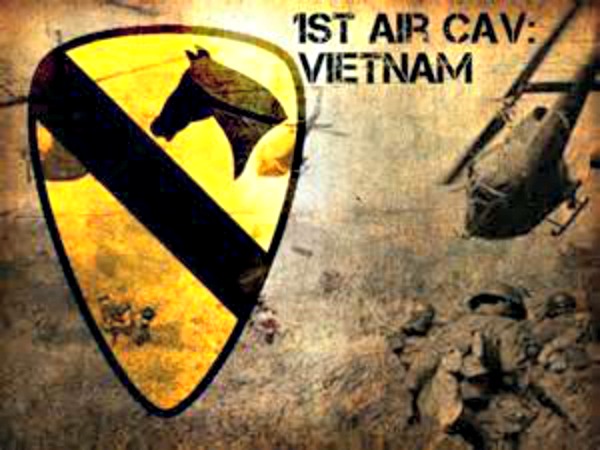




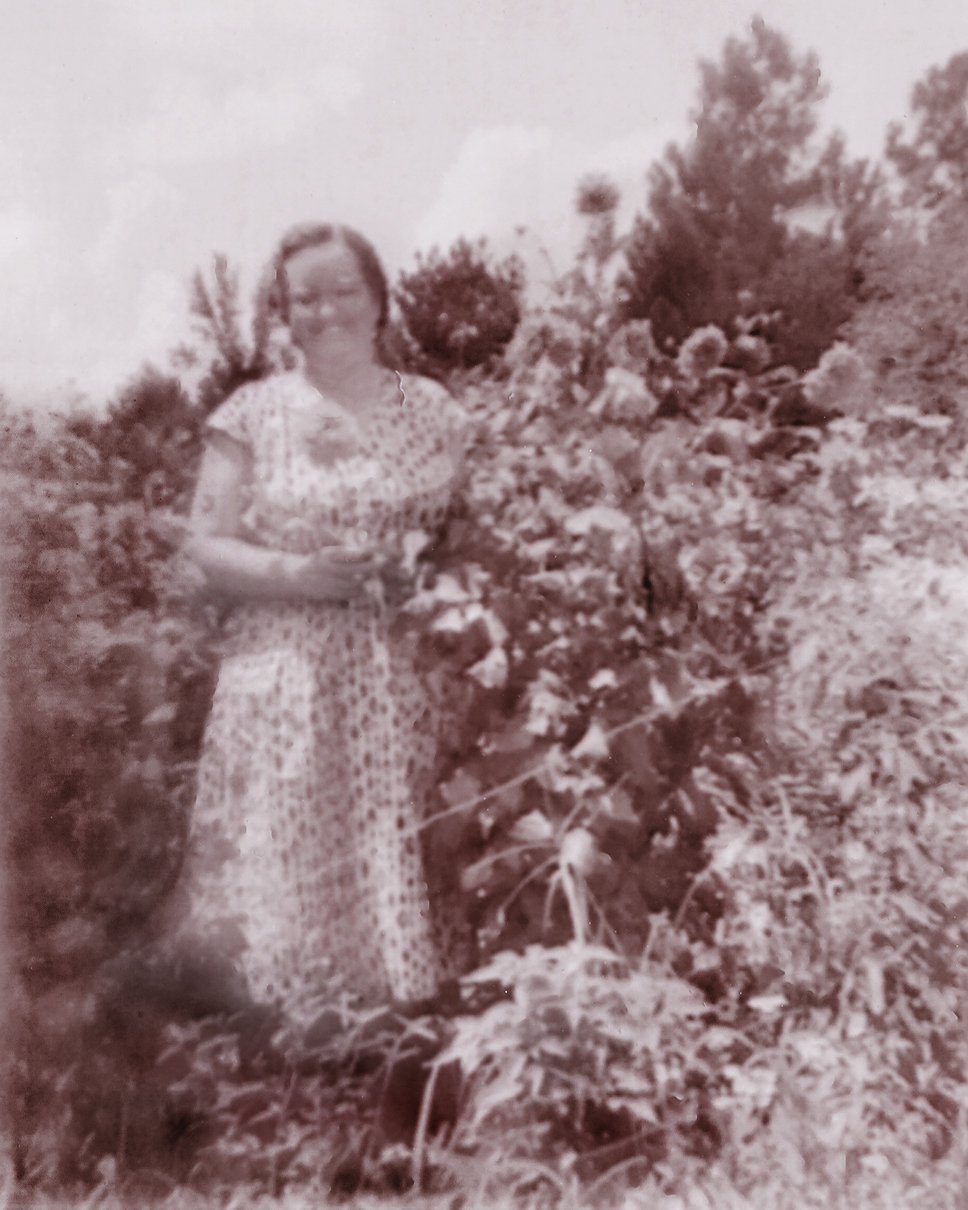
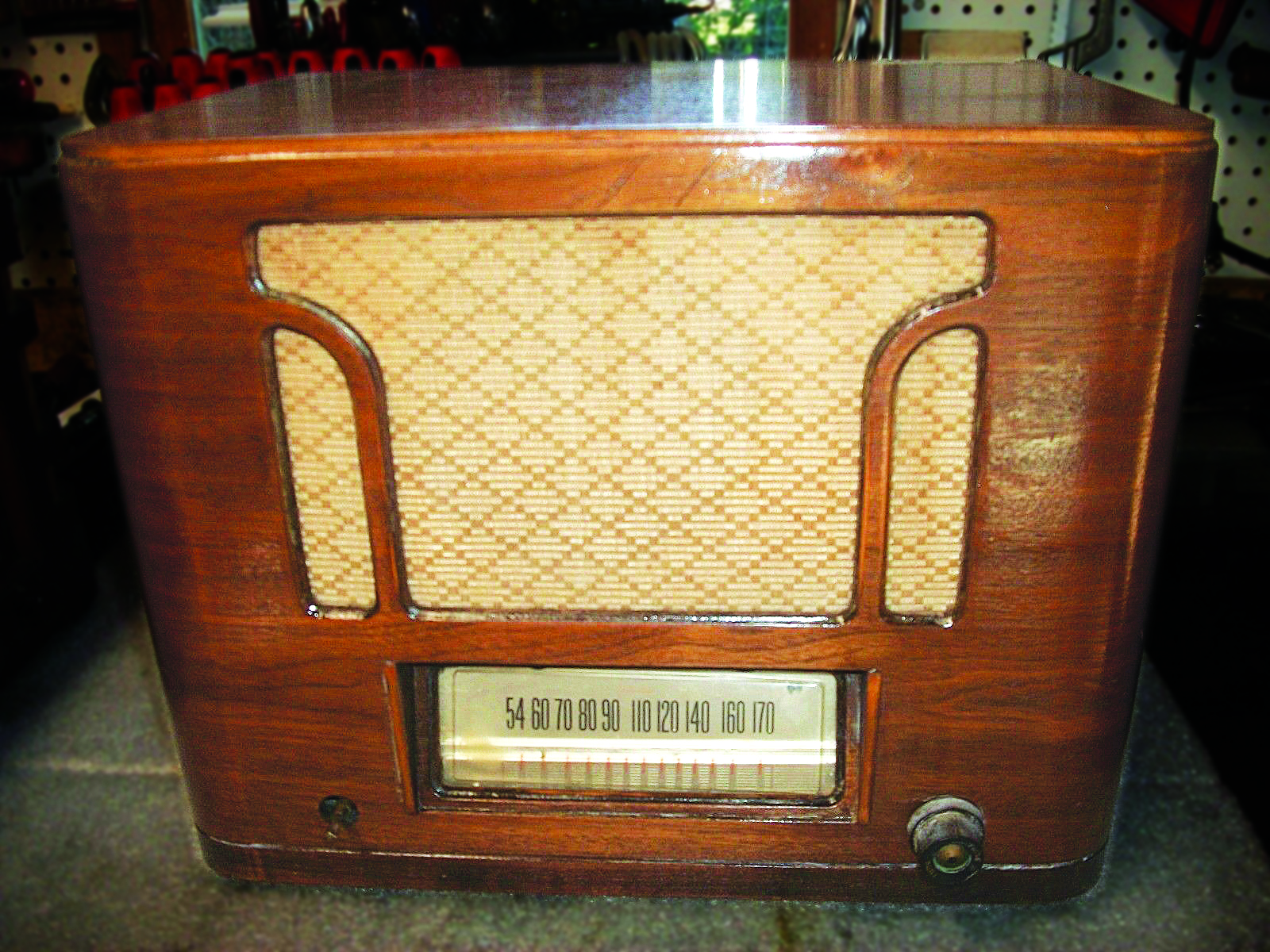
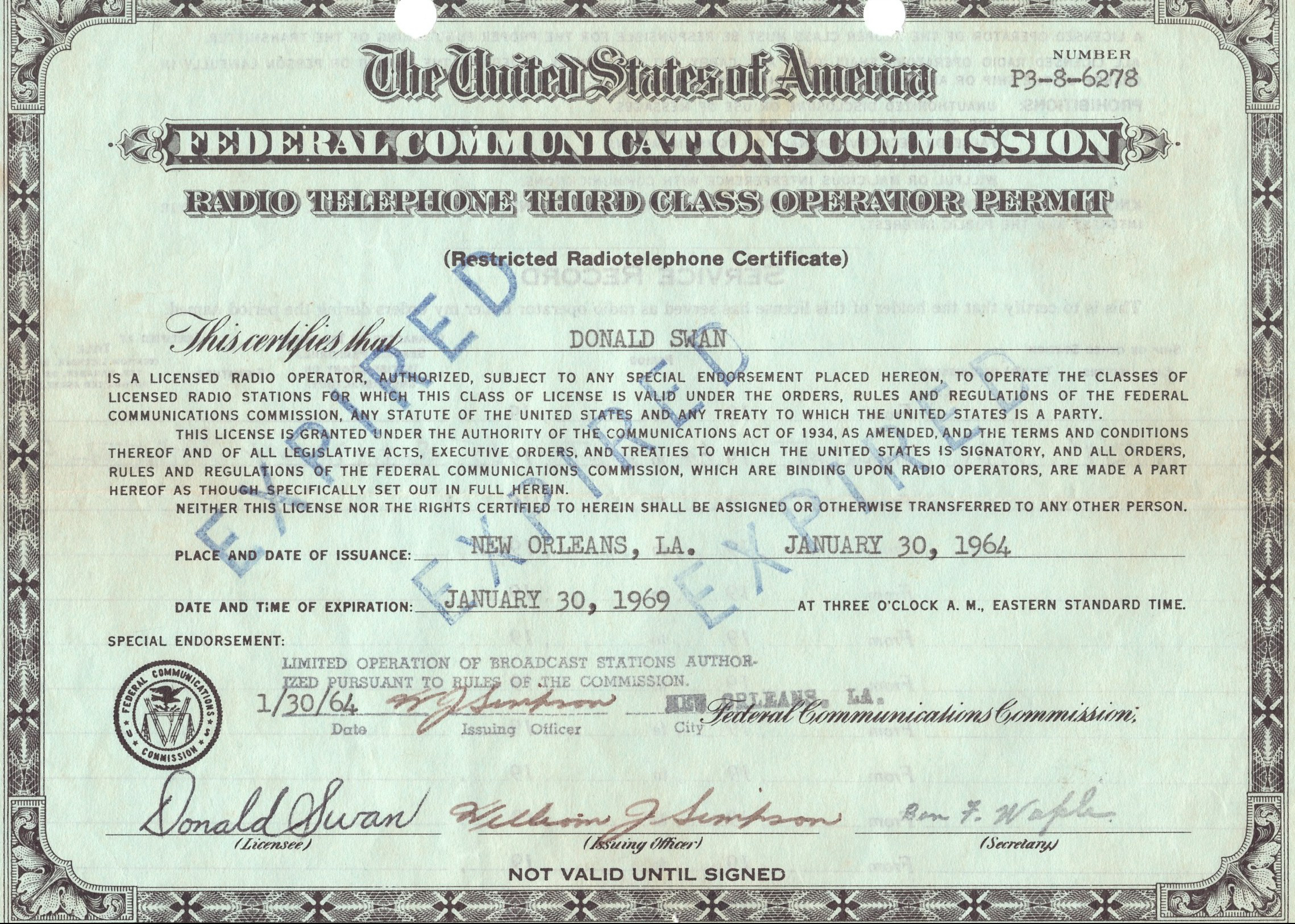


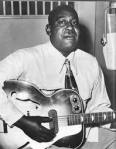


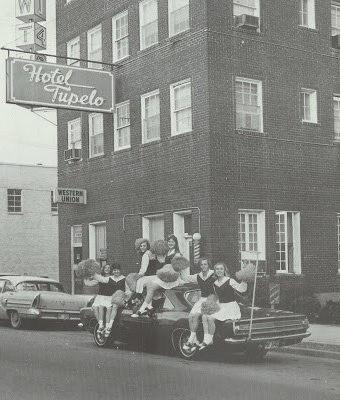
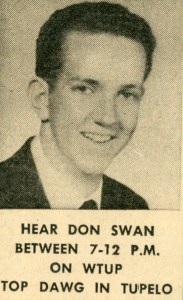
 Swan's Song Series
You must be logged in to post a comment.