Chapter 19: AFVN, An Khe /1333

“I am not going to lose Vietnam. I am not going to be the president who saw Southeast Asia go the way China went.”  Newly inaugurated President Lyndon Johnson, November 24, 1963.

It had to be over 100, with humidity to match, an oven with no turn-off knob upon my return to Bong Son. My butt was chafing, my shrapnel wounds were stinging, and my ingrown toenails were punishing me with a burning sensation, more painful with each step.

And it was about to get worse with an unexpected ass-chewing, shocking since I was naively expecting a welcome back. Good thing I didn’t waste time worrying about someone patting me on my back (where my shrapnel wounds were).

“I don’t know what kind of shit you pulled in An Khe, but I’m still your boss when you’re out here. Did you get the interview?” Lt. Blankenship greeted me upon my return to Bong Son.

“Yes, but my tape recorder was KIA, sir, though I may have saved somebody’s life,” I answered. He countered, “Yeah, yeah, OK, so you didn’t get the story, and you destroyed government property. Is that about right, Swan?” I didn’t answer.

“Alright, get outta here and get back to work and be sure to take care of your wounds,” he snapped sarcastically.*

After I reported on the Ambush, I noticed that Lt. Blankenship was treating me differently and not in a good way. I could not fathom why. Now it was getting worse (like the condensing greeting above). Understandably, my morale was low.

Little did I know that someone would come to my aid during this challenging period. I would find it none other than the two-star General who happened to command the 1st Cavalry.

I had the occasion to interact with Maj. Gen. John Norton, not long after, my lieutenant had dressed me down. He was giving his last interview as commanding General with a reporter, where I was present, hosting the newsman.

He remembered me from the field where he presented the Silver Star to Hagemeister the morning after the Ambush (Chapter 17) when I interviewed him. The General seemed sincere when he asked me how everything was going. I stuttered in my response, saying nothing specific. I believed he sensed something was amiss.

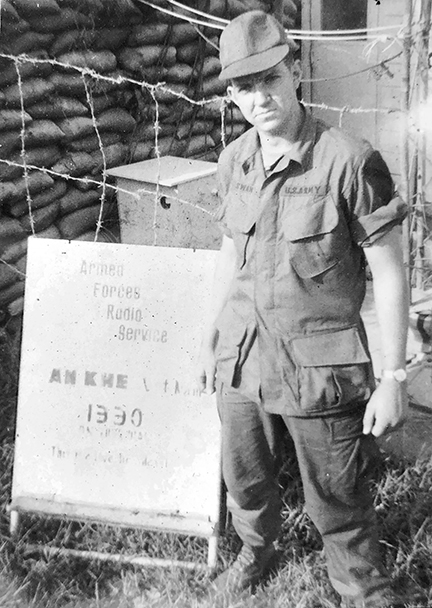
Don in front of sign
No shock Jock: Spc. 4 Don Swan, standing in front of the barricaded studio of AFVN AM & FM, An Khe in 1967. (U. S. Army PIO photo)

I suspect the General had an aide call Major Witters, head of PIO, and ask to speak with him presently or for an immediate return call. The difference in rank from a major to a major general is considerable. The General probably suggested I get a break from the field.

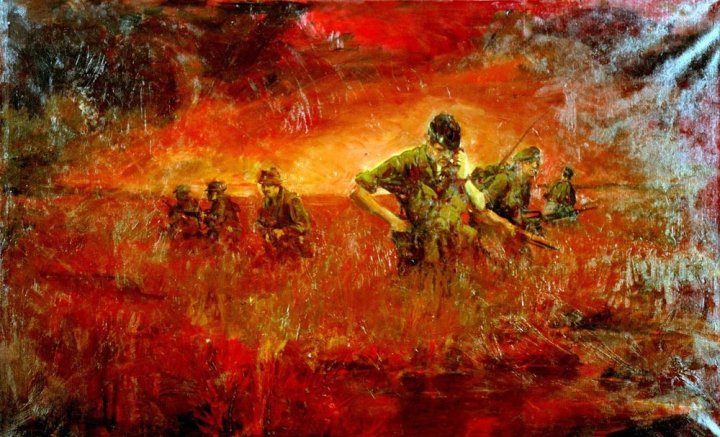
I thrived at AFVN, An Khe. I dedicated songs to chopper pilots, artillery, engineers, infantry, and men like the ones I had met in the field. The soldiers who were doing the real work.

Of course, men who were in the shit would not be listening to AFVN. But in the field, somehow, the troopers found a way to listen to the hits emanating from An Khe.

There were reports from GIs in the field; their transistor radio was second only to their M-16, and music was like the comfort of a pet. Chopper and other pilots picked up my broadcasts on their FM frequencies.

It was good for morale; songs they had listened to with their wives and sweethearts, like (You’re) My Soul and Inspiration by the Righteous Brothers, When A Man Loves a Woman by Percy Sledge, and Cherish by the Association. But, most importantly, they were reminded of what awaited them back in the “World.”

Occasionally, I got fan mail from women who lived in nearby villages. One, in particular, asked me to play songs for GIs she’d met, I can only surmise, while they were in the village of An Khe, aka Sin City (probably when they were picking up their laundry).

I didn’t dedicate the personal — “From Kim to Larsen and Knelly”— but I did play the songs she requested, doing my part for “Winning the hearts and minds of the people.”

There were no Arbitron ratings in the combat zone. But among the 25,000 or so GIs who had access to my show, it was estimated (tongue in cheek) that I had almost as many listeners as Hanoi Hannah.

About the over-hyped “Good Morning Vietnam” thing made famous in a movie of the same name by the late Robin Williams, most GIs detested the “greeting.” In some rare cases, grunts after hearing “Goooooo-o-o-o-o-od Morning Vietnam” one too many times, promptly shut down their radios courtesy of their M-16s.

Obviously, these men found no “Good” in their morning and didn’t need some smug DJ sitting in the comfort of an air-conditioned studio in Saigon telling them it was.

There was no Good Morning in Vietnam despite the movie that portrayed Vietnam as a place to be romanticized, in my opinion, and a soundtrack that included What A Wonderful World!”

As for our little station in An Khe, my only real friend in Vietnam, John Bagwell (1st Cav PIO), was enthusiastic about our operation and did many things to improve it. He talked Seattle’s KJR rock station into sending us current hit records and some oldies.

And unbelievably, by just writing a few letters, he convinced a popular production company (in the U.S.) to record professional jingles for 1330 AM & FM AFVN, An Khe (valued at $2,000 in 1967 money).

Bagwell was a genuine radio guy who did a lot for our station and made our operations better for the troops we served. Late in his tour, he saved a cameraman’s life while working with an NBC reporter he was hosting near Khe Sanh. Bagwell almost lost a foot in the engagement and nearly became a POW.

Bagwell received the Bronze Star for Valor and Purple Heart.

“John, I will never forget you and the good you did in Vietnam. You never got the credit you deserved for your deeds in An Khe and other efforts.

I hardly made any friends because I traveled so much, but with so few, thank goodness, I had a friend in you.”***

Go figure, on 5 Feb 1968, the only real friend I had In-Country was almost captured and nearly killed. (A priest helped hide him in his church, separate from his weapon.)

But the bad news gets worse, on that February day: Six of his PIO comrades were captured from the Hue AFVN facilities. Steve Stroub, a recent colleague, an An Khe DJ, was executed by the NVA shortly after he was taken prisoner. Two more soldiers were killed during the attack on the AFVN studios. And the remaining five PIO members that were captured at Hue became POWs and spent five years in captivity!

When a fellow vet notices my Cav patch. I’m immediately asked what unit I was with. When I reply 15th Administrative Company. It doesn’t sound nearly as impressive as the 2/7 Seventh Cav. They are apt to think I was a REMF (Rear Echelon Mother F–ker). I ask them to read my book.

I was proud to be recognized for my efforts at PIO and AFVN, An Khe. Here’s a clipping that ran in the 1st Cav’s official newspaper in 1967, The Cavalier.

Don newspaper article
Note my British Mk V .455 sidearm and skull (representing Guns-a-Go-Go) on the soldier’s pocket (Right). Dustoff attempts a landing similar to the one at “Saved by Stream” near Bong Son (U.S. Army PIO)

Incidentally, the same Mike Larson who pinned the above has written Heroes, A Year in Vietnam With the 1st Cavalry Division. Published by and available from iUniverse.

Songs that stand out from my time as a DJ in Vietnam are Happy Together by The Turtles, Strawberry Fields Forever by the Beatles, 96 Tears by and The Mystreians, and naturally, We Gotta Get Out Of This Place by the Animals.

Although I had an easier job now (and no interference from Blankenship), I was anxious to get home to Marty. Unfortunately, I still had a long eight months

remaining. I used to pinch myself — yeah, I’m really in Vietnam.

*Unfortunately, some Officers and NCOs in Vietnam were quick to display condescending behavior toward low-ranking GIs like myself. In my experience, they were in the minority.

***Although I didn’t get to know many of the men — remembering what my 1st Sgt. said about not making too many friends — here are some who were with PIO, An Khe: Maj. Witters, Capt. Coleman and Master Sgt. Bradley. Others whose ranks I don’t remember are Larson, Grizzle, Knelly, Basile, Ferrel, McGrath, and Jim Pruitt. (Not sure of all spelling.) Many members of PIO went on to distinguished careers in journalism, including Donald Graham (before my time with the Information Office), who eventually became publisher of The Washington Post!


I don’t remember where I was on July 27, 1967, even though I would turn twenty in a few days. But many Sailors would remember where they were on that dat, andetheyy would never forget. One hundred and thirty-four gave their lives fighting the fire aboard the USS Forestal (aircraft carrier deployed near the coast of Vietnam). About 167 were horribly burned, with many experiencing a lifetime of pain.


Chapter 20: Short-Timer /1504

We do this escalating . . . U. S. military involvement in Vietnam . . . in order to slow down aggression . . . We will not be defeated. We will not grow tired. We will not withdraw either openly or under a cloak of a  meaningless agreement.” President Johnson, April 7, 1965.

On the subject of Vietnam, one can find an argument for just about anything.  But her beauty is not one of them. From tropical lowlands to densely forested highlands, the Annamite mountain range, the Mekong Delta, and the Coastal lowlands. Don’t forget the 12 great rivers and beautiful beaches on the 1,650 kilometers of coastline. Vietnam is beautiful indeed

I stand corrected; There is an argument. Some foot soldiers and Marines who weren’t used to seeing Vietnam from the air or treading the beaches disagreed.

All they remembered was dirt and mud, the jungle and rice paddies, squalid villages, ancient men and women, naked, dirty, hungry children. The bomb craters, barbed wire, sandbags, impenetrable jungles, soldiers burning shit, natives crapping in public, a lot of ugly things.

My purpose was not to enjoy her beauty or the ugliness of war, but to periodically go out with line units as a correspondent for AFVN An Khe radio news. 

There were deaths and injuries in battle on a few of my field assignments, like Combat Assaults and other skirmishes, where we rarely got a good look at the enemy. But there was nothing that compared to the Ambush on 20 March. (Chapter 17).

When I was in the field on assignment, I was realistically in the same danger as the grunts, except maybe the point man or RTO. I, too, was in the monsoons with mud sucking at my jungle boots and in the oppressive heat. I was there where insects, booby traps, ambushes, and snipers were plentiful. (See chapter 19).

The enemy didn’t know or care who I was, and I got hot, hungry, and scared, just like the foot soldiers. I had no advanced training in tactics or special weapons, and no buddy to keep an eye on me. I was most likely a distraction. Moreover, they didn’t know who I was, and if I’d met anyone, it was just briefly.

However, I was out with the infantry, aircrews, and other combat units maybe once or twice a month and for just a few days; I saw a tiny fraction of what they endured, lived with, and died with 24 hours every day for weeks, if not months, without respite from the rot of the jungle.

Disclaimer: My job as a combat correspondent was not even in the same universe as those in the line units.

Although I was assigned to AFVN in An Khe, I still had assignments such as recording Hometown News Interviews.

“This is Specialist 4 Don Swan near Bong Son, Vietnam, and today I’m talking with Sgt. John Gilliam of Columbia, South Carolina. John is a squad leader with A Company of the 1st Battalion, 9th Cavalry, 1st Cavalry Division (Airmobile). Sergeant, what do you have to say to the folks back home about the work you’re doing for the people of Vietnam?”

After a dozen or so interviews, they were packaged and sent to the Hometown News Center in Kansas City (where I would later be assigned) for distribution to the radio stations in the soldier’s hometown.

Although not my favorite job in Vietnam, it was a good program. Citizens of the community got to hear from a soldier, perhaps one they knew, serving in Vietnam. For family and friends, no doubt, it was good for their morale, maybe even a source of pride.

Occasionally, I also got plum assignments, such as Master of Ceremonies, at Bob Hope’s USO shows in Vietnam. I interviewed the icon after one of his shows for AFVN. It was to be a greeting from Mr. Hope for those unable to attend the show (almost everyone).

Unfortunately, I didn’t get that message across in the interview. I still remember the producer’s words: “You got nothing here [fit to air].” It was one of my most straightforward assignments in Vietnam, and I blew it.

December had finally arrived, and I was officially Short with just thirty-six days (and a wake-up). I began to believe I would actually make it home. But maybe I shouldn’t have been so optimistic after hearing the story of one man’s last night in Vietnam.

Tonight, he relaxed on his bunk, rereading the most recent letter from his wife and gently rubbing his index finger over a picture of the daughter he had never met.

He tried to stay cool and get comfortable with the feel of his OD boxers.**  His jungle fatigues had already been traded in for khakis. Ribbons — the medals he’d earned here — were precisely mounted, pinned above his left front pocket, and his unit patch hung further below. Those khakis were neatly folded and rested atop his tightly packed duffel bag — his shiny-black low quarters sat nearby.

Late that evening, he had shaved and showered, one less detail for tomorrow morning. AFVN was playing Strawberry Fields Forever. When the call came, he would be ready in an instant.

Looks to be NVA launching a 60-mm mortar. (Courtesy alabamava. org)

Soon after, he fell asleep, no doubt dreaming about the small family that awaited him.

He unnecessarily rehearsed his first moves, like kissing his wife while caressing the soft skin of his baby.

His mind most likely wandered to some of the worst times in the field, but somehow, he overrode that vision. Instead, he continued with the good dream that in a few hours, he would leave Vietnam forever.

On the same overcast evening, somewhere in the darkness, less than a mile outside the perimeter of the airstrip, a small team of NVA/VC was setting up a tripod and adjusting distance and direction. At 0200-hundred a 60-mm mortar burst from its tube with a noticeable ssss.

(Courtesy C. Lee & Pinterest)

He would still be returning, just not in the cheering section of the jet with those pretty, good-smelling, round-eyed female flight attendants. The Vietnam veteran would be going back to the States, his first stop Dover, Del.

He died in this stinking, godforsaken country with just a wake-up remaining!

Incredibly, like the man above, 1,448 servicemen died on their last scheduled day in Vietnam, and 997 were killed on their first day In-Country!

“We have reached an important point where the end begins to come into view  . . .  I am absolutely certain that whereas in 1965 the enemy was winning, today he is certainly losing.” General William Westmoreland, 21 November 1967.

It was an unseasonably cool 70 degrees under a high cloud ceiling when I boarded my 707 Freedom Bird out of Tan Son Nhut on 7 Jan 1968. Ecstatic passengers and a happy crew; all seats were filled with cheering GIs for the roughly 17-hour flight “Back to the World.”

A couple of hours before we were scheduled to touch down at SFO, in our country, the land we had fought for, dreamt of, and yearned for more than a year. The pilot told us not to expect “Thank You For Your Service” but to be prepared for a welcoming from organized protestors shouting insults at us.  

~

20

*Thankfully, the majority of my assignments did not include blood and battle.

**Most GIs who were in the field for extended periods wore no underwear.

Chapter 21: Back to the World; Home & Marriage​ /2977

I slept through the night, I got through to the dawn
I flipped a switch, and the light went on
I got out of bed, and I put some clothes on
It’s a pretty good day so far

I turned the tap, there was cold, there was hot
I put on my coat to go to the shop
I stepped outside, and I didn’t get shot
It’s a pretty good day so
far

I didn’t hear any sirens or explosions
No murders coming in form those heavy guns
No Army tanks, I didn’t see one
It’s a pretty good day so far

No snipers in windows, taking a peek
No people panic, running scared through the streets
I didn’t see any bodies without arms, legs, or feet
It’s a pretty good day

There was plasma bandages and electricity
Food, wood, and water, and the air was smoke-free
No camera crews from my TV

It was all such a strange sight to be home
Nobody was frightened, wounded, hungry, or cold
And the children seemed normal, they didn’t look old
It’s a prett
y good day so far

I walked through a park, you would not believe it
There in the park, there were a few trees left
And on some branches, there were a few leaves

I slept through the night, got through to the dawn
I flipped the switch, and the light went on
I wrote down my dream, I wrote this song
It’s a pretty good day so far

Loudon Wainwright Pretty Good Day lyrics © Spirit Music Group

I had made it back to the Promised Land. Finally, I was on United States soil!

Judy In Disguise (With Glasses) played as I rushed through the corridors at SFO for a commercial jet that would get me to Wilmington, North Carolina, as soon as possible. With the unpleasant reception I had just encountered here, I’m not sure I would have worn my uniform on the flight had it not been required to get the substantial military discount.

When I called Marty from the airport, she didn’t recognize my voice; she hadn’t heard it in more than a year.


Knowing the date and scheduled time of my arrival, Marty’s family and local citizens (remembering I’d worked in Wilmington less than two years ago) assembled a group of one hundred or more at the airport. There, they gave me a hero’s welcome. 


I awoke from that dream not long after I touched down. It was just Marty at the airport, and that was good enough for me; I could touch the girl I’d been dreaming of my entire time in Vietnam.

After more than a year apart, the girl who had waited for me was now standing in front of me. Even more beautiful than I had remembered. Marty was tall and thin, with sparkling blue-green eyes and short bleached-blond hair. And was in love with me. She was 18. I was 20.

We were wed the next afternoon, one day after my arrival. The ceremony would be held in a spare bedroom of the preacher’s house, who, in the eyes of God, was about to bind us in holy wedlock. There had been no bridal or wedding shower, no gifts of any kind, just advice. (Little did I know that Vietnam veterans suffered a divorce rate of more than 50%.)  But it wouldn’t have mattered to me at that time.

All of three people attended. Unfortunately, one was Marty’s aunt Hill, who kept squawking in her shaky, 98-year-old-sounding voice, “Don’t forget to pay the preacher.” Then, in my ear one minute later, “Don’t forget . . . .” To get her to shut up, I palmed him a five-dollar bill before the vows.

Marty was not in a formal gown, but radiant. She had a nice yellow-gold wedding band for me. I had the small silver-gold ring to match the engagement diamond she had already lost. She said it was swept up by the surf on the Atlantic coast while playing with her little niece.

We headed south out of North Carolina and began our mini-honeymoon with our first stop at the new Holiday Inn® in Myrtle Beach, South Carolina. (The city had ways to go before becoming the trendy tourist attraction it is today.) 

On the way to see my parents in Mississippi, we searched the airwaves for our songs now that we were together, not 9,304 miles apart. Hits like You’re My Soul and Inspiration, Happy Together, Wouldn’t it be Nice, and Dedicated to the One I Love.

After we rode through the rest of South Carolina, I sped up as we bypassed Augusta (Ft Gordon) and continued through Georgia. But we slowed in Alabama when we ran into an unexpected light dusting of snow in the little Mustang with well-worn tires.

No shower or wedding gifts in Mississippi, either, just advice. But we were given the use of Aunt Dara’s unoccupied house, sans indoor toilet. It was quite a way to make an impression on a new bride. But it was decent otherwise, and a free place to extend our honeymoon.


Seven days after leaving North Carolina, we had gone through Marty’s small amount and the $200 or so I had brought. For my one year in Vietnam (where my income was just over $3,000).

I spent money on my R & R, paying off Marty’s engagement ring, savings bond debit, a small allotment sent to my folks back home, and Marty.  Still, I managed to save $300.00, which the bank sent me before our cross-country trip continued.

We extended our honeymoon, enjoying the benefits of sleeping together as husband and wife and resting in cheap motels along the 1,958.3-mile route to California for my next assignment.

We’d already driven 900 miles from North Carolina in Marty’s Springtime Yellow 1967 Mustang GT®, with little room for all our worldly belongings, no A/C, threadbare tires, and a broken gas gauge (we ran out of gas somewhere in Oklahoma).

It was a nice car, but somehow, she had managed to get saddled with a monthly payment of $105 (over $900 in 2025 money). This was on a car costing just less than $3,000! About 30 payments remained. I’ll bet that was a lot of undercoating and zero down.

Angel Of The Morning, Young Girl played as we motored through Arkansas, Kind Of A Drag, Magic Carpet Ride rang out in Oklahoma, Green Tambourine, I Wonder What She’s Doing Tonight in Texas. Itchycoo Park, Bend Me-Shape Me, Spooky, in New Mexico and Arizona. And all the hits from January 1968 played as we searched for stations that were playing our songs on the long trip west.

Much of our travel West on I-40 ran parallel to Route 66 in many places. We went through cities like Tulsa, Amarillo, and Albuquerque and towns like Shamrock, Tucumcari, and Needles.  Our one tourist stop was just a 12-mile detour down old Route 66 to see the three-quarter-mile-wide Barringer meteor crater near Winslow, Arizona. Impressive.

Early in the evening, after three days of travel, we rolled into big LA. A spectacular sight, Los Angeles; by far more lights than Marty had ever seen and, indeed, as many as I’d seen in large cities like Saigon.

I’m surprised we found our way through the city, covering more than 4,000 square miles and incorporating some 80 municipalities. As soon as we hit city limits, now a passenger, I began celebrating with a 40oz can of cold Colt-45.™ We had to traverse most of LA to get to our destination, Marty frequently stopping at service station restrooms for me. Finally, had made it to San Pedro, near the Port of Los Angeles.

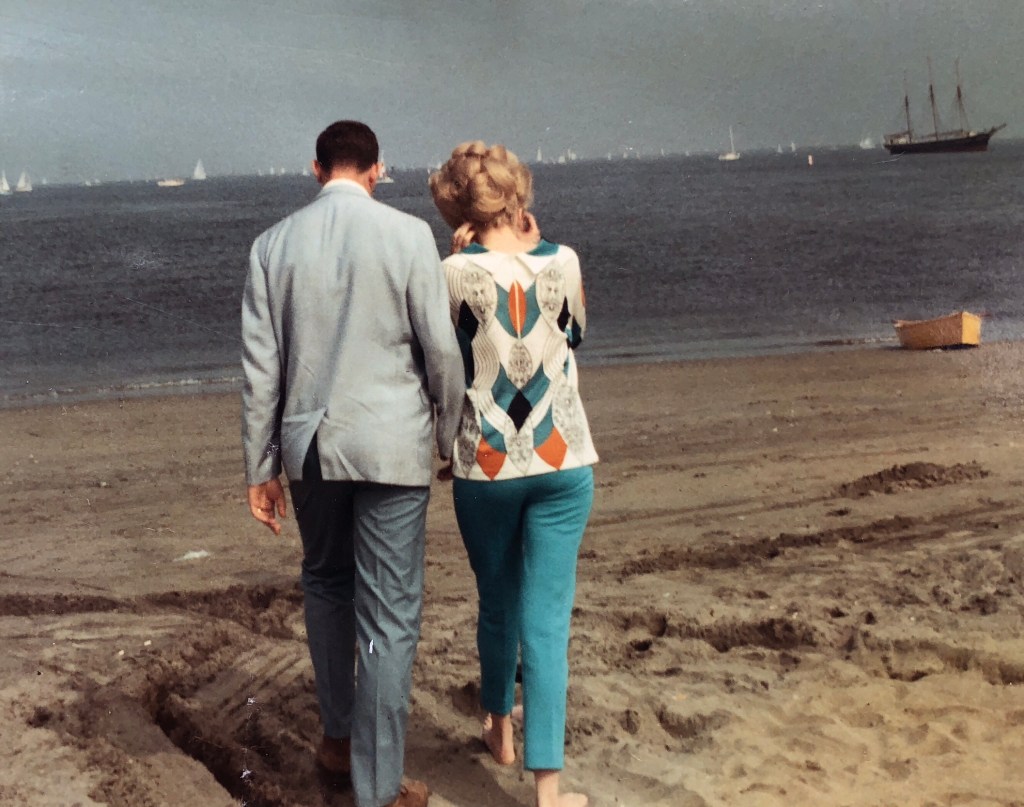
This image has an empty alt attribute; its file name is img_5104.jpg

Newlyweds, Don & Marty, at Cabrillo Beach, San Pedro, California, in early 1968. (Swan Archives)

We settled into a “furnished” one-bedroom apartment across the street from the hospital at Ft. McArthur. We bought new tires, California coverage for the Mustang, some Melmac® dinnerware, and a 23″ B&W Emerson® TV. It came in a wheeled cart.

After getting my travel pay, we decided to celebrate a bit. After all, we had made it across the country, and I from Vietnam. Not to forget — marriage. 

Peppy’s was a San Pedro restaurant with a reputation for excellent food. We had a great dinner there, including a good bottle of wine and dessert. The cost: $20, including the tip (about $186 in 2025 money).

There would be no more outings like that because, on day one, we were in trouble financially.  My base pay was $226.20 monthly, plus a $105 housing allowance. (Average income for civilians was around $750.) So, after rent, car payment, insurance, and so forth, we had just over $100 to subsist on for 30 days.

The $300.00 we left Mississippi with and the travel pay were almost gone. I procured toilet paper from work. We made love as Love Is Blue played on KHJ. An hour later, we agonized over money. And she wondered why I wore no underwear. I told her it was to save money before I told her the real reason. GIs in the field typically ditched their shorts (going commando) to prevent chafing.


At Ft. MacArthur, a few weeks after I reported for duty at the 37th Command Information Detachment, the officer in charge handed me a tattered parcel. He smiled and said, “They must have really liked you.”  Inside were a Purple Heart, Air Medal (both unexpected), and Army Commendation Medal. Maybe someone recommended me for those first two medals, knowing what happened with the Bronze Star below. (All are recorded in my DD 214.)

I was, of course, honored and also a bit disappointed. I’d heard from a friend in Vietnam that Lt. Blankenship, before his DEROS,* had told the sergeant responsible for enlisted awards, “No Bronze Star** for Swan.” I have no ill feelings for the man; Blankenship will self-destruct all by himself if he doesn’t get his insecurities under control.  But as for myself, I’m disappointed to have even shared this story. Why?

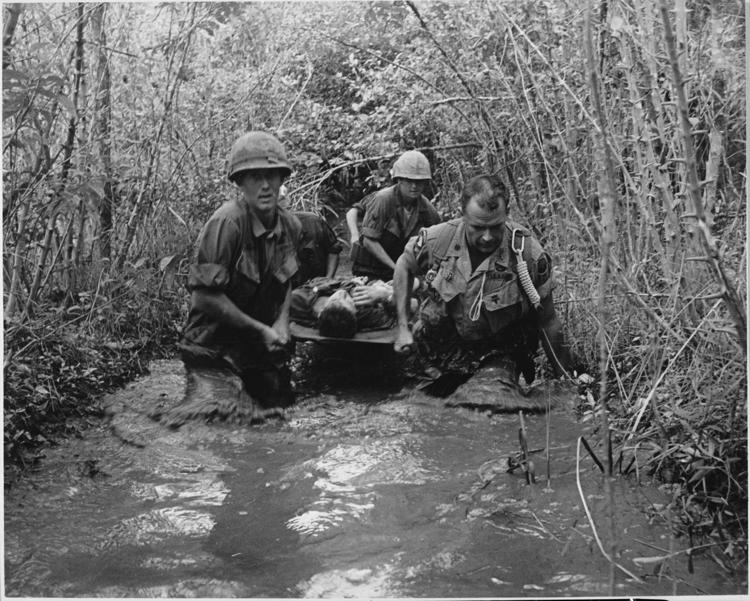
Soldiers who were doing the real work. (Paul Halverson, National Archives)
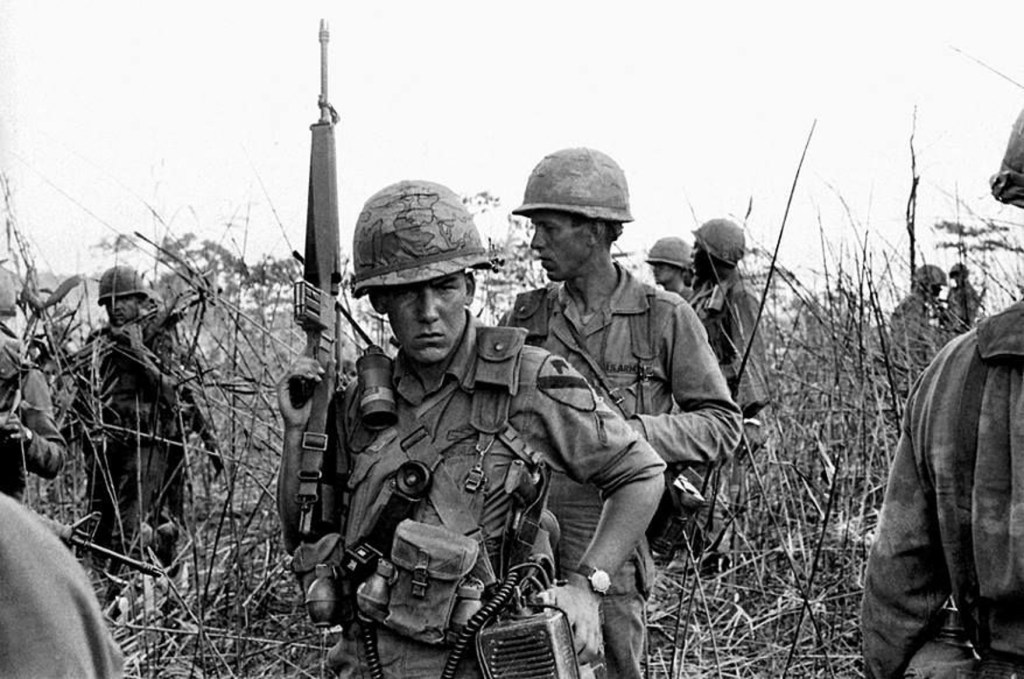
Soldier in sharp-bladed elephant grass, M-16 at high ready. (National archives)
Ground pounders in the muck, check out the load in his Rucksack. (MACV PIO)

(Below) Unidentified 1st Cav RTO M-16 is “checked up” while moving cautiously with members of his qsuad somewhere in Binh Dinh province in 1967. (US Army photo)

Under fire, a 1st Cav trooper slithers in a rice patty (fertilized with human waste), trying to keep his M-16 dry. (Henri Huet photo, from G. Jacobson post)

1st Cav trooprers srtrain to carry body of a dead comrade, 25 clicks north of Bong Son in 1966. (US Army Rick Merron)

Many of the soldiers who did the actual work — the men I honor above — didn’t get a medal recommendation at all.*** Most were sent home as E-4s, a rank lower than I achieved.

And I carp about not getting my Bronze Star!


A 1st Cavalry trooper stationed in Vietnam with the 7th Cav wrote about a common refrain used by many GIs, “Don’t mean Nothin’.”

We said it every miserable day of our miserable lives. It became our mantra. We said it in all kinds of situations for all sorts of reasons, and we said it a great deal, most often when we were miserable, which was pretty damn often . . . .  We said it when it rained, and when it didn’t rain and when it was really hot and when it was even hotter. ‘It Don’t Mean Nothin’ was said a lot.’

We said it to keep from crying, we said it when we stopped moving and when the bloodsucking insects attacked in swarms, and our faces swelled and our hands swelled, and our lips swelled, and our ears swelled and when we thought we were getting malaria, (Should we quit taking our pills?) and we thought about how good that would be because you got out of the boonies if you got malaria unless you died from it. Dying from malaria sucked . . . but the prospect of staying inside the wire, sleeping on a cot off the ground, under a dry tent at the hospital, with hot chow, clean sheets, and nobody shooting at you made the risk of a slow, agonizing death from a deadly tropical disease seemed totally worth it. How bad could it be? We were kids. What did we know?  ‘It don’t mean nothin.’

Something just don’t feel right. So shut up and saddle up Trooper. Your night on LP, your turn on point, but ‘It don’t mean nothin.’      Jack “Boz” Parente. (From Caviler,1st Cav newspaper, 1968)

*DEROS: Date Estimate for Return from Overseas.

** I was told I had been recommended for a Bronze Star just for actions in the field (chapters 17 & 18). Furthermore, most soldiers serving in a similar role to mine in PIO were awarded the Bronze Star, which is higher than the Army Commendation Medal I received.

***There were two medals (“Vietnam Service & Vietnam Campaign”) that were automatic for those who served in Vietnam, needing no recommendation. In addition to those medals, Infantry soldiers who spent the required time in the field as an Infantryman received the Combat Infantryman Badge, not an insignificant award.

~~

I had nightmares about Vietnam almost every night during our honeymoon and months after that.* And I had turned into a wimp, a side Marty had never seen, and a disposition I never had. One day, we were having a get-together with some of my buddies from the post; Marty was acting a little testy, and one of the guys turned toward her and said, “What’s the matter, you on the rag or something?” I laughed with them instead of telling him to knock it off and not to talk to my wife that way.

I was acting like a wuss (Marty called it cowardice), and she was very disappointed in me. It was a problem in our relationship. In a few years, I did an about-face, eventually to the point of wanting to rip off somebody’s face. (Marty called it backbone.)

Just back from Vietnam, I wasn’t trying to live high, but after the mess I’d been in over there, maybe dinner with drinks once in a while.

But that wasn’t to be. After the $20 outing when we first arrived in LA, the luxury of dinner and drinks was over. Der Wienerschnitzel™ once in a while, maybe.

By the 20th of most months, down to just a few dollars, we were looking for change in the sofa and between the car seats. One day, while leaving our apartment, I found a five-dollar bill lying flat on one of the steps. Nobody was around. With that five, I got three or four sacks of food from the commissary.

Then, a week or two later, I was on gate guard duty (graveyard shift) at a satellite location in Ft. Mac, (top side) primarily used for reserve training.

Listening to (Sittin’ On) The Dock Of the Bay on 93 KHJ. At about 0200, a carload of reservists, who had apparently taken advantage of being away from home, appeared at the gate.  I was about to motion them in when the driver palmed me a twenty-dollar bill.  I assume he thought I was overlooking a missed curfew or their possible intoxication, or both. My only orders were to determine that a vehicle and its occupants were authorized on the post.

Twenty dollars; that, for me, was a lot of money, especially when you’re broke. Did I feel guilty (no) or tell anyone? No. I splurged with a fifth of Canadian Club®. Marty got her hair done at a salon, and I still had money for groceries.

We had been in California for just a few months, and Marty kept saying she’d been out with girls again and “Everybody’s Pregnant.”

I had a lovely stay-at-home Mom and no baby.  Stay tuned.

We had work duty on Saturdays at Ft. MacArthur, though we were usually relieved at noon. We were also on constant alert because of the incendiary nature of 1968. Think of the assassinations of Martin Luther King Jr. and Bobby Kennedy, the Weathermen, the Black Panthers, Bobby Seale, Huey Newton, Eldridge Cleaver, SDS, and the Vietnam War protests; as is often said, “To name a few.”

There was a rotating on-call system for soldiers like me. Those living off base had to arrive at our assembly point within half an hour of notification. Even if not on ready alert, one could be called and told to stay in place for standby. The Army required you to be reachable at all times, unless on leave or pass; check in with the Command Post before going to a movie.

Not for those restrictions; I had a chance (after an audition) to be an on-air DJ covering two six-hour weekend graveyard shifts at the Number 1 Rock station in LA, 93 KHJ, and a $100 check for the weekend. With that gig, I’d have had a better chance of securing a prime-time slot — though still a long shot — in the highly competitive LA market, the third-largest in the U.S.**

I’d make it from AFVN An Khe to LA, just not to KHJ. It could have all ended right there.

*Still do sometimes.

**The LA market became the second-largest in 1984.

Chapter 22: Ft. MacArthur, Two Medals of Honor /1,371

Twelve months had passed, just a year, since the horrific ambush at Binh Dinh — 7,800 miles away from LA.

An hour of sunshine remained on this beautiful March afternoon in SoCal as I eased Marty’s springtime yellow Mustang GT off the post from another tedious day at Ft. MacArthur.  I took a right on S. Pacific Avenue and headed to our tiny apartment in San Pedro. Marty would have a Swansons® TV dinner and a Tom Collins ready. She would be bored and happy to see me.  Same here. I’d have something for her as well. We could catch the sunset at Cabrillo Beach another time. 

Life was pretty good.

But, after Vietnam, my expectations may have been a little high. Life would not be perfect, nor close to perfect. The ice cream I’d dreamed of for a year didn’t taste as good as I remembered. 

Although I intend to remain faithful to my promise to write honestly and give you the unvarnished version of how I was feeling, reacting, or coping at any given time. I believe I complained a bit too much in the previous chapter.

Rather than sniveling, I should have said: “I’m out of Vietnam, back in the World with no worry of being shot by a Kalashnikov, no booby traps — no incoming. I have no field expedition requirements, and despite my on-call status, I’ve not been apart from my pretty blond wife for more than 24 hours. And I sleep beside her warm body in a comfortable bed every night.”

SoCal is a Hip-Laid Back megalopolis, and we had already visited Disneyland. Ft. McArthur was a beautiful and historical post, named after one of our most famous generals. It was a great assignment.


I was working in the HQ building (at Ft. Mac) on the second floor in the Awards and Decoration section one day in April 1968.  I heard raised voices from downstairs, a slight commotion. Someone was yelling, “Where the f–k’s personnel?”

It was a young man in civilian clothes, a bit scruffy with an attitude, standing near the Sergeant Major’s office.  With no authority over someone he didn’t know to be in the military and not in uniform, the senior NCO was in no position to dress him down, but he was doing so anyway. The man had walked into the HQ of an active army post using profanity, after all; what gives?  He was looking for the personnel office to pick up his . . .


                     WAIT FOR IT  . . .

                    WAIT FOR IT . . .

. . . Medal of Honor!

We were astounded when we found it to be true. At least I was, the Senior NCO, a bit more, after chewing out a recipient of the military’s highest award for bravery. Uttering the F-bomb on Post, had the NCO known, might have been excused.

While the Sergeant Major stood with his mouth agape, I began chatting with the Vietnam veteran. He wanted no ceremony, no publicity. I asked him if he had considered staying in the Army, as the Medal Of Honor (MOH) would surely be a boon to his career. "F--k no, are you dinky dau?" he snapped, "I'm hanging drywall, making five dollars an hour."*

I considered telling him about President Truman, a combat veteran, who, upon presenting a soldier the Medal of Honor in the White House, remarked: “I’d rather have [earned] that medal than be President.”

Oh, well.  This superhero, presumably, returned to his apartment in Downey, tossed his MOH in a drawer, got up the next morning, and went to work — hanging more drywall.

On the subject of work, I wondered what plum assignment a warrant officer in our section had. He would come into the office early in the morning, looking sharp in his Class-A uniform, stay a few minutes, and be gone the rest of the day.

Then I found out. Our warrant officer was occupied with notifying the LA area next of kin (NOK) of those killed in Vietnam. When a family is informed, the military member must be at least equal in rank to the KIA. Most helicopter pilots in Vietnam were warrant officers.

Our soldier of that rank, outside of bloody combat, or Graves Registration in a combat zone, was fulfilling the worst duty in the military — ringing those doorbells. This dreadful detail would not only continue but also increase. The deadliest year for US troops in Vietnam was this year, 1968, and that included lots of helicopter pilots.

I can imagine him wheeling a big olive drab ’65 Ford Custom 500 staff car, without A/C or power steering, around the streets of LA.  The yellow three-inch tall lettering on the front doors read: “U.S. Army For Official Use Only.”

He was an excellent target for citizens, who occasionally gave him the finger. It may have come from those active in protest movements, or people who just hated the US Army for what it did to them or their families. 

With likely outdated paper maps, he crept slowly through neighborhoods looking for that address. Spotted by service member wives, daughters, sons, or parents, they pointlessly retreated to the back of their houses. They were trying to hide from their front doors, but listening still, for that knock and praying that it never came.

A team member notifying NOK told me a story about arriving at the home of a KIA and finding a 3-year-old boy running toward him, thinking he might be his dad. The excited child jumped into his arms, sat in his lap, and, through tears, begged him to “Go over there and bring back my Daddy.”

~~

Medal of Honor recipient Charles C. Hagemeiester, a medic with the 1st Cavalry Division (Airmobile) earned for actions during an ambush in Binh Dinh Province March 20, 1967. (U.S. Army photos)                                                                                                              

Charles C. Hagemeister  Aug 21, 1946 – May 19, 2021  


hagemeister_a


Back in the States, away from the war, I hasn't thought much about General Nortons declaration. That's until May 1968. I was out with four or five friends from the post. The TV was playing in the background, when the news came on.

I saw President Johnson at the White House place the Medal Of Honor around Hagemeister’s neck!  

This image has an empty alt attribute; its file name is images-18.jpeg

Imagine earning the most venerated medal for bravery in all the military — The Medal of Honor — in what was, for most, an atrocious and despicable war. That’s what we have here. But it’s not antithetical to Hate the War while also saluting and celebrating our Warrior.

I often think of that day in 1967, about Hagemeister, about the brave men who got no medal at all, and about those who gave it all. Now I live secluded near the ocean, counting my blessings every night in a comfortable bed. I’m no longer worried about taunts from my fellow citizens — like those at the airport the day I arrived from Vietnam — or incoming from the enemy we fought for so long, so long ago, so far away.

As for those who may have said, “People who served in Vietnam were Suckers.” I disagree. “No Thank you for your Service Suckers” lacks a speaker’s natural, sincere, and smooth delivery; it doesn’t flow well.

Instead, we should be saying to the “leaders” who sent us there: “The only dominoes that fell were on the 58 thousand plus souls sacrificed and the survivors, many of whom are still suffering.”

This concludes my In-Country chapters on Vietnam. However, it will be a source of reflection and discussion in the following chapters: How We Could Have Won In Vietnam & The 1st Team In Vietnam, and others.

~~

 *(about $45 in 2024 dollars.)

I stayed in the US Army for a few more years until I was diagnosed with Crohn’s disease. I had a particularly nasty case and endured several surgeries, one of which resulted in a colostomy. I squeezed every bit of my GI Bill and obtained an undergraduate and a Master’s from the University of Denver. In that city, I was a popular DJ, worked in Public Relations, and dated scores of beautiful women.

“And Men will not understand us . . . and the war will be forgotten.”  All Quiet On The Western Front.

(All fonts not purposely in Italics)

Could we have succeeded in using some of those tactics without provoking China or the Soviet Union? In this chapter, I will present my proposal how — without inciting those countries — we could have won and should have won in Vietnam.

I don’t feel it necessary to bloviate about the mountain of research I have conducted from scores of books, articles, and interviews. I also relied on my own Vietnam experience in reaching my verdict. 

(All fonts not purposely in Italics)

This endeavor was more difficult than I had imagined, yet it is not an academic treatise on How We Could Have Won in Vietnam. There is a plethora of scholarly research and even more books about turning points and other observations on the Vietnam War. My conclusion — outlined in this extended chapter — is specific and straightforward.

I will first present scenarios of strategic opportunities missed before Tet in the paragraphs that follows. Then, I will proffer specific battlefield conditions and circumstances during Tet that should have been a clarion call for a new strategy.

Tet: Both sides agreed to a truce for the most important Vietnamese holiday. The communists used the occasion for a series of surprise attacks on cities, towns, villages, hamlets, and U.S. installations throughout South Vietnam on Jan 30, 1968, and beyond. Considered a turning point in the Vietnam War, there were heavy fatalities on both sides, especially for the VC/NVA.

              STRATEGIC OPPORTUNITIES PRIOR TO TET (Jan 30, 1968)

1) As early as 1966, General William Westmoreland (Commander of  U.S. forces in Vietnam) drew up plans for a campaign where U. S. troops would cross the border into Laos. Westmoreland’s men would blunt enemy infiltration into South Vietnam and deny the North Vietnamese Army (NVA, also known as the People’s Army of Vietnam) usage of the Ho Chi Minh Trail. President Johnson rejected his request. (Archives. Gov.history/mil)

Ho Chi Minh Trail, undated. (Wiki Commons) 

2) In mid-1967, 5′ 0″ General Von Nguyen Giap (Commander of all communist forces) opposed an all-out offensive against American forces and cities in the South (Think: Khe Sanh, Tet, Hue, Easter Offensive). He believed such an invasion by the NVA into the South would spur the U.S. to attack just north of the DMZ, where his main contingent congregated.  

He thought it logical that Westmoreland would be “provoked to invade Laos to cut the Ho Chi Minh Trail,” the top-ranking NVA general reasoned. “[My] major concern is that the United States will expand the conflict beyond South Vietnam’s borders and that an American landing in North Vietnam might have disastrous consequences for the North Vietnamese regiment,” Giap rationalized.  (Vietnam Magazine, History Net.Com, Post-war NVA documents)

3) Hanoi needed to determine how the Americans would respond to a communist buildup and offensive. Giap decided to launch attacks near the DMZ. The U.S. response would help formulate and develop the offensive he was set to command. His battles along the DMZ (from March to August 1967) near Cam Lo, Khe Sanh, Con Thien, Camp Carroll, Quang Tri cit,; the Rockpil,e and Route 9 served as the test. The NVA soldiers incurred heavy losses.

But when the U.S. did not send troops across the DMZ or Laos, Hanoi believed the U.S. would continue to react only defensively. Now Giap felt his chances for a successful offensive were good, and his men would continue with their charge into the South.  (Post-war NVA documents and as reported in Vietnam Magazine and other sources)

NVA regulars with PPSh-41,a Russian-madeesubmachinee gun, during the Vietnam War. (Wikipedia)

4) Gen. Giap wanted to test America’s strategic intentions one final time before giving the green light for Tet.  He staged his buildup of forces at the juncture of Laos and North and South Vietnam. His offensive plans would continue if his corps-size presence did not trigger a U.S. invasion of North Vietnam or Laos. Since the closest US base to Laos and North Vietnam was Khe Sanh, his final test was to attack there. (Post-war NVA documents as reported in Tet, The Turning Point)

5)  On December 21, 1967, Giap’s division tangled with U.S. Marines near Khe Sanh. Westmoreland then ordered the Marines at Khe Sanh to scout assault routes for a possible Laos incursion and, on December 27, 1967, sent a Flash cable to Washington with an urgent request.

His proposal outlined, in detail, the need for a strike across the border to blunt enemy infiltration. A few days later, Westmoreland received another rejection from LBJ for the Laotian strike. (The Vietnam War Almanac, Interview with Maj. Gen. John Tolson and other sources.)

6) After the massive bombardment of the Marine Combat Base at Khe Sanh by the NVA on Jan. 21, 1968, the U.S. responded the same way it had during the past two years, according to Giap. The communist general was certain the U.S. would not counterattack outside the South Vietnamese borders.  

Hanoi’s ambition and overreach was Westmoreland’s opportunity to bury Giap’s divisions under a cascade of bombs and a cross-border strike the NVA were dreading. Westmoreland was never given the chance; Tet was on. (Post-war NVA documents reported on History Net.com)

7) The U.S. command did not know of Giap’s specific intentions, but U.S. intelligence knew of his presence just beyond the DMZ. And there were rumors of a major campaign (that became Tet). It was no secret in Westmoreland’s command.

Two weeks before the Jan 30, 1968 Tet strike, Westmoreland even asked Nguen Van Thieu , President of South Vietnam, to cancel leave (that most of his troops would be on) for the Tet holiday. Although Westmoreland was mostly rebuffed, Thieu recalled some of his troops a day early from their leave. One can understand the confusion and logistics of such a recall. (Vietnam Magazine, Vietnam: A History)

                 MISSED OPPORTUNITIES DURING TET:

1) General Earle Wheeler, Chairman of the Joint Chiefs of Staff, on Feb. 8, 1968, cabled an urgent message to Westmoreland in Vietnam.  Johnson was not prepared to accept defeat just yet, adding:  “If you need more troops, ask for them, we’ve entered a critical phase; request what you believe is required under the circumstances,”

Wheeler highlighted in the Top Secret communiqué.  “Capitalize on their casualties [in Tet] to materially shorten the war,” he relayed to Westmoreland.   Johnson had already contemplated calling up the reserves. The President, he said, was ready to pursue “A winning strategy.” The Tet battles had crippled the communists, as Westmoreland knew and Johnson had proclaimed. On Feb 28, 1968, Westmoreland sent his detailed proposal to Washington for 206,756 more troops. (The History Place™ and public domain.)

2) Now that we have the benefit of the Hanoi regime’s records, we know they were struggling after their losses during Tet; as many as 60,000 in the first month!  Our intelligence knew they were in peril. The Viet Cong (VC) especially could no longer fight as a cohesive force, and even the communists agreed their combat readiness was in “jeopardy.” Giap is reported to have said, “We were on our knees.”

NVA General Tran Van Tra said “We did not correctlyevaluatee the specific balance of forces between ourselves and the enemy; in part it was an illusion based on our subjective desires.” A captured communiqué said the following: “We failed to seize a number of primary objectives and to completely destroy mobile and defensive units of the enemy. We also failed to motivate the people to stage uprisings and break the enemy’s oppressive control.”

General Tran Van Tra, also said, “In all honesty, we didn’t achieve our main objective [in Tet] which was to spur uprising through the. As for making an impact in the United States, it has not been our intention, but it turned out to be fortunate result.” (Postwar NVA/Hanoi documents as reported in the Vietnam War Almanac andthe Public domain.)

3) On the Internet today, there are stories quoting Gen. Giap:  “You had us on the ropes [after Tet]. We knew it, we thought you knew it. But we were elated to notice your media was definitely helping us. They were causing more disruption in America than we could in the battlefields.”  I can’t verify the above quote with 100% accuracy. It does, however, coincide with conditions in the field andwith how the U.S. media were reporting on Tet.

The following quote, however, is not in question: “Do not fear the enemy, for they can only take your life. Fear the media far more, for they will destroy your honor,” Gen Giap said on more than one occasion. (Public domain, The Guardian.Com, Bookings.Com) 

4) For a brief moment after the Tet offensive began, Americans rallied around the flag in predictable patriotic fervor, with an upward spike in Support. A survey conducted around the time of Tet revealed 55 percent (of U.S.) wanted a tougher policy on Vietnam with stronger military operations. (New York Times) 

“Tet was a military disaster for the NVA but a political victory for them in the West,” New Yorker Magazine wrote in Feb. 1968. Even Walter Cronkite  before his famous denunciation of the war — reported on his Feb. 13, 1968, broadcast “First and simplest, the VC/NVA suffered a military defeat [in Tet]. Its missions proved suicidal.” The Washington Post and New York Times made similar assessments. The communist forces were not successful, and they admitted it.

Number 5) is continued several paragraphs below.

Well, we know what happened next.

(All fonts not purposely in Italics)

Jane Fonda in N. Vietnam at anti-aircraft site targeting U.S. planes. (Commons) >

President Johnson announces he will not seek another terand capitulates on Vietnam ,March 31, 1968. (Wiki Commons)

This image has an empty alt attribute; its file name is eyjidwnrzxqioijwawn0dxjlcy5jlxnwyw52awrlby5vcmcilcjrzxkioijgawxlc1wvzmmyxc8ymde4mdmyndiymdexnzawm19ozc5qcgcilcjlzgl0cyi6eyjyzxnpemuionsizml0ijoiy292zxiilcjozwlnahqiojyzmcwid2lkdggiojeym.webp

Cronkite’s broadcast Feb. 27,1968 (Commons)

Then came Cronkite’s broadcast of Feb. 27, 1968: many thought it was the death knell for LBJ’s war in Vietnam when he reported:

“To say that we are closer to victory today is to believe, in the face of the evidence, the optimists who have been wrong in the past. To suggest that we are on the edge of defeat is to yield to unreasonable pessimism. To say that we are mired in a stalemate seems to be the only realistic yet unsatisfactory conclusion. To suggest that we are on the edge of defeat is to yield to (sic) unreasonable.

“On the off chance that military and political analysis are right, we must test the enemy’s intentions in the next few months in case this is indeed his last big gasp before negotiations. In the next few weeks and months, we must test the enemy’s intentions. (Author’s note: isn’t this an opening for a surge?)  

“But it is increasingly clear to this reporter the only rational way out then will be to negotiate, not as victors, but. an honorable people and lived up to their pledge to defend democracy and did the best they could.” (CBS archives)


5 ) On March 23, 1968, Westmoreland learned LBJ would send only a fraction of the 206,756 men he had requested. Just 13,500 were approved. (An increase of approximately 2, 600 troop was redeployed in all of 1968. (Washington Post). On the same day, the Chicago Turbine ran at 72 point headline: WESTMORELAND RECALLED.” He would remain commander in Vietnam until June 1968. (Vietnam, A History and other sources)

6) Still in charge, Westmoreland saw an opportunity where he could “take advantage” of an enemy in peril that would not require Presidential approval. The U.S. Marines in the Battlele of Dai Do, April to May 3, 1968, were outnumbered 10 to 1, yet they cut off routes at the D,MZ terminating NVA infiltration of the NVA Division. The enemy suffered 1,568 killed. U.S. losses were 91. Two Marines earned Medals of Honor in the campaign. (the History Place, Vietnam Magazine) 

U.S. Marines from 2nd Battalion, 4th Regiment “Magnificence Bastards” charge with M-16s and LAW anti-tank weapons during the battle of Day Do, a decisive U.S. victory in early 1968. Note the camo othe n helmets of the two Marines at the right. (U.S. Marine Corps photo)

Map showing U. S. bases and villages near DMZ. Dai Do is west of Dong Ha (right center at highway 1) and about 11 kilometers south of the DMZ, where Marines won a decisive battle that thwarted infiltration of NVA crossing the DMZ, April 30–May 3, 1968. (Wiki Commons)


I have written the following speech; the speech LBJ should have given. It is my strategy on How We Could Have Won the War In Vietnam.

I have asked for this airtime tonight to make two major announcements. Firstly, I will not seek reelection as your president (pause to let that sink in). Secondly, I have initiated an all-out campaign of Surge and Strike to end and win the war in Vietnam before the end of my term in January.

To that end, I have called up the Reserves so that our military will not be spread too thin, and I have extended the tour of those serving in Vietnam indefinitely. Although winning this war will take more than the sheer size of our force, I have already approved an increase of 50,000 more combat troops. As I speak, several hundred are already in the air over the Pacific, headed to that war zone. Presently, more than 150 U. S. aircraft are carrying out offensive operations over North Vietnam.

My commanders will have at their disposal all the might of the U.S. arsenal, and I have ordered them to use all necessary force to end this conflict with a victory. I’m serious about winning, and win we will. I do not wish to expand this war beyond its present borders, but nothing is off the table in my determination to bring this war to an end — with a win.

The only way to stop the U. S. Surge and Strike Offensive — from the ground, air and sea — is for the communists to withdray all of its troops from South Vietnam, Laos, and Cambodia, and the immediate closure of the Ho Chi Minh trail. In addition, all our POWs must be immediately released unharmed and with full accountability. We will not give the enemy a chance to regroup during a ceasefirere until it is clear that our demands are being met.

Too much blood and treasure have been lost to give up now, and everyone agrees that this war has gone on far too long. And without having to worry about a reelection, I will devote all the time necessary to win this war for the United States and the people of South Vietnam. Initially, U.S. casualties are bound to rise, but the enemy will lose much more — the war. To the loved ones of our fighting men: My goal is to end this war before my term expires in January. In the unlikely event that our all-out effort falls short of my expectations, I will at once withdraw all our forces from Vietnam before my time as your president ends.

I will not answer any specific questions tonight about this campaign; I believe I have said everything. But, to reiterate, we will do what is necessary to end this war in our favor. Finally, I am convinced the majority of the American people want this war to end with a win, and I, along with our brave men in Vietnam, intend to do just that.  God bless our troops and the people of South Vietnam. God bless the USA.

The above speech that I wrote — the one LBJ should have given — is my strenuous but surmountable strategy for a U.S. victory in Vietnam.*

WHY THIS WOULD WORK

1) The Commander In Chief is now committed with all the might of the U.S. Military. He ordered his commanders — who have been itching for a chance — to execute a winning strategy. The General’s would now have the green light to expel the enemy from its sanctuaries, wherever they are. Any VC/NVA forces in a one-on-one battle — especially with the likes of the U.S. Marines, the 1st Air Cavalry, and our Navy and Air Force air assets — would be crushed.

2) I believe, as they say in my heart of hearts and with my head too if the commanders began prosecuting the war to win, — the men could tell. Morale would spike. Our troops would fight with a fury to get out of that stinking country and be home by Christmas as victors. Our allies, the ARVN (Army of the Republic of Vietnam), would surely fight alongside us with greater vigor. It would become obvious that the more we punished the communists, — the easier it would be eaiser for the RVN to defend themselves upon our departure.

3) The U.S. population, in general, might be more supportive of the war, knowing we were fighting for a quick resolution. Likewise, relatives at home should feel a little better, knowing their loved ones were fighting in a war that was winnable and soon to be over.

       WHAT ACTUALLY HAPPENED:

1) We let Tet, Khe Sanh, Hue, Walter Cronkite, and the anti-war movement defeat us. Well, LBJ did! Thanks, Walter. Thanks, Jane.

2) On March 31, 1968, LBJ announced on National TV that he was not seeking reelection; he also declared plans to: “Limit the war [in Vietnam],” and later to cease all bombing above the 17th Parallel and then announced withdrawal talks with Hanoi. (Brookings.com, Public domain sources) He capitulated and sent a message to the communists and the rest of the world: “I’m giving up, let the next President deal with it.” (Author’s percipience)

3) What was LBJ thinking? Let’s have a few mor ceasefireses to give the enemy time to regroup, and then [to save face], we’ll keep fighting on the communist’s terms. (Authors elucidation)  Let someone else deal with the mess I created?

4) In case you don’t remember how it ended, our fighting men soldiered on for five more years-plus while ridiculous rules of engagement hampered our troops and our pilots.

Many men in the field were also frustratet with the ARVN’s tepid motivation and questionable fighting against the communists. They were supposed to take charge of their war so U.S. troops could go home. Sagging morale was inevitable as the men marked time — just trying to stay alive.

Our soldiers realizing their fighting would not result in a victory. Even though offensive field operations in the last two years by U.S. troops were limited, men were still being castrated by landmines and losing limbs and lives.

5) After LBJ failed to take advantage of the opportunities, in late 1967 and early 1968, (and to reiterate) the war would drag on five more years-plus. Our POWs continued to suffer and more than 38,000 additional Americans were killed — and untold numbers of Vietnamese! Let that hang in the air for a moment.

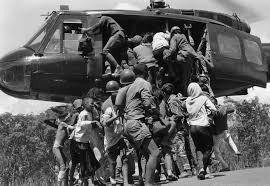
Refuges trying to flee Vietnam storm chopper at the last minute, April 29, 1975. (Wiki Commons)

“During the day on Monday, Washington time, the airport at Saigon came under persistent rocket as well as artillery fire and was effectively closed . . . . I . . . ordered the evacuation of all American personnel remaining in South Vietnam.” President Gerald Ford, April 29, 1975.

The next day, the communists took Saigon and renamed it Ho Chi Minh City. But not before two U.S. Marines assigned to the Embassy Guard were killed in a mortar attack on April 29, 1975, one day before the fall of Saigon.  They were the last U.S. servicemen to die in Vietnam proper; if that were not enough, their bodies were left behind and not returned to the U.S. until early 1976!   Charles McMahon had been in Vietnam for eleven days, and Darwin Judge had been there for less than two months. (The Last Men Out)

McMahon (left) age ,22 and Judge 19the , last In-Country fatalities of the Vietnam War. (Wiki Commons)

I am ending this chapter in memory of 58,220 U.S. souls who perished so far away, so long ago, for a people to be free.

“Painful as it is to remember — Least we forget.”  Donald Swan.

*Other Alternatives: 1) LBJ could have used his speech on March 31, 1968, to declare victory and begin the immediate withdrawal of our troops.

2) One might also make a case for withdrawal after the bloody battle of Ia Drang (the first major battle of the Vietnam War for the U. S November 1965). Although it was a clear victory for the U.S. it was also very costly. LBJ could have said something like: “We are not quitters, and as JFK said just three years ago, ‘We do these things not because they are easy, but because they are hard.’ ” 

However,  after careful consideration and consultation with both houses of Congress and my conscience, I have determined that the cost of this war is too high for a job the boys of South Vietnam should be doing for themselves. Therefore, I will immediately withdraw all our combat troops from Vietnam. The U. S. will continue to provide some support for the government of South Vietnam in its efforts to stop the spread of communism.”

3) The US could have used its Airpower more aggressively earlier in the conflict, before North Vietnam buildup its air defenses.  Cutting the Ho Chi Minh Trail. Mining the Hi Phong Harbor sooner.

4) Finally, LBJ could have declared that the Vietnam War was not winnable and begun a withdrawal any time he chose.

~~

Sources and Additional Reading:

Numerous books, articles, and documents were researched in the compilation of this chapter: Wikipedia; The History Place™; New York TimesWashington PostNew Yorker;USAA Today: Archives.gov; History-Army.mil; BBC.com; The Guardian.Com; Brookings.com; The Hidden History of America At War, Kenneth Davis R. Dee publisher; Vietnam War Almanac, Col Harry Summers Ballantine Books; A Bright Shining Lie, Neil Sheehan Random House Publishing; The Best And The Brightest, David Halberstam Random House; Vietnam, A History, Stanley Karnow Viking Press; After Tet, Ronald Spector Hatchet Press: The Hidden History Of The Vietnam War, John Prados Ivan R. Dee; Tet: The Turning Point, Don Oberdorfer De Capo Press; The Fallacy Of The Turning Point, Mark Bowden Atlantic Monthly Press; VietnamMagazine and public domain not requiring credit. My library has some 150 books, about US involvment and the war in Vietnam.

Author’s Note: Every effort is made to ensure that all my writing is 100% accurate. Any misstatements or errors are the fault of the author and are unintentionaldonaldswan@msn.com

About the Author: Swan is a decorated Vietnam veteran who served in the  US Army as a Combat Correspondent with the elite 1st Cavalry Division (Airmobile). He’s authored several feature articles about veterans and their combat experience. Swan holds a BA and MA degree from the University of Denver. He was a senoir Public Affairs Officer with the US Air Force, a Denver DJ, a Pro-Am race car driver and a single parent.“Bravest of Them All” is his first full-length book. He lives in Northern California with a View of the Pacific, with his wife and three canines.

Chapter 24: 1st Team in Vietnam /1210

eagle

As a well-known veteran and writer, I sometimes get questions from my community and beyond about my time in Vietnam. People want to know my take on the war, how well we executed our mission, motivation, etc.

During my

time there, I observed soldiers who saw purpose in their mission and were thankful for a job that took precedence over spit-and-polish.  No matter where, soldiers bitch and moan (especially lower enlisted) at just being in uniform.

I was In-Country Jan. 67 to Jan. 68, and I can speak assuredly about my unit: 1st Cavalry Division. (Had I been serving,

say, in 1970, or with a different unit, I might have a different attitude toward the war.) Although my tour in Vietnam was no easy ride, I was honored to have served, especially as a member of The First Team. 

You will remember, from previous chapters, that I traveled extensively while in the 1st Cav and was on the ground with the troops during several operations. I had practically unfettered access from the PFC to the CG (Commanding General) and to classified information. I believe that — as an unassuming, ordinary soldier — I was more likely to get my subjects to speak freely and give me unfiltered responses.

When I share my opinions and observations, you can trust that I am in a position to do so.

The overwhelming majority of the several hundred soldiers I met, from cooks to colonels, were highly motivated and serious about our mission in Vietnam. With the infantry stuck in the field, sometimes for months, and often

with poor supply support, especially for fresh uniforms, that percentage dropped considerably.

The infantry soldier’s morale was not the highest, especially when they returned to the rear for a few days’ rest and instead were assigned menial details.

However, while these soldiers were bitching about the awful conditions in the field, they were fighting with tenacity and for each other. And many times, soldiers wanted to remain with their men. Some who were lucky enough to get a job in the rear volunteered to return to the field to be with their buddies.

When I was on the ground in 1967, we, the 1st Cavalry Division (Airmobile), with its 16,000 Skytroopers, 434 choppers, Infantry, Artillery, Engineers, Scouts, Airborne, Rangers, Reconnaissance, and other specially trained troopers, were a motivated and lethal fighting force. We were The First Team, gung-ho and kicking ass.* There was a bounty on our men; the VC/NVA offered a monetary reward for the capture of a 1st Air Cavalry combat soldier!

How confident were we about the job we were doing, and what it meant? A group of us used to talk about how someday we would be relaxing in a condo on the beautiful beaches of the South China Sea — subsidized by the grateful people of South Vietnam — because we saved them from communism. Many thought, “Someday we will triumph, and this will be a better land for our coming.” But in the ensuing years, as the war dragged on, the troops in the field realized what was going on.

Nevertheless, we honor our troops.

images-6
All Crests, Patches, and Artwork from Swan Archives. (Cheri Swan Photos)

 Below is a tribute to Combat & Support Units of the fighting 1st Cavalry in Vietnam, The First Team:

1st Battalion, 5th Cav Black Knights.  The CG’s ready strike force. The Cav Commander lauded these men, saying their Cambodia campaign was one of the Cav’s most impressive operations. In addition, 1st/5th operated in Binh Dinh Province and participated in the Pleiku and several other campaigns. I was in the field with this unit when a medic from A Company, 1st/5th, whose actions were so heroic that he received the Medal of Honor.

Unknown

2nd Battalion, 5th Cav. Ironhorse. Relief at Ia Drang, fighting in Khe Sanh, Bong Son, A Shau Valley, and DMZ. I spent time in the field with this unit.

     Fifth Cav. Fatalities: about 800 men.           

6 Medals of Honor earned.**

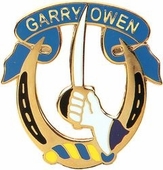
1st Battalion, 7th Cav.  Garry Owen. The bloody battle of  Ia Drang Valley, one of the primary units featured in the book and movie We Were Soldiers Once . . . and Young. Sixteen campaigns, including fighting at Hue.

2nd Battalion, 7th Cav Garry Owen, Battle

of Ia Drang, Masher, White Wing, Khe Sanh, and Cambodia. It was the first unit in the Cav to engage in combat operations. I spent time with those men.

7th-cavalry-regiment-pin-5
images-5

5th Battalion, 7th Cav, Garry Owen. Arrived a year after other units of the 1st Cav. Air assaults in Binh Dinh Province, Operation Pershing, Thayer II, and the decisive battle at Hue.

Seventh Cav had about 1,000 fatalities, more than any Cav unit.       7 Medals of Honor earned, most in the entire 1st Cav.

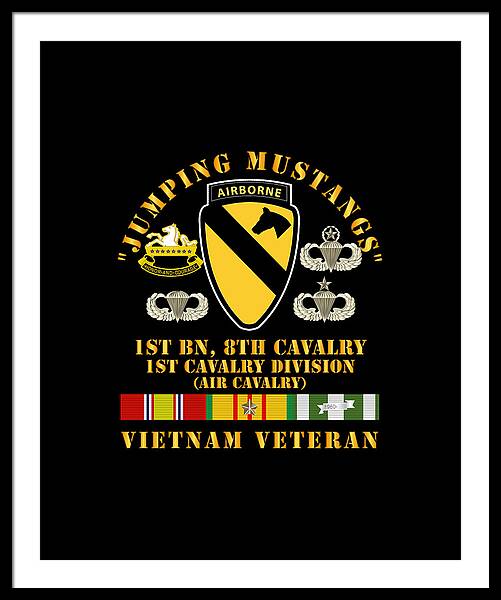
1st Battalion (Airborne) 8th Cav.  Jumping Mustangs. Straight to Bong Son, Operation Irvin, Crazy Horse, Navy-Cavalry ops. I spent time with this unit.


2nd Battalion (Airborne) 8th Cav. Stallions. Peli Me Campaign, Cambodia, and others.

Eighth Cav fatalities are almost 700.

5  Medals of Honor earned.

1st Squadron, 9th Cav. Headhunters. Known as the Cav of the Cav.  Reconnaissance Scouts is one of the most active units in the Division. Numerous campaigns, including those in

Cambodia. Rangers and Long Range Recon. Patrols (LRRP) attached. I spent time with this unit and flew with them on combat air assaults. First to adopt the black Stenson as special headgear for elite Cavalry fliers.

Ninth Cav. Loses about 550.  4  Medals of Honor earned.

dsc08000-987x988

mf7rmaxnoo5uzdbpkki9lba

1st Battalion (Airborne) 12th Cav. Always Ready. Operation Lincoln, LZ Bird, and several others. Made one of the largest assaults in Vietnam, I spent time with them. Believed to be the first troopers to make a combat assault.

12cr_dui

2nd Battalion, 12th Cav. Thunder Horse. An Khe Defense, Masher, Bong Son, Tet, decisive battle at Hue, and other campaigns.

Twelfth Cav loses almost 750.    6 Medals of Honor earned.

227th Assault Helicopter Battalion, SpearheadBattle of Ia Drang,  Laos,  numerous campaigns.  

Nearly 700 fatalities.  1 Medal of Honor earned.

patch
228

1st_avn
 228th Support Helicopter Battalion, Deployed ACH-47 Guns-A-Go-Go in campaigns. About 170 Fatalities.
Dscn3491


229th Assault Helicopter Battalion, Winged Assault. Battle of Ia Drang, Laos, numerous campaigns, and spent time with this unit.      About 600 fatalities.   2 Medals of Honor earned

s-l640

15th Medical Battalion, “Angels of Mercy.”    About 35 Fatalities.    

557dab2d911bb84efede49b6a28e17b4
Division Artillery, 2nd/20th ARA Blue Max. About 60 Fatalities. All artillery units suffered about 200 Fatalities.


09444a7159808fa3c595faaeee9fd668
11th Aviation Co. About 100 Fatalities.


48f24b83e163188701deadc1c958a7f9-1
13th Signal Battalion. About 16 Fatalities.


Although far from a player in any direct combat role, my own unit of record, 15th Administration Company, with finance, supply, casualty, legal, and the like, suffered 10 Fatalities, including 3 from our fifteen-member PIO. (Over a period of sixty-six months.) 

The 1st Air Cavalry fought in all 4 four Corps Tactical Zones in Vietnam, including Laos and Cambodia.

For their bravery in battle, several units of the 1st Cav were awarded the prestigious Presidential Unit Citation more than once and scores of other awards. 

eagle

 Skytroopers of the 1st Cav earned more Medals of Honor by far — 31 (25 Posthumously)! — than any other division in Vietnam.

My Little Town

Had the town where I was born lost as many souls as did the 1st Cav in Vietnam, it would no longer exist. The 5,621 killed in the 1st Cav would more than wipe out the entire population of Amory, Miss, at the time of my birth.  

                         Each soul a sacrifice 5,621 times over. 

A salute to all who served, especially those who can never return it.

1st Cavalry Division (Airmobile) Vietnam 1965-1971 (5 yrs & 6 mo.)   

The First Team. Indeed.

*This is not meant to glorify War.  It is not pretty; people die, including our own, of course. Had I been serving, say, in 1970 or with another unit? My take on the Vietnam War would most likely be different and not in a positive way.

**Sources for Fatalities and Medals of Honor: 1st Calvary Division Assoc. Book Of Honor. The listing may not include every single unit of the 1st Cav nor all of its attached support contingents. Includes the Ist Cav Troopers who served in VN and were awarded MOHs in later years.

If you’re reading just the Vietnam portion of this book, scroll to Chapter 45.


Chapter 25: Twins & Trouble /1,328

What’s a young married couple, just starting their lives together, struggling financially, and repeatedly arguing to do? Have a baby, of course.

I was awakened by our alarm clock radio playing Honey by Bobby Goldsboro. happened to be Marty’s favorite song. I quietly eased out of bed and was in the bathroom shaving when Marty pounded on the door.

Her morning sickness had begun. There was no time to comfort or contemplate. I had to make the formation at Ft. MacArthur in half an hour.  I left her in our 400 sq. ft. apartment, throwing up. Marty was 19 and away from home for the first time, 2,623 miles apart to be exact.


It was July ’68, and I had less than a year remaining on my enlistment. That was too short for another tour in Vietnam, but, hopefully, enough time left to see Marty through a complicated pregnancy. No civilian doctors were apt to treat her at this stage, and besides, we had no health insurance once my enlistment ended.

Essentially broke and worried about Marty’s pregnancy, I did what a year ago was unthinkable — subjecting myself to another tour in Vietnam — reenlisting in the US Army for three more years! The good news was a reenlistment bonus of about $1,800 (over $16k in 2024 dollars) and continued prenatal care.

My peers on the post thought I was a total idiot, called me a lifer (pejorative term), and ridiculed me even after our top Sergeant told them to knock it off.  “Swan, I never saw you as being that stupid,” was one of the milder comments. But none had a wife pregnant with twins!

We made arrangements with the company that financed Marty’s Mustang for an uncontested repossession. Then, with some of the reenlistment money, we bought a slightly used pale blue ’68 Chevy Impala, 4-door.


November 28, 1968, Thanksgiving Day. Twelve hours of hard labor, seven minutes between baby one: Lisa (pseudonym), 6 lb 8 oz., and the breech birth of baby two: Laura (pseudonym), 7 lb 9 oz. Fraternal twin girls — squalling and screaming.  Luckily for me, fathers-to-be weren’t allowed in the birthing room. Marty was in no mood for visitors, especially me.

Family leave hadn’t been invented in 1968, so I took all the regular leave I had to assist in round-the-clock duty for the twins. Lisa and Laura overwhelmed Marty and me. With two babies, it was always somebody’s turn.

Imagine young first-time parents with twins waking up at different times during the night, whimpering and wailing. For the first few months, we got little sleep. We did not have the convenience of disposable diapers, and there were no relatives within two thousand miles. Neither of us got a break from the twins, not even a half-hour.

Now I had a lovely stay at home, miserable mom.


Not long after the twins were born, I got a Permanent Change of Station (PCS) notice, thankfully not for Vietnam. We were leaving hip SoCal for the Sacramento Army Depot. We packed all of our worldly belongings in the 327cid Impala, traveling for the first time as a family of four.

We mainly listened to 93 KHJ on the way, hearing songs like Do You Know The Way To San Jose by Dionne Warwick. No, we’re headed for Sacramento, thank you. Then we picked up KYA San Francisco with “Magic Carpet Ride” by Steppenwolf and “Spooky” by the Classics IV. The twins were finally asleep, and I dared not turn up Hey Jude by the Beatles.

ar120907434840701
Governor Reagan’s residence in Sacramento. (Lyon Realty)

In Sacramento, we would have no trouble getting around after navigating big LA for a year. We rented a small furnished 2nd-floor apartment near the Capitol. I was assigned to the 317th Maintenance Co. at Sacramento Army Depot. It was a phantom unit and a cover for the classified work a small group of us were conducting around Gov. Reagan’s residence. (He lived in the governor’s mansion for just four months.)

I was also an operator-technician at the Military Auxiliary Radio System (MARS) site at the Army depot. Our 24-hour facility took calls from stations overseas, which we transmitted via a commercial telephone line. The person receiving the call, say from Vietnam, would only pay the toll from their phone in the USA to Sacramento.


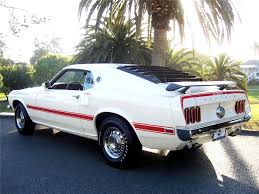
In less than a year, we departed the Depot for another PCS to Ft Lewis, Washington. We headed to the Pacific Northwest in our brand-new ’69 Mustang Mach 1, 351 cid, with rim-blow steering wheel and AM/FM radio.

Why? I still had a few reenlistment dollars and traded the ’68 Impala. I figured the army was a pretty secure job, and we just did it. A smaller car and a larger car payment. It sounded fine to us.

 
Identical to Swan’s 1969 Mach 1. (Courtesy Barrett-Jackson)

During our drive toward Tacoma, somewhere along the Pacific coast — listening to In the Year of 2525 by Garz & Evans — I saw where the sea and the mountains converge and thought that would be an ideal place to live someday, maybe during retirement.

I might be getting a little ahead of myself. I was 21, married, with two infants and a career to create.

On the four-speaker Mach 1 radio, we listened to Sugar Sugar by the Archies, and wow, two hits by Elvis, finally: In The Ghetto and Suspicious Minds. The latter was his first top ten hit since Crying In The Chapel in 1965.


At Ft. Lewis, I was assigned to the Visitors Welcome Center, part of the Post Headquarters. The Officer in charge of our small unit said he had heard good things from visitors and others about my public relations skills; that I had represented Ft. Lewis and the US Army well.

A couple of months later, I was told to report to Post Headquarters.  Major General Willard Pearson called me to attention and pinned on staff sergeant stripes.  A below-the-zone promotion to E-6 conducted by a General officer!  I had been in the army just over three years. Such a promotion usually took six years or more, and certainly not in a ceremony with the Post Commander.

My monthly basic pay (in early 1970) was $372.98, and soon I began receiving tax-free Proficiency Pay of $50 a month.*  A sign over our front door read: SSG SWAN. Inside was our spacious three-bedroom duplex in base housing, no rent, no utilities. As a family of four, our income tax was minimal, and Marty had been doing some babysitting.


D. B. Cooper had recently jumped from a 727, possibly within a few hundred miles of us, but we never attempted to score any of the $200,000 that may have been scattered in the forest. We went instead to Beneficial Finance and left with a check from a high-interest loan we used to purchase household furniture, new pots and pans, and a Philco®-Ford™ Console Color TV.

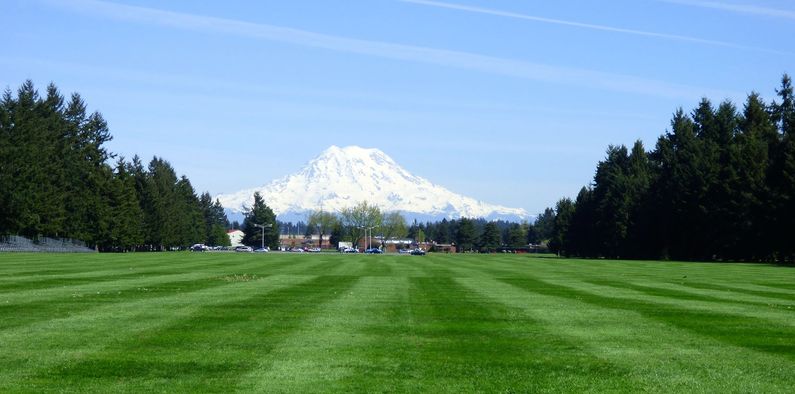
          Mt. Rainier, as seen from Ft. Lewis parade grounds. (US Army)

My monthly salary was still well below the $806 median income for civilians, but “free” health care, tax advantages, and living quarters helped offset some of the shortfall. Finally, our finances were in decent shape, and we would not be getting any more cars that we couldn’t afford.

Marty still struggled with the twins. A  quick way to strain a friendship, we learned, was to have them watch Lisa and Laura for an hour or two. But I wasn’t on alert status at Ft. Lewis, so I had more time to help with the girls. The Pacific Northwest, with the Puget Sound, snow-capped or covered Mt. Rainier, and rugged forests, made for a magnificent year-round spectacle. Life was pretty good.

It wasn’t to last. We would be leaving the beautiful Pacific Northwest for another PCS and even farther from Marty’s family. A lot farther — 4,309 miles precisely.

*Awarded to enlisted men who scored in the top ten percent on their annual exams and efficiency reports.


Chapter 26: Destination Deutschland​​​​​ /1,415

A light dusting of snow covered the Puget Sound just as Spring had arrived in March 1970.  I was sitting on a single sheet atop a cold metal table. I was in a medical suite somewhere in Tacoma to get fixed, sniped, you know, a vasectomy. I figured a set of twins was enough. I didn’t think the U.S. Army would perform such a procedure, and I didn’t even ask. Today, they pay for sexual reassignment.

When I returned to my office the next morning, there was a call for me from a captain at Post HQ. “Congratulations, Sergeant Swan, you’ve been reassigned to Germany.”

Congratulations, eh? We didn’t quite see it that way. We were comfortable at Ft. Lewis. It was a major move, especially with two infants to tow. It required 2,861 miles just to get to the point of debarkation. And then another 3,857 over the North Atlantic to Frankfurt.  Luckily, we were afforded concurrent travel which meant the entire family would be together for our trip to Germany.

There was a lot to be done before we left for Deutschland. We needed immunizations, passports, and briefings. We also needed to out-process, arrange for our household goods for pick-up and so forth. We also needed to liquidate the Mach 1. Ford™ bought it back at Kelley Blue Book® value. Since it wasn’t paid for, they didn’t allow the car to go overseas and out of their control.


We flew from Sea-Tac (SEA) to see my parents in Mississippi. I picked the 1966 VW that Dale had refurbished with parts from the one I had wrecked in 1964. This time I would buy it.

My parents thought the twins looked sickly, too skinny, and wondered why they cried so much. Of course, they were proud to see their first Grandchildren and gave us lots of advice.

From there, we headed to North Carolina in the noisy non-air conditioned Beetle to visit Marty’s folks. American Woman by the Guess Who droned from the small speaker and War by Edwin Starr was played often. It was no Mach 1 but there were no care payments either.

Marty’s parent’s patience was tested, as well, when these first-time Grandparents wondered why they cried so much. Lisa was way too skinny, were we feeding them properly?  They worried about our trip abroad with the twins, and then we got lots of advice.

We picked-up 1-95 North for the ten-hour drive and soon were getting tired of Simon and Garfunkel’s Bridge Over Troubled Water, and Everything Is Beautiful by Ray Stevens. We rested overnight near Newark.

The next morning, we dropped off the little VW at the Bayonne port for its boat ride to Bremerhaven in Northern Germany. Later that day, we took off from Newark International (EWR). It was scheduled for a roughly nine-hour (non-stop) flight over the Atlantic.

As the 707 (300) ascended into thinner air, our eighteen-month-olds and other small children cried out as their eardrums popped. Then they cried on and off for the entire flight, I guess that’s what young children do on airplanes, eardrums popping or not.

We landed at Rhein-Main in Frankfurt. There, in our temporary lodging, Marty and I contracted food poisoning. In my opinion, that’s about as sick as one can get without dying.  Caring for two small children when that ill, very challenging.

2ce9021ae97154b7f2e86316a37f995b
Intriguing medieval bridge houses in Bad Kreuznach,* built around 1300. The town itself, famous for its spas, dates back to the Stone Age. In the 5th Century BC, it was occupied by the Celts and Romans. Its population in 1970 was around 40,000, not including 8,000 U.S. troops. (Photo courtesy Wikipedia)

I was stationed with the 8th Infantry (Pathfinders) in the Public Affairs Office at Rose Barracks in Bad Kreuznach (BK) for a three-year tour. We were in Germany to discourage any over-the-border attack from the East, and the Soviet Block controlled East Germany. The Berlin Wall was a 96-mile zigzag border between East and West Germany. It included 27 miles that separated East and West Berlin and were fanatically controlled by the German Democratic Republic (GDR). Their definition of democratic is undoubtedly antithetical to most of the Western world.

images

The last time there were no U.S. troops in Germany, a World War broke out. Interestingly, as part of my job at the Public Affairs Office, I arranged Berlin Tours for U. S. military members. That included the Brandenburg Gate, the East-West checkpoint.

eicebus
Our drab quarters at Bad Kreuznach were in an old five-story building circa 1935. Fortunately, we landed a second floor unit as there were no elevators.
(Swan archives)

Our quarters at Bad Kreuznach were in an old five-story building circa 1935. Fortunately, we landed a 2nd-floor unit as there were no elevators.

The Armed Forces Network Europe (AFNE) did not broadcast TV to BK, just radio.  Local phone calls were 25 cents.

Marty didn’t bother to get an international driver’s license. She took a taxi to the commissary, PX, or taking the twins and herself to the dispensary. She was stuck in our dour apartment with two two-year-olds — All day. All night.

Marty soothed her loneliness somewhat by ordering lots of stuff from the Spiegel catalog, listening to AFNE radio, writing letters home, and seeing a psychiatrist. Taxi service — in a Mercedes diesel no less — to the hospital, commissary, post exchange, and around town was very reasonable.

img795
  Lisa (l) and Laura guided up the stairs by Marty in  Germany, 1971. (Swan archive

I was part of a small Civil Affairs (G-5) team at my new post. It was the army liaison with local property owners. They were reimbursed for farmland we damaged and chickens we killed with our tanks on maneuvers.

I was also responsible for scouting locations for public affairs units around Baumholder. It was the main area where we trained with our Allies.  As was the case in Vietnam, I was anxious to get out of the rear echelon Public Affairs Office. I wanted something more exciting here as well.

I requested and was accepted to attend the selective Seventh Army NCO Academy in Bad Tolz. It was the oldest and most highly regarded in the U.S. Army. Graduating from this intensive eight-week course was usually a ticket for a below-the-zone promotion. The 10th Special Forces Group stationed there was our advesary in war games. Little did I know it was a school within a school.

Upon arrival at the academy, the commandant congratulated us on our acceptance. Then he informed us that anyone who completed the course in the top ten percent would be eligible to apply for a special assignment. The candidate also needed a top-secret clearance and some language proficiency in Deutsche.

What was it? Those showing interest were told something none of us had heard of, Operative Protection Specialist (OPS). It was a solo assignment to shadow Operatives in the field. This undercover operation that came with $65 per month of extra pay, excitement, and special weapons.

It seems there was a shortage, and the DOD asked the Academy if they could recruit and train a few for these special missions. Those selected would attend a rigorous training regime. Throw down that gauntlet to a group that included some young, fearless, egotistical, combat-tested soldiers. You get volunteers. Ten, to be exact. One of whom was me.

Seventh Army Academy gained my release from Public Affairs back in Bad Kreuznach. They granted an open-ended Temporary Duty (TDY) assignment.

You may remember from an earlier chapter that I was wimpy shortly after returning from Vietnam. No more. After eight weeks of Special Forces-led rigorous physical, specialized, and firearms training. I graduated well enough to qualify for the three-week OPS course. And it was grueling; half of our group either withdrew, were injured, or failed. Unlike the Academy course, for those who didn’t finish, nothing negative was entered in the soldier’s 201 file.

Graduating from OPS was an amazing confidence-builder, and my 6′ 3” frame was buffed to a solid 229 lbs. I became a credentialed and sanctioned OPS and was sent to Frankfurt for orientation and assignment.


*On or about April 4, 1945, Lieutenant George S. Patton, upon leaving Frankfurt,  stopped in Bad Kreuznach to find some American soldiers wounded. An Officer and some enlisted admitted their wounds were self-inflicted to get out of fighting. Unsurprisingly, the general was not happy and summarily chastised the soldiers while reminding them of those who bravely fought and died.


Chapter 27: Deceit​ in Deutschland​ ​/1,710

It was with a sense of pride that I took another look at my confidential orders. They confirmed my new assignment and officially declared me an OPS. I took the A95 and motored through Munich and Stuttgart. Then I picked up the A8 and finally B428.

I took in the beauty of Bavaria and other sites (though the autobahn is not the most scenic route). During the journey, I recalled some history of the last hundred years in this part of Germany. During my six-hour drive on the mostly no-speed-limit autobahn, cars flew by, trucks too, leaving the old Beetle that maxed out at 115kph.

I was happy to see Marty and the twins at our quarters in BK. She was impressed with my physique and anxious for us to have some time together. But it was not to be; I had just one day to spend. She was understandably stressed and could use some companionship and help with the girls.

We were still involved in field exercises with the well-known REFORGER (Return of Forces to Germany) training, I told her. “That’s the price we pay when on active duty in the U. S. Army. This is far from Ft Lewis, not just in distance. We are patrolling soldiers who are patrolling us. It’s a Soviet Bloc country that, with just one provocative move, would heat up the Cold War.  I love you and the twins and will, hopefully, see you soon. For now, duty calls.”

Before leaving, I purchased a beige 1969 VW® Squareback with an automatic transmission. I left it with Marty, just in case she decided to get her International Driver’s license. She didn’t.

The Wonder Of You by Elvis played on AFNE radio as I motored NW from Bad Kreuznach in the old black Beetle. Why wasn’t I in that sterile and safe studio in Wiesbaden introducing the King of Rock ‘n’ Roll? I could be talking about Elvis’ recent meeting with President Nixon at the White House. Because I wanted something more exciting, something a little more hands-on in our effort to discourage East Germany from crossing the border into West Germany.

What had I gotten myself into? It became clearer after my final briefing in Frankfurt, when I was issued a “Do not Deter, Detain or Disarm Document.” It was signed by the Supreme Allied Commander Europe (SACEUR)* and authorized by NATO.

Facsimile of OPS Document (Unclassified version).

By order of NATO and Supreme Allied Commander Europe: The holder of this Document is on an assignment of great importance and shall not be Delayed, Deterred, or Disarmed. Individual is authorized to carry special weapons and other lethal devices and is entitled to special access up to and including TOP SECRET CRYPTO. If deceased, this Document is to remain with the corpse.

BY ORDER OF:

*DONALD SWAN, SACEUR OPS*

This image has an empty alt attribute; its file name is img774-3388810467-e1719900115572.jpg

(I carried my Operative’s Credentials)

Unauthorized use of this document is a serious Federal Criminal Offense, 50 U.S.C. Sec. 38

DO NOT COPY

After my briefing at the I.G. Farben building, I was picked up by a driver from the Federal Republic of Germany (FRG) in a black 1970 Mercedes® 220.  He recommended that I sit in the front passenger seat — not chauffeured — making me less of a target. Whoa, okay. In jest, I asked Karl if lying flat in the back seat would be even safer.

As we sped down the autobahn, I joked with him about a possible detour to Scotland, where the Rolling Stones were about to perform in Glasgow. He didn’t appreciate the juxtaposition and maintained his heading south on the A5. He kept the Merc at a steady 130kph on the way to meet my charge.

unknown copy 8The Renown I.G. Farben building near Frankfurt is the headquarters of the Supreme Allied Commander Europe. Gen. Eisenhower occupied this building as Commander from April 1951 to May 1952. I was here on temporary duty several times in 1970-72 when Gen Andrew Goodpaster was Commander. (DOD)

When I tried conversing with Karl in just Deutsch, I did not do well. It was embarrassing, actually. Thankfully, the trip was soon complete, and I bid my “Chauffeur,” Auf Wiedersehen.

Awaiting me at my destination was a gray 1968 BMW® 1800 containing the very weapons I’d trained with in Bad Tolz. Also included was considerable ammo, a life-saving kit, and a TAR-224A crypto radio. Several hundred dollars in cash in three currencies were provided. Finally, there was a specially tailored 42L trench coat. It would conceal a twenty-four-inch weapon.  And my charge?


I didn’t know the man I was to protect or for whom he worked.  Unassuming, he looked like a manager of a carpet depot in Tacoma. We would collaborate over the next few weeks and rehearse enough stratagems that I realized he was — a spy.

He worked unarmed and had diplomatic cover; I carried his DIA credentials, and we wore German civilian attire. I thought he deserved protection just for the amount of cash he possessed in Deutsche Marks, French francs, and U.S. dollars.

Once operations began, there was no commingling.  We communicated just enough that I was cognizant of his missions and that we were vigilant of each other’s whereabouts.

I had just one job: protect my asset, up to eliminating the threat, with extreme prejudice. As for who would protect me, I was on my own. My only contact other than the Operative was a source at SACEUR in the I.G. Farben building in Frankfurt. This was classic Cold War.

Armed with a D2 K-Bar,™ silenced H&K™ VP70z** with an 18-round magazine, and a subcompact SIG Sauer™ for backup. I stayed close and shadowed him everywhere, which seemed to be every club and brothel in the cities we worked.

By now, I knew my man (code name Hans) was a Defense Intelligence Agent (DIA). But I was no spy and never a part of any intelligence-gathering or recruiting. Eye on my Operator, concealing my hand cannon, ready to dispatch it in a split second, kept me occupied.

HK_VP70_55641
The H&K VP70z, with its detachable stock and 18-round magazine, was an advanced weapon, especially with its high-capacity clip.  The manual safety was deactivated on my H&K.      (Courtesy FOREX)
 

800px-Nancy_Porte_de_la_Craffe_BW_2015-07-18_17-21-30_1
Craffe Gate in Nancy, France, was built in the 14th Century to protect the city from invaders.  We also visited a few other European countries.  (Wiki Commons)

During the more than three months of shadowing my operator, I never fired either weapon in anger. But I could do a mean stare-down. A working girl feeling me up was tricky. And some other encounters had forced me into revealing one gun while at the ready with the backup.

My weapons were always at condition one, as neither had a manual safety. I honed my shooting skills off-duty and was fanatical about keeping my weapons at peak performance. Still, I worried about screwing up. I worried about my family.  Sometimes I vacillated from being lax to getting jumpy and anxious.

If a suitable replacement were available, I could resign if not under investigation, since this was a volunteer, high-stress assignment.  The Operative could relieve me at any time. Efficiency reports were straightforward; he rated his OPS to SACE as “Satisfactory.”

OPS was an engaging, exciting experience. My per diem was generous and without scrutiny. I stayed in good hotels, ate well, and visited fascinating cities and areas pivotal in the Second World War.

But 100 days were enough for me, and a replacement was available. I contacted my source at SACEUR and requested relief and permission to return to my previous assignment. (DIA began using its own resources in 1972, and active duty army involvement was discontinued.)


Several weeks later, I walked into the Public Affairs Office (where I was initially assigned) at Rose Barracks. Still buffed and back from TDY. I felt the presence of someone approaching my six.*** I swiftly swung toward him, about to execute a crushing elbow thrust to his neck and a quick and stiff knee to his groin. I realized, just in time, that it was the lieutenant colonel in charge of public affairs wanting to give me a hug from behind.  

The reunion was nice, but I was looking for a way to get out of Germany. I had over a year left on my tour.

As for the joys of touring Germany, France, and other European countries, we did some (see photos). But my work, finances, and the twins prevented us from traveling more.

Unknown-2
Church built in stone on the side of a mountain in Idar-Oberstein, Germany. We visited this and other sites in the country. (Wiki Commons)

Two great opportunities arose after I returned to BK. The first was a message from Washington, D.C., for qualified enlisted personnel. It was a fully funded Environmental Science and Engineering program at Texas A&M University. Upon graduation, the member would become a commissioned officer.

I started my application immediately. It was a daunting and drawn-out procedure. The packet (needing to be perfect) contained about a dozen pages, including attachments. I received lots of encouragement, culminating in the Commanding General of the 8th Infantry Division endorsing the application with: “Highly Recommend Approval.” Off the packet went to D.C.

The second was an opportunity, a few weeks later, inviting qualified enlisted to apply for Recruiting Duty. It came with a choice of station. That meant we could go to North Carolina and be near Marty’s folks.

The other good news is that if selected, we could leave Germany presently, a year early. It wasn’t like becoming an officer, but it was a great opportunity with $75 a month in incentive pay and a chance for early promotion.

After Marty’s two years, mostly alone in Germany with the twins, I was willing to and did withdraw my application for the engineering program and give up my chance to become a commissioned officer.

My recruiting application was approved. 

*Although DIA reports to the Secretary of Defense, SACEUR is the host and must be aware of activities within his domain.

**Just released and known as a Machine Pistol, it had a detachable 8″ stock and was capable of a 3-round burst.

***Six 6 o’clock is directly behind, and 12 o’clock is directly in front, commonly used by fighter pilots and others in the military


Chapter 28: Be All You Can Be /1,508

Only the best, the U.S. Army says,  are considered for recruiting duty, and from those, fewer still are chosen.  But I was selected anyway.

We departed Germany a year early for my new assignment in the States.  Children still cried on the plane, including our own. But the trip home was better than our flight over, two years ago.


Awaiting me at Newark was a brand-new 1972 Gremlin X V-8 that I had ordered in Germany through a special overseas program. I paid the $2,400 price in cash. Laugh at your peril.

images-1
Rendition of Don’s 1972 Gremlin X. (Courtesy Wikipedia)

It was modified by Randall Motors, factory-authorized, and produced about 250 h.p. It weighed just 2,600lbs. It came with a Chrysler® sourced torque flight three-speed automatic, 4.10 gears, and HD suspension. The black sleeper had reasonable insurance rates, and it was the only V-8 available in that price range. It ran a 13.9 sec. Quarter-mile, as fast as any production car in 1972, including a base Corvette®. And it was slightly quicker than a 1972 Trans Am™ 455. I surprised a lot of people at stoplights in small Carolina towns and on country roads.

Dear valued reader: If you would rather not hear the details of my struggles with diarrhea and all the unpleasantries that came with it, including incontinence, problems at work and at home, surgeries, and the like, I understand and ask that you skip to the next Chapter: “Kansas City Here We Come.” I will discuss the problems I had with my colon in future chapters because it was a big part of my life. But I will try not to dwell on it.

Once again, I found myself at Ft Benjamin Harrison; this time, I attended Recruiting School. About three weeks into the eight-week course, I began having frequent stools, diarrhea.

That is symptomatic of what one might get when arriving overseas, usually not upon returning, as I just had from Germany.  It was almost as bad as the dysentery I had off and on in Vietnam.  I always tried to be near a bathroom, and there were a couple of times I didn’t make it. That was a real confidence-builder, especially when giving a presentation, in a demanding course (I say sarcastically). Nevertheless, I toughed it out and graduated on time. Surely this is a temporary thing.

I was a recruiter in Lumberton, North Carolina, where we bought our first house. It was a pleasant town with about 17,000 people in the southeastern part of the state, located on I-95, the halfway point between NYC and Florida. We were just eighty miles from Marty’s parents, her older married sister, and her younger brother.

Army-Recruitment-Vtg-1977-Print-Ad-Join-The-1
Call Sergeant Swan at 733-5000 or visit at 300 W. 7th St across from the U.S. Post Office, Lumberton. The U.S. Army has over 300 job opportunities. (U.S. Army)                                                                      

My recruiting partner at our Lumberton station was a Staff Sergeant, just as I was, but outranked me because of his earlier promotion date. That wasn’t an issue until my health deteriorated.

We were a successful team. He was from the area and had been in the Army Reserve before becoming a recruiter. My partner knew the best places for Barbecue, which many consider the best in the country. As for my recruiting style, there was never any pressure, which seemed to put potential recruits at ease.

We always met our quotas, and we received commendations for our performance. After a few months on the job, the diarrhea and cramps that I experienced in Indianapolis not only returned but worsened.

I went to the doctors at Ft Bragg, North Carolina (about an hour from Lumberton). After describing my symptoms, the doctor said my diarrhea was probably a result of the pressure of being an Army Recruiter. And how was my marriage? Are things OK with you and your children?

He scoped my rectum and sent me on my way with four Atropine™ (anti-diarrheal drug). The medication helped as long as it lasted, like one day, and my symptoms continued unabated. Unabated, as in about six semi-liquid stools per day.

Naturally, trying to work while the symptoms persisted was difficult. Playing the role of father to the twins, who were sweet and loving, and husband to Marty, was difficult and at times impossible. She continued to see a psychiatrist, as she did in Germany.

After several weeks with no improvement, my recruiting partner and our supervisors in Raleigh were not understanding. How could someone have third-world type dysentery, here in the United States, to the point they couldn’t work full-time? The doctors weren’t sure what was causing the amount of diarrhea I was having.

I wasn’t surprised; it seems the doctors had never heard of such a thing either. Fatigued, with bloody stools and a bleeding rectum, I returned to see the doctor. I had a perianal abscess.

A Proctoscopy exam using a rigid 10-inch steel scope through my raw and inflamed rectum was ridiculously painful.  The results were normal but consistent with someone who had been in the throes of diarrhea, i.e., inflammation and blood. I considered not complaining to avoid those procedures. The doctor prescribed six Atropine and antibiotics and suggested sitz baths three times a day. The frequent stools continued.


I wondered what would have happened had I been in the Environmental Science and Engineering program at Texas A&M (last chapter). If I were having the same symptoms in the engineering program, the Army might be thinking this guy just couldn’t cut it, wasn’t officer material. That might have been worse than my present dilemma. But I digress.

Within a month, I had a fissure and fistula of the rectum, which required surgical repair. Incidentally, while at Womack Army Hospital in Ft. Bragg for the surgery, the principal architect and loser of the Vietnam War, LBJ, died. An irreverent patient, making a joke about what LBJ may have done with farm animals in Texas, had me chuckling. A good laugh is not wise when you’ve just had rectal surgery.

My partner and officers from the Raleigh station came by for a jovial visit. OK, you’ve had surgery, now get off your ass and get back to work full-time, was their expectation.

No, perianal surgery does not cure dysentery. I was released without any Atropine, “Get that from your GI doctor, we’re the surgeons,” they reminded me. Once I started eating again and returning to work, the frequent semi-liquid bloody stools continued, as did the abdominal cramps, incontinence, and dehydration. Since arriving from Germany ten months ago, I have lost 35lbs!


I’ve heard of and read about patients who were very ill, some with terminal conditions, whose relatives said they never once complained. My theory: If you’re not complaining, you must be too sick to, or not miserable enough.

Unbelievably, the doctors and my supervisors still assumed that the high-stress job of being a recruiter was the primary cause of my diarrhea. The doctor reminded me that my proctoscopy examination was regular (except for “non-specific inflammation”). Oh, and how was my relationship with my wife? Now, not so great, she’s not causing the diarrhea, she’s frustrated because I have it. And you’re doing little to help.

Finally, the doctors decided to give me a refillable prescription of Atropine and some rest: “No Field Recruiting Duties until further notice.” I did better having my medication in ample supply and recognition, at least, by one doctor that I needed a break.

I wasn’t about to sit on my butt, feeling sorry for myself, so I became a part-time DJ at a local radio station while resting from recruiting. I promoted Army recruiting on my show by broadcasting pre-recorded spots I’d prepared.

For a few weeks, with restrooms nearby, I was playing Big Bad Leroy Brown by Jim Croce, We’re An American Band by Grand Funk Railroad, Kodachrome by Paul Simon, Give Me Love (Give Me Peace On Earth) by George Harrison, and occasionally some oldies from Elvis. I happened to be on-air the joyous day our POWs were released from North Vietnam.

streetview
Our first house was purchased in Lumberton, NC. (Form a later photo by ReMax® Realty)

A couple of months after the doctors gave me a break from recruiting, I was given a PCS for the Army Hometown News Center in Kansas City, Missouri.

We had been in Lumberton for just 18 months. Fortunately, we had no problem selling our house and even realized a small profit. As for Marty, leaving her relatives was not as good as she had imagined.

After our household goods were picked up, we packed up the twins and all the other stuff we could fit into the little Gremlin. We eased out of the driveway one last time.
Marty had liked Lumberton,* and I had enjoyed recruiting — both were now in our rearview mirror.

* 2019 update: Fox8 TV in High Point, N.C. reported Lumberton to be the worst place to live in the state, based on high crime, high unemployment, and low wages. USA Today reported similar findings about Lumberton, N.C.