Chapter 6: In The Game & 1580, WAMY
Should I Just Take the Advice of the “DJ at the Bottom of the Stairs” (last chapter) and concentrate on my studies in high school? Maybe get into a good university, work at the school’s radio station, and be the first in my family to graduate from college? Naw.
I did not give up on WAMY, and I continued to visit at every opportunity.
Joel Camp, one of the full-time announcers, about twenty-three and blond, allowed me to stay in the control room when he was on air. He played Roy Orbison, Chubby Checker, Connie Francis, and other popular songs of the early sixties. His favorite, however, was Ray Charles. He brought in all his albums of the blind soul singer, which gave him the opportunity to play all of his favorites on his radio show.
I helped him straighten up when his shift ended and followed him to his car. It was. a striking white-on-white 1960 Thunderbird with leather bucket seats. Did I mention he was also engaged to a beautiful girl? Now, I knew I had to become a DJ.
After all my time in the studio with Joel, I would soon learn — surprised, disappointed, crushed — that someone else had been working on him. And he wanted to become a DJ, too. He was older, had already graduated high school, and not only knew Joel; they were friends.
I had been counting on maybe filling in for somebody on the weekend. But now Mel Webster, having landed the entire weekend shift, was spinning The Four Seasons, Bobby Vinton, The Shirelles, and, you know, Elvis!
The first time I heard his whiny voice on the radio, my Momma slapped me for what I said.
For the next few months, I tried to forget about radio. I was occupied with church, school, and, of course, helping out on the farm. I was also praying about my future and trying out for the JV basketball team at Hatley. Although enthusiastic and six feet tall, I barely made second string. The coach said I was over-anxious on the court, and frequently, I jumped into the free-throw lane too soon, always causing a penalty.
Then one night on our home court, I was warming the bench in a close game. Coach Tubb yelled to his assistant, “Give me some muscle.” After pointing to my chest, I sprinted onto the court; It was me, Number 18 in Blue and Gold, representing the Hatley Tigers in a contested game of basketball.
In the ten minutes or so I was on the court, I surprised everyone (me included) laying in six points, in the game we won against rival Greenwood Springs. I wondered to myself if I did that… what else was possible?
I sought out activities at school that could make me more popular or anything remotely related to broadcasting. I set up the PA system for football and basketball. Also, I did some announcing of the games, anything that would get me some exposure. Once, I played the national anthem (on a turntable) at the wrong speed before a home football game. Screw-ups like that certainly got me exposure, but not the kind I wanted.
As a member of the 4-H Club and Future Farmers of America, I did well in oratory competition. I even had a part in a few plays. I had excellent grades in my first eight years of school; now, they were just average. School was now about number five on my list of priorities.
First was Radio (really long shot), Girls (no shot at all), Basketball (long shot), and Church (lay-up). Instead of taking notes in History class, I would doodle and scribble in various elaborate ways in my notebook: W-A-M-Y.
Riding the bus back from a basketball game one evening, I sat next to a girl; we held hands and rested our heads together. That was it.
School was not a fun time for me. I was not a jock or one of the tough guys, and my hair was too curly for a flat top, a very popular hairstyle at the time. This wasn’t an era when being a little different was cool. It wasn’t that I was unattractive, but I did have the teenage curse of pimples.
After holding hands with that girl on the bus and that one improbable basketball game, my confidence was rising like water under the Tallahatchie Bridge after a spring thunderstorm.
I doubled down on my efforts to score that radio job. I was determined to be ready when the chance came. I would need little or no training on the equipment, but I would need an operator’s license from the FCC to broadcast over the airwaves.
When I received my packet from the FCC, I breezed through the 12-question test. I signed a statement that I was no felon (whatever that was) and a U.S. citizen, and sent my postage-paid application to New Orleans. “The successful applicant should receive their license in eight to ten days,” said the FCC. My confidence was blooming like a Mississippi Magnolia.
Day 10, nothing; day 12, nothing; and day 14, nothing. I asked those around the station who had gone through a similar process, but none had experienced such delays. With practically everyone in the County knowing of my dream, the fuss, the preparation, and my effort, could I have flunked the simple test?!
Day 15, bingo, my Operator License arrived in the mail. My address was Greenwood Springs; the letter had been misdirected to the city of Greenwood (not Springs), Mississippi, causing the delay. Then, I got my driver’s license using Dale’s ’37 Chevy.
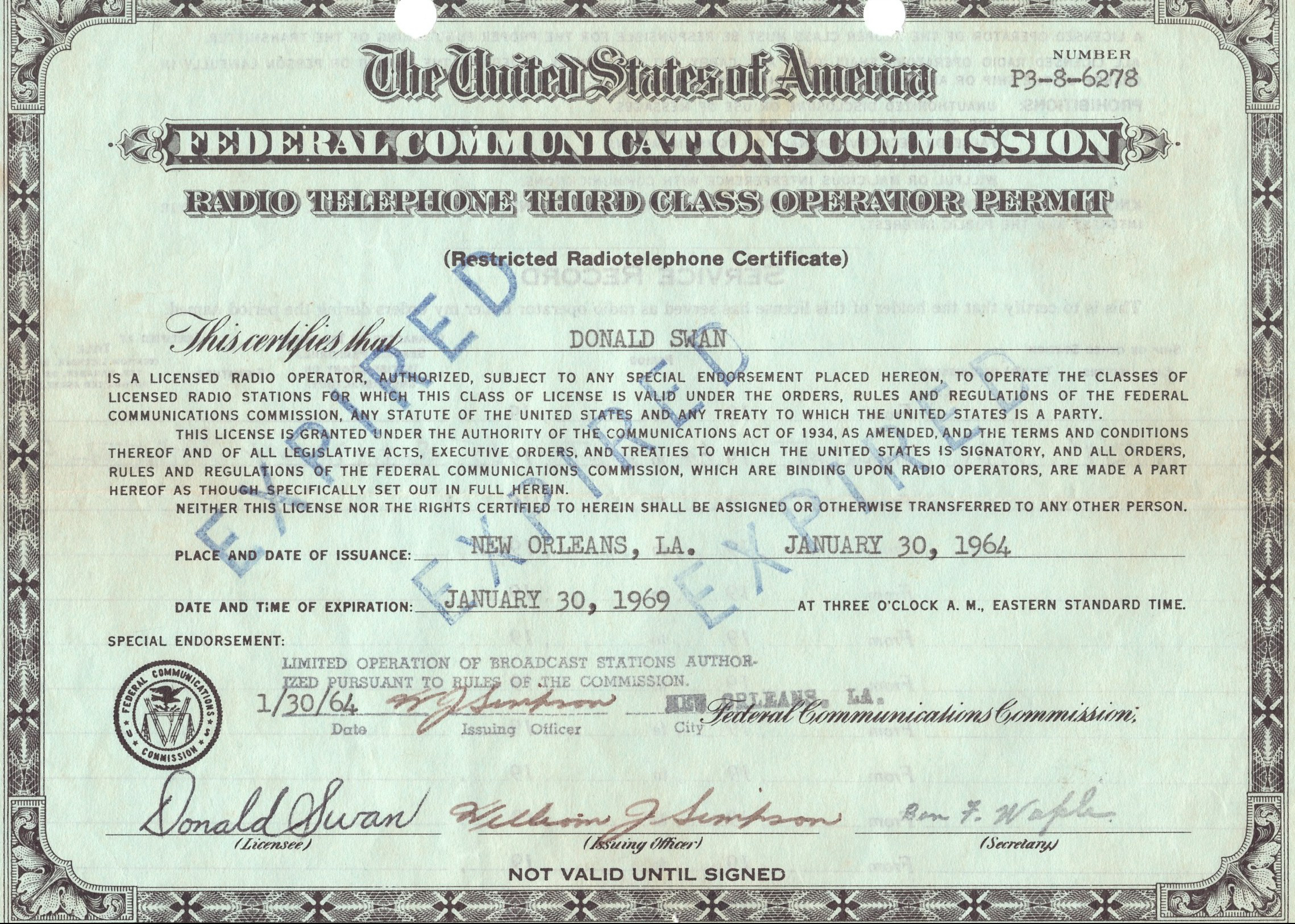
After a six-month probationary period, my regular FCC license was issued. (Swan archives)
All the while, Momma prayed that God would have his will in my life. By now, I think Momma and God knew that I would never be a preacher of the gospel.
Speaking of God, I don’t know if he led me to WAMY on this particular late spring afternoon. I had been sweeping out school buses all day — the heat inside, over a hundred — I stopped by the radio station. The fellow I had written to in West Point about a job had just been hired as the on-site manager for WAMY.
I worked on the new manager like Bro. McLeod went after lost souls. I was ready right now, I said; I had my FCC license, driver’s license, and access to a car. I was a better announcer than Mel. I asked to prove it with an audition. For Mel, I said it was just another job; for me, it was a calling. Mel knew I was jousting for his job, and he no doubt concluded that I wasn’t going away, at least not quietly.
Then, a minor miracle occurred a few days later: Mel quit! He took a job operating the printing press at the local newspaper; technically, he would be working for a competitor. I told you he was not radio material.
Don Swan would be on the air in Amory — W-A-M-Y — the Five Thousand watt regional Clear Channel, 1580 AM! I had landed the entire weekend shift, sun-up to sun-down, Saturday and Sunday.

The cotton-picking, cow-milking, pimpled-faced class clown and dreamer would be rocking in the free world, playing music for the masses.
At age 15, I was let loose with Five Thousand watts of power booming to tens of thousands in Northeast Mississippi and Northwest Alabama. The FCC rules, if not followed precisely, could result in the station losing its license to operate. No pressure.
On that Saturday, my first day on the air, I skipped up the flight of stairs to the second floor of the unremarkable old two-story building on Main Street. I turned into the hall, unlocked the second door on the right, and walked in through the record repertory and past the live broadcast studio. Straight ahead was the door with the overhead “On-Air” light.
I anxiously stepped into the nerve center of WAMY — the eight by 12-foot climate-controlled studio. In the control room, there was lots of soundproofing. The large window facing Main Street was opaque except for a three-by-12-inch slot that gave me a perfect view of the Bank of Amory. It had just installed, a state-of-the-art digital time and temperature display.
I powered up the electronic devices, retrieved the weather forecast from the Teletype, and checked for any bulletins. I assembled my logbooks and two pens with black ink in front of the control board. I made sure the Emergency Broadcast System cart was in its compartment, and queued a record on each of the two turntables.
Then, I initiated the five-minute procedure to warm up and activate the transmitter.
At precisely six a.m. I pressed play on the pre-recorded sign-on tape, fitted my earphones, positioned the mic close up, and sat down.
I was literally ready — to Rock ‘n’ Roll, and in 1963 it was no cliché or metaphor.
Had I crashed and burned coming home from my first shift at WAMY, I would not have died in vain.
Spoiler alert. I would not screw this up — too much.


You are the best writer ever.
LikeLike