Chapter 29: Kansas City, Here We Come /1,510

An old Chinese proverb says, “A journey of a thousand miles begins with a single step.” So we quickly dispensed with ours — a single mile — with just 1,090 left to Kansas City. Then, depending on our AAA Trip Tics,™ we motored northwest on I-40. We passed through Asheville and the scenic Pisgah National Forest, and toward Charlotte, listening to Cats In The Cradle on WAYS.

The little Gremlin looked for prey as The Streak played, and we drove toward Nashville. We rested overnight there in a Motel 6.® Then, we slowed a bit while enjoying the scenic southern tip of the Blue Grass State. We entered the Land of Lincoln and headed due north while listening to I Love You, I Honestly Love You. I sat on my “inflatable doughnut” for most of the trip, trying to ease some pain.

The twins were handling the long drive reasonably well, but kept asking, not, “If we were there yet,” but “Why were we moving again?” You’re Having My Baby by Paul Anka played as we were leaving Illinois. 

Funny Face, I Love You by Donna Fargo, possibly the worst song of 1973, rang out as we headed due west into Missouri on I-70. We drove almost the width of the Show-Me State and, about 50 miles from our destination, tuned to WDAF, Kansas City, where The Streak by Ray Stevens resonated once more.

Soon, Arrowhead Stadium appeared to our left, and the skyline was just ahead. Impressive, we had made it to big K. C. 

We rented a duplex in Independence, about 20 miles east of Kansas City, and bought a second car, a 1966 Ford Fairlane. Lisa and Laura wanted their own rooms, but when that didn’t happen, they were happy to learn that there were two bathrooms. Marty and I were, too. It was a first for us.

The twins had been uprooted twice in as many years, and I tried to explain why.  I was in the Army, and the Army moves me around a lot, which means we were all in the Army.

They were overactive and inattentive, said the teachers at the nearby kindergarten where we enrolled them. So maybe the twins were just ahead of their time — an antecedent to ADHD?

Marty and I liked the Kansas City area. We were blessed with lots of friendly people, again, great barbecue, and good radio stations. And among the best professional teams in football and baseball: the Chiefs and the Royals. 

In downtown K.C., there were several war monuments, and it was home to the official WWI memorial. The cost of living was reasonable. The gasoline embargo and subsequent shortage had little adverse effect in the Kansas City area, except for the price increase.
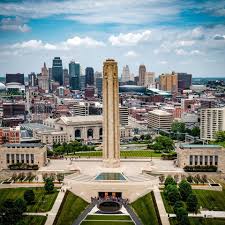
Congress declared the 217-foot-tall Liberty statue as the official WW I Memorial in 1926. Kansas City skyline in the background. (Wiki Commons)

My symptoms improved as the doctor I was seeing at Ft. Leavenworth, Kansas (45 minutes northwest), had me on a regiment of Atropine and treated me with compassion. The doctor thought I had something called Irritable Bowel Syndrome (IBS), then not commonly diagnosed, and had me experiment with different diets. He also suggested I see a gastroenterologist at Fitzsimons Army Medical Center in Denver.

I did well in my job as chief of statistics at the News Center, where we processed and sent news releases to soldiers’ hometowns. The mainframe computer we used to process the news releases was the size of a minivan.

While stationed there, I took a few courses at the University of Missouri, Kansas City (UMKC) night school, where I maintained a 4.0.

I desired to be well, not just for my comfort but also for the benefit of my family. I had another incentive to get healthy when the Center’s Commander prepared a special efficiency report recommending that I be promoted as soon as possible. The request needed to go through the “System”  at the personnel center in Ft. Myers, Virginia and could take up to a year.

Nevertheless, it would come with me having been in the Army for less than 8 years, well below the zone for Sergeant First Class (E-7). That’s the average rank one retires with after serving 20 years.

But I would not remain in the Army long enough to see that promotion. After spending a few days at the nearby Richards-Gebaur AFB Hospital for another perianal surgery, rest, and a strict diet, I received orders for Fitzsimons Army Medical Center in Denver to see a specialist. Another transfer within a year, but this one would not include the family.

Just as I was about to leave Kansas City for my medical treatment in Denver,  Marty wanted to talk and asked me to sit. She had been thinking and wanted to share her thoughts with me before I left.

Maybe it wasn’t any of my past or present work that was causing my illness, but she and the twins. Perhaps we should just cut our ties after six years of marriage to improve my health, she suggested. Was I hearing this correctly? So a divorce would be good; it’ll make me all better? That’s one I had never heard. 

Surprised, confused, and saddened, I tried to swallow the lump in my throat while holding the twins tightly. As I was preparing to leave, I pried their little fingers from my legs as they cried. Finally, I walked out the doorway with a flood of emotions and what I could carry in a single suitcase.


Fitzsimons could hopefully determine why I was having 6-8 stools a day and incontinence one or two times a week. The diarrhea was so acute that I’d already had three surgeries to repair fissures and fistula.

Agent Orange exposure causing health problems like mine — the Army and VA said in 1974 — was far-fetched. But I wondered. (In 2021, the VA added Crohn’s/Ulcerative Colitis/IBS to its list of  diseases possibly caused by Agent Orange.)

I was processed into Fitzsimons, a huge medical center that once treated President Eisenhower. A Suite was named after him. And within it hung a robe with stitching that read: “Much Better, Thanks.” He wore it when meandering about with the Secret Service, tired of answering people about his condition.

I was surprised when they put me up in his larg,d comfortable suite on the top floor, which had a balcony overlooking the Rocky Mountains.  (Not true, of course, I just wanted to see if you were paying attention.) He was treated for a heart attack here in 1955.  Later, at a different hospital, he would be diagnosed with the same malady from which I was suffering.

I, however, was given a nice two-person room that didn’t include a roommate. And the nurses, wow. One could think that, and even say that in 1974, as the “Thought Police” hadn’t been invented. Complimenting a member of the opposite sex with, “You have pretty eyes,” would not result in federal charges for sexual harassment. Granted, some of our evolving mores are good, like taking actual sexual harassment seriously. And progress in how we treat people with disabilities and show more respect toward all people

But I digress. The more I thought about Marty’s proposal, the better I felt. Not much was going on medical-wise except for experimenting with diets and so on.

I was anxious to see the Aspen in the Colorado High Country in the fall and was granted a weekend pass from the hospital. A pretty girl was recruited for the trip strictly to show me around. We rented a car, and off we went into the Rockies.

Although Ted Bundy is believed to have been mingling in Colorado ski country by now, we don’t recall seeing him.

The scenery and the weekend were incredible, and I was looking only to the future.

Marty had other ideas. She saw the credit card receipts that came with the bill and wanted to know what was going on. Why had I rented a car? I told her. I also volunteered that I was doing better since arriving at Fitzsimons.

Maroon Bells recreation area, Colorado, with Aspen in the foreground. This photo was not a lucky sho;, when conditions were just right. It actually looks like this. (Courtesy Atlas Obscura)

Although, she had come up with the idea that a divorce might be the best for both of us. Marty’s mercurial temperament began to show as she backtracked. She wanted to keep her options open and never expected that we would actually go through with a divorce. I, however, had already done my grieving and, feeling sorry for myself. I would move on and concentrate on the future. 

The Twins under Momma’s care in front of the Mississippi home, circa 1974. (Swan archives)

Life goes on, long after the thrill of living is gone.  John Mellencamp

About a month after I left home for the hospital in Denver, Marty did what any stressed but loving mother would do (I say sarcastically):  She drove Lisa and Laura to Kansas City International (MCI) and purchased a one-way ticket. She informed the flight attendants they would be traveling alone, told them to behave on the plane, and sent them to my Mother in Mississippi.

As the twins wandered into the jetway, Marty turned away and — literally and metaphorically — never looked back. She had no intention of them returning and living with her again. They were five.  Marty had no contact with her daughters, nor would she see them again for another twenty years.

Guess I needlessly worried about Marty becoming a single mother.

She was the woman who had written me almost every day when I was in Vietnam. Waited for my return, stood by me during difficult times, provided a good household for our family, and was alone with the twins for months while I served in the Army. She was the woman, I thought, who loved and cherished me and the girls.

I continued paying child support to Marty for a few months before I got the advice of a family attorney. I began sending the money to Momma instead. Marty was pissed. I went back to the attorney and filed for a divorce and for custody of the twins. Marty never responded, and I was granted sole custody.  Now the twins were completely and legally, my responsibility, although they were still with my mother.

Nothing From Nothing was playing on KIMN.

There were not enough data, the doctors said, for a precise diagnosis. Maybe I had Irritable Bowel Syndrome (IBS), a spastic colon. This condition usually aligns with someone who is high-strung personally.  I prefer to call it Type-A.

There were not enough data, the doctors said, for a precise diagnosis. Maybe I had Irritable Bowel Syndrome (IBS), a spastic colon. This condition usually aligns with someone who is high-strung personally.  I prefer to call it Type-A.

With an illness, about the worst news is: “Can’t give you a definite diagnosis, don’t know what to tell you.”  Except that I might want to stay near a restroom and continue with the Atropine. Very funny, huh?

When I was on a clear liquid or a minimal fiber-low residue diet, the cramping, frequent stools, and diarrhea were uncommon. Seems all that was required for me to do well was to rest in a hospital on a strict diet, always near a restroom.

I had just received the sequence number for my upcoming promotion (about three months away). That’s when the Medical Board informed me that I had been declared physically unfit to serve. My Army career was over.

famc_over-1Fitzsimons Army Medical, Denver, where I was confined until diagnosed. (Public Domain)
After several months at Fitzsimons, the doctors settled on a diagnosis for me: “Crohn’s disease.” It’s an incurable disorder that features abdominal cramping, fever, diarrhea, blood in stools, and drainage from the anus. There’s more: Inflammation of the liver, skin, joints, and eyes, fatigue, immune system degradation, and sores in the mouth. (Veterans are more prone to get Crohn’s disease, concluded a recent study, than the population at large.) 

Thankfully, I never had all the symptoms occur at the same time; that is rare. But three of four are enough to knock you down hard. And knowing the others are possible is stressful enough.

The side effects of early drug treatment for Crohn’s were sometimes more detrimental to my health than any benefit it provided.  Prednisone, which I  took, off and on, for the disease, was especially precarious for long-term usage. It’s a steroid that comes with about a dozen warnings. Frequent use is known to cause heart failure, liver damage, and diabetes.

This disease is no “You have eight months to live” cancer diagnosis.  Indeed, it’s possible to die from complications of Crohn’s. But it’s more likely one will just suffer from its symptoms for a few decades and then die.

Today, it is not unusual to see an ad for Crohn’s. But in 1973, most physicians were unfamiliar with the disease or had not seen or treated anyone with it. (Count me as an early experiment, I suppose.) All my colonoscopies without sedation had shown non-specific inflammation of the small intestine and some granuloma. However, I had no ulcers in the intestinal mucosa resembling “cobblestones,” which are consistent with Crohn’s disease.

Before being officially medically retired in February 1975, I visited the hospital commander for advice. Should I try to just tough it out, request a medical waiver, stay on active duty, and get my promotion to Sergeant First Class? No.

I was surviving on six to eight Atropine tablets a day (a narcotic and controlled drug). Some of the best years of my life were made possible by those tiny white pills. They kept my diarrhea manageable and my life functioning with some normalcy. (Eventually, while on the move, I could swallow two or three pills without any liquid.)

But there were downsides to Atropine: Blurred vision, euphoria, headache, fever, confusion, stultification, and depression. There’s more: drowsiness, dry mouth, numbing of hands and feet, and so forth. I had some of those symptoms, but thankfully, no more than a few at a time. 

My medical retirement income was $421.00 a month, a pay cut of almost 50%. I was unable to work any demanding job, or perhaps any job at all. That is, unless I was allowed unlimited restroom breaks and could get frequent sick days.

Ill, divorced, and now bankrupt, my possessions included a 1966 Ford Fairlane® showing 212 thousand miles, a 13” color TV, and my clothes were mostly army uniforms. Unsurprisingly, this was not one of the better times in my 27 years.*

But That’s Alright, Mama, because:

We had practically nothing in common except that we were veterans and divorced. Sam told me of the constant stress of flying over the skies of Europe during World War II.

As a machine gunner on hazardous missions in a B-17, he worried that he might not survive long enough to complete enough sorties to allow him to go home. 

Scan_20190405_173015
Sgt. S.E. Trott Nov. 4, 1944. (Swan archives

Sam made it back, only to lose his family because of his drinking and gambling. He warned me, whatever my demons, not to succumb to those evils. He died many years ago, but I will remember him for a long time. I’ve finally written my book, and as promised, Sam, you’re in it.

After settling into my studio apartment in Denver, I enrolled in a program to earn an FCC 1st Class license, sometimes called a First Phone. It was known to be a challenging exam, especially for those like me who had not done well in high school math.

Having this license was a real plus for getting a job in radio. It was a requirement for stations with 10,000 watts or more that were broadcasting directionally to have an operator with a 1st Class License on duty at all times. And with the First Phone, one could be called an engineer at a radio station. Wow, that sounded pretty impressive. Don Swan, an engineer? Mr. Pete Vaughn (HS math teacher) would be stunned.

Not so fast, I don’t have the license just yet.

After completing a four-week training course, I reviewed the course material for several days, studying trigonometry, calculus, and geometry needed to complete the test successfully. (About 40% fail the exam on the first attempt.)

The extra work and dedication paid off. Under the tutelage of a stern FCC proctor in downtown Denver, I passed the two-hour exam on my first try and obtained my First Phone. It was a significant boost to my morale and confidence. (Five years later, it would be worthless. The FCC deregulated many of its rules for radio stations, including the requirement for a 1st Class licensed engineer.)

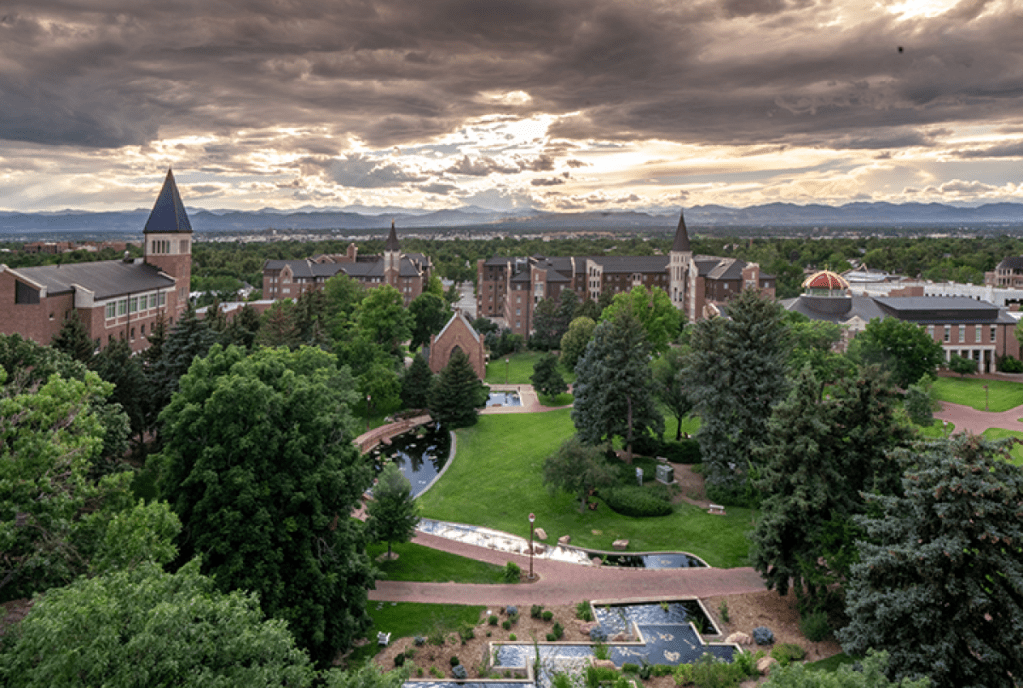
University of Denver campus. (from Princeton Review)

I can’t complain, but sometimes I still do. Joe Walsh.

Eight months after being discharged from Fitzsimons — sick, broke, divorced, and bankrupt — I was a sophomore at the University of Denver (DU). Thanks to my First Phone, mellow voice, and great personality, I was also a Denver DJ.

And during that period, the Veterans Administration gave me a 100% rating for Crohn’s Disease and service-connected injuries that resulted in $684 monthly compensation. A nice raise from my army medical retirement income, but I couldn’t get both.

DU is a private, competitive, and selective school where more than 30% of applicants are rejected.  Despite my high school transcript (White-Out, please), I was admitted to DU. Undoubtedly helped by an honorable military record, my General Technical score, credit for many military schools, and my UMKC transcript. I would study Speech and Mass Communication. DU was no easy ride; I had graduated from high school in Mississippi, where I was an unremarkable student.

I would be a full-time student and a D.J.

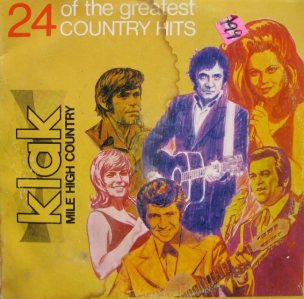
KLAK was the number one Country music station in Denver, the eighteenth-largest market in the U.S. We broadcast on 1600 AM at 10,000 watts and on 107.5 FM at 50,000 watts.  The manager hired me on the spot while I was meeting with him about doing voice-overs for commercials. I was offered the 7 pm to Midnight shift Mon-Fri at $150 a week, which increased to $250 (about $1875 in 2025 dollars) after my show’s ratings and popularity were validated. 

Rock ‘n’ Roll was my first choice, but  I probably had a larger audience at KLAK because there were so many Rock stations competing for listeners. Just one other station was broadcasting the C&W format. 

klak-ktel-325-_0003a-2
I did the 7pm to Midnite show. (Swan archives)

At KLAK, we had a modern country format. I was playing Blue Crying In The Rain, I Will Always Love You, Don’t It Make My Brown Eyes Blue, Have You Never Been Mellow, Goodhearted Woman, Rhinestone Cowboy, lots of Elvis, of course, and Rocky Mountain High.

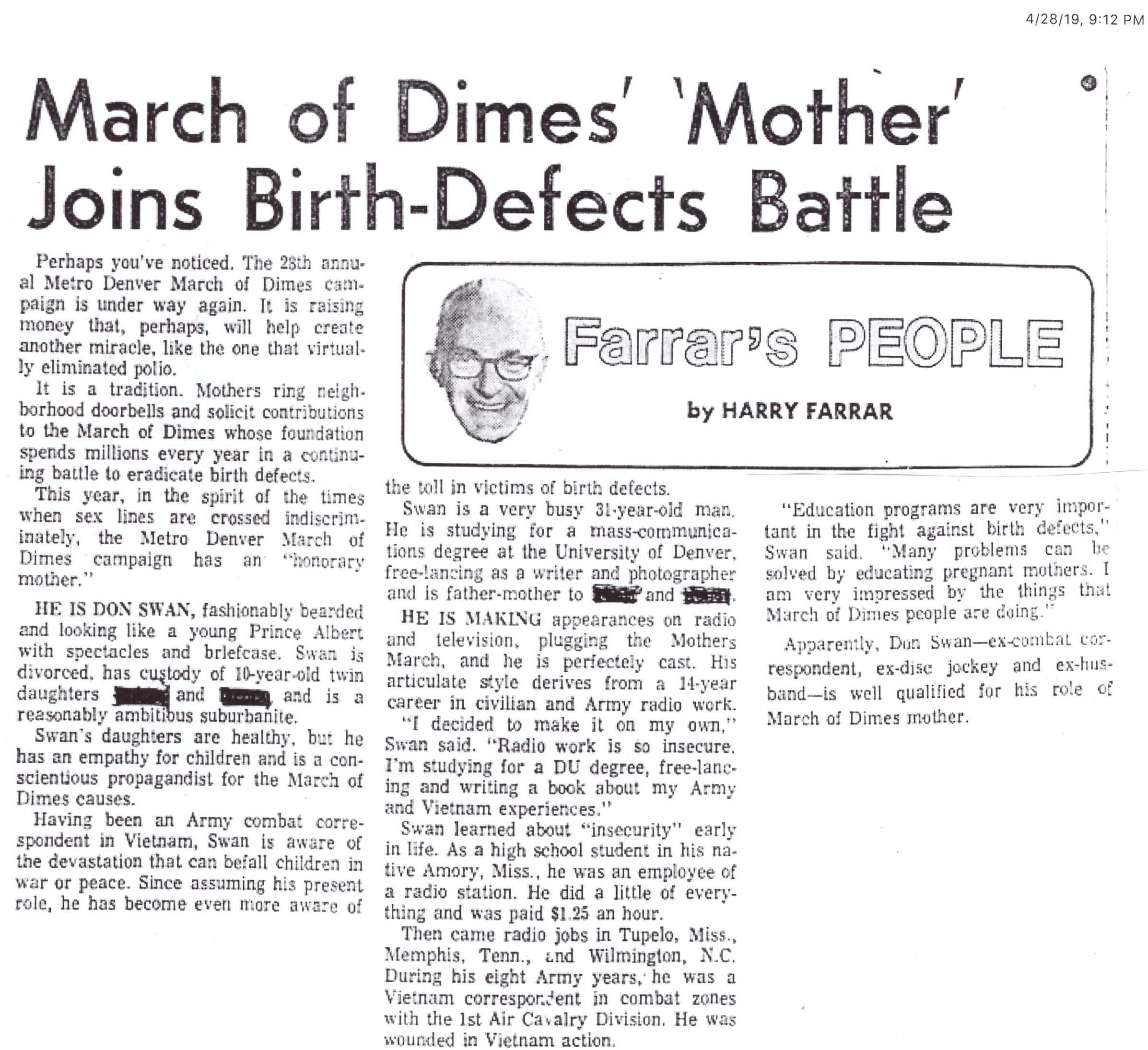
I had a fan club that was always sending me stuff.  On air, I became known as  Don “Mother” Swan, a moniker that stuck after a Denver Post article (in Chpt. 33) on my volunteer work for The Mothers March Of Dimes. The non-profit that worked to prevent birth defects made me an honorary Mother.

At KLAK, I was a popular on-air personality and became the station’s entertainment director. I hosted Country Music performers like Waylon Jennings, Willie Nelson, Merle Haggard, Crystal Gayle, and others. I opened (as opposed to emceeing) a show for Jim Stafford (My Girl Bill) and Kenny Rogers (The Gambler) at the Complex in Denver, with a comedic bit.  It was my first and last gig as a comic, despite being voted the wittiest at Hatley High School.  But:

DSAppear
scan_20190513_184829-e1557799279956.jpg
Scan_20190515_124403.jpg
Scan_20190515_120500
Hard to read sentences; bottom line, my “Night Life” show increased ratings by 38%.
(From KLAK memos in 1976. Ratings from Jul/Aug 1976 ARB Seven County Central  Audience Zone, Quarter Hour Audience Estimate)
Scan_20200809_212140_001

At KLAK, I was putting in about 35 hours a week and filled in for other DJs, including the most important shift: Morning Drive. For me, hosting the 6-10 a.m. show in a top twenty market was heady stuff, with an estimated audience of 70,000. Notably, the show’s regular Morning Drive DJ was pulling in some serious money, about $500 a week, a bit over $2,800 in 2025 dollars, and was soon on to WJJD in Chicago, making even more. (Great money, but if your ratings tank, you’re out the door.)

Some of the most popular Country songs I was playing: Convoy–C. W. McCall; Before The Last Teardrop Falls–Freddy Fender; Chevy Van–Sammy Johns; (Hey, Won’t You Play) Another Someone Done Somebody Wrong Song–B. J. Thomas; Thank God I’m A Country Boy–John Denver; I’m Not Lisa–Jessi Colter; Please Mister Please–Olivia Newton-John. The Dolly Parton version and the song she wrote, I Will Always Love You, is the best, in my opinion (approx. 13 million views on YouTube!™

Outside the station, I was a one-person advertising agency, did voice-overs for some major advertisers, and was a full-time student at DU.  A performative documentary I narrated won a bronze medal at the New York Film Festival. In addition, I played Col. Forsyth and the off-stage voices in Arthur Kopit’s Indians (for graduate credit) at the DU theater, a play that ran for several weeks and received good reviews.

More top Country hits I was playing on 16AM KLAK: Torn Between Two Lovers–Mary MacGregor; Faster Horses–Tom T. Hal; Don’t The Girls Get Pretty At Closing Time–Mickley Gilley; You’ve Been Talking In Your Sleep–Crystal Gale; Mama’s Don’t Let Your Babies Grow Up To Be Cowboys–Waylon & Willie; Lucille–Kenny Rogers; You Light Up My Life–Debbie Boone; Snowbird–Anne Murray and Luckenbach, Texas–Waylon Jennings.

Disc Jockeys from around the Country were looking to come to Denver. I got calls from DJs in Philadelphia and other markets larger than Denver, wanting to work in the Mile-High City.

The mid to late 70s were a great time to be in Colorado, as the state saw a surge in popularity.  You may remember John Denver; he touted Colorado (think: Rocky Mountain High).  People were flocking to the Mile-High City and the even higher Rocky Mountains to the west.

I happened to be on-air (March 1976) when the news broke that Andy Williams’s wife (Claudine Longet) fired several .22 rounds into the belly of Olympic ski star Spider Sabich in an Aspen Ski Chalet bathroom. (He died in the ambulance on the way to the hospital.) Williams (Can’t Get Used To Losing You, Moon River) was an immensely popular singer who had his own TV show and Christmas special.

He wasn’t in the rotation of music we typically played on KLAK, but for some reason, news outlets from around the world were calling our station for news about the sensational event. I was quoted in the foreign press, especially in Australia, about the shooting death (I had no insight into the case; I just verified the story). I joked on my radio show that the next Andy Williams Christmas special would probably be held in Cañon City (home of Colorado State Penitentiary).


*It is unintentional if any of my writing ever sounds like I’m feeling sorry for myself or seeking pity from my readers. Others had money problems more significant than I had. As for sickness, So many also had it worse, like small children with incurable cancer or young girls with incontinence and all the other perils of incurable Crohn’s disease

Chapter 31: To Some of the Girls I’ve Loved Before 759

Author's Note: If you are likely to be offended by what today would be considered masculist language, this story from some forty-five years past is not for you. Thanks for reading, but skip this chapter.

Disclaimer: With the challenges I’d faced to this point (Think: Vietnam, Crohn’s disease), I believe I have a license to extol the good times too. Here's what I missed: The free love period (I was in VN), the last three years of marriage, and my age 15-17 celibate years. That’s six years plus.
scan_20190417_194432.jpg
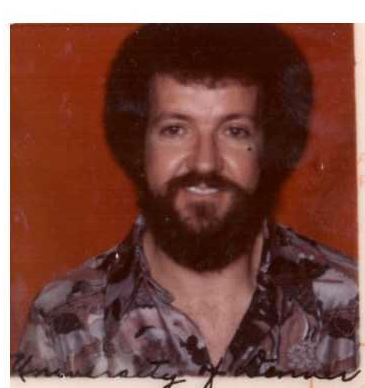
Handsome Dog or just Dog? (From Univ. of Denver   ID, 1976)                                                      

I had the privilege to meet and date scores of intelligent and beautiful women in my five-and-one-half years in Colorado.  A few asked me out, and some sent me flowers.   

Many women, and people in general, found my single-dad-ship of two girls quite virtuous. They gave me even more respect as they spent some time with the twins and saw how difficult they actually were.

I had more than one desirable marriage offer. It seems women thought it was great for a father to take on the responsibility of caring for his children alone, especially girls. I was appreciative and fortunate but never seriously considered marriage at the time with the unique needs the twins required. I thought a permanent relationship, matrimony, would unnecessarily burden my preteen children and a new wife.         

But it was perfectly fine for the twins to see me with different women, coming and going.  I didn’t say it was a perfect plan. Hold on; the children aren’t even here yet.

Warning: Egotistical Rodomontade Ahead:

img793

          Don in 1976. (Credit Sam Trott)>

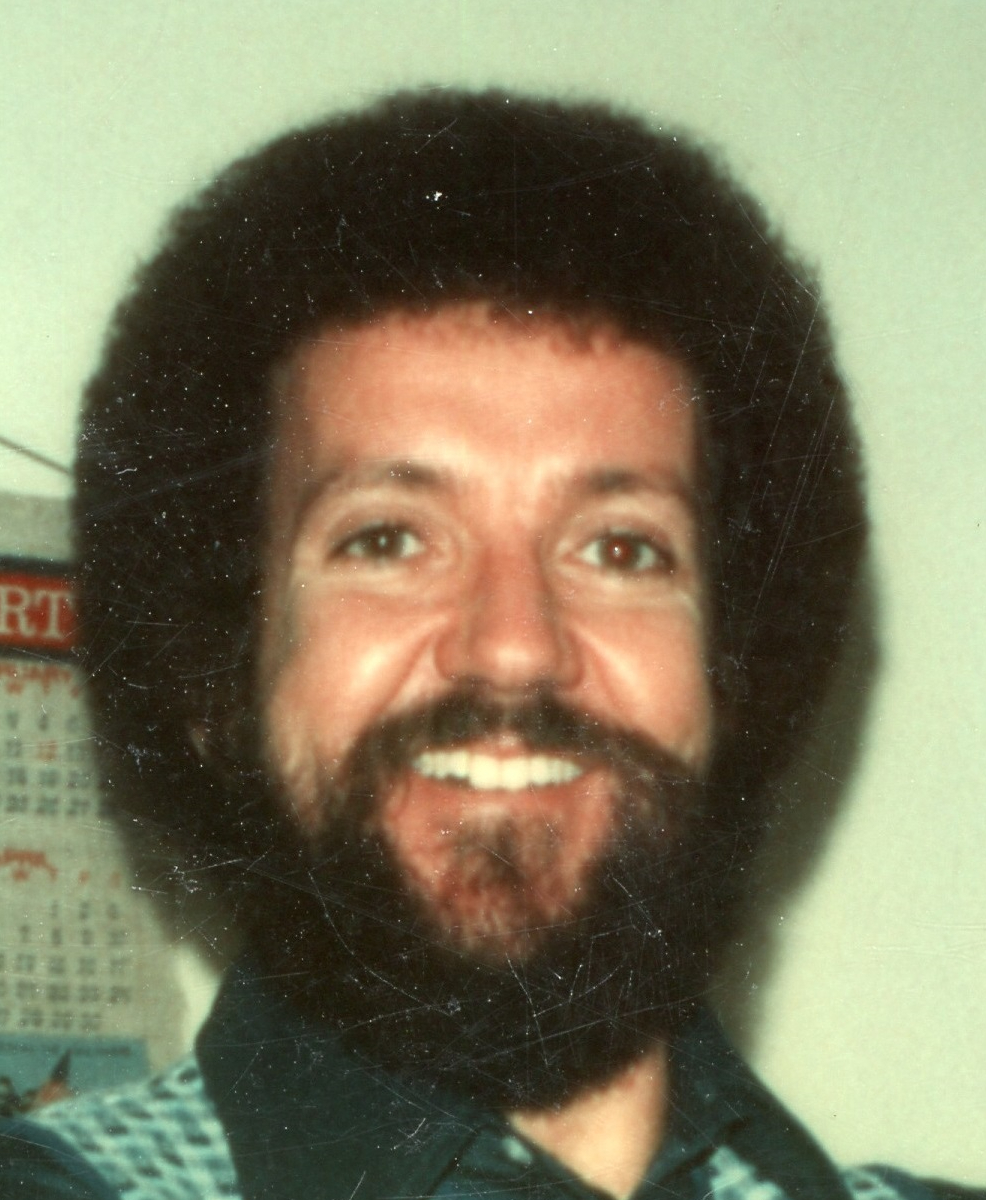
In the late 70s in Denver, a 6’ 3” “good-looking” single with an afro and full beard who was a popular DJ and Master of Ceremonies for touring Rock and Country bands on the University of Denver intramural basketball team and knew how to treat a lady — could get a date. Now, imagine that man with a vasectomy. I did alright, and with so many opportunities, tough choices had to be made. Had I driven a 930 and had a cute Golden Retriever, no telling.

To understate it dramatically: Life was so good. It could have ended right there.

I would never be so crass as to estimate the number of women I dated, (over a 17 year period, including and after Denver)  but if I were forced to, I would need to count with all my fingers, okay, toes too. And there were several months at a time when I was in love, dating just one woman. I know, I know, what a sacrifice.

Despite explicit scenes of war and peril that I unequivocally depict elsewhere on these pages, any sexual escapades that may have emanated from my interaction with the fairer sex — will not be. However, if you let your imagination flourish ne plus ultra, you will have a good idea of the responsibility and delight that came with me dating so many. 

I promised the women in my life who were especially good to me that I would treat them kindly in my book. Now with My Life At The Limit finally a reality. Here is my promise kept.

                                                                 In random order:

PamJeanJodieDiDiDorindaGingerJoyceKathyCharleanLeaSandyMarciNormaMarshaSonnyPattyKelaPennyDarleenBevLindaCarolynMaryTrishVerlaSusanLoriRoseDebbieDeboraMartiDinahDoryKayBeckyJaneGeorgiaMargieMarilynClaudiaB.J.EarleneSallyJessicaChrisMichalynTerryAngieMeaganJanPattiJoMendyOliviaKaleaCherylCourtneyCynthiaAmyNancyJoan.
 I’ll stop here, lest I am accused of boasting. For those inadvertently left off, you’re just lucky, I guess.

scan_20190513_170532-2-e1559331984401.jpgSwinging with my tamed afro in cigarette ad. (Swan archives)
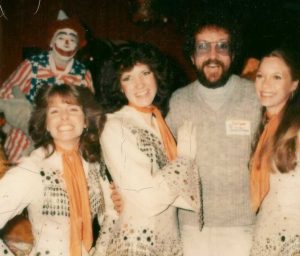
Life was good; everything was going great, but one thing was lurking below the surface — the twins. I was here in the Mile High, having a wonderful time, and my Momma, in her mid-sixties, and Daddy, at seventy, were taking care of two six-year-olds in Mississippi without modern conveniences.

The twins had been with her since Marty sent them there in late 1974, almost three years ago. I needed to make a decision. Would I leave them with Momma indefinitely,  have them stay until they turned eighteen? I knew the right thing to do, even with me in college full-time, working full-time, and dating full-time.  Bringing them to live with me in Colorado would be a significant adjustment for all of us. That is an understatement, indeed.

Another day at work.     (Swan archives) 

img789
                         A wonderful wife.  A wonderful life. Thanks, Cheri. (Swan archives)                  
Do I have the most amazing wife (readers too) who are not offended that I included in my life story such nonsense as mentioning these women in my book? Yes, I do. Safe to say, she’s not an insecure woman.


Chapter 32: Elvis Is Dead & Rocking In The Rockies. 2,691

The sun had set on another hot August day in the Mile High. With heat rising into cooler air, city lights were flickering as far as I could see when I crested an elevated stretch of the 6th Avenue freeway, headed east toward home in Littleton. Already nostalgic from my last shift at KLAK, a DJ on KBPI casually made the announcement: Elvis was dead in Memphis. Between radio jobs, I had no immediate outlet to talk about Elvis, to honor his legacy or play his music.

Now more than ever, I had to continue with my own dreams.  After more than two years at KLAK, I had an opportunity with a relatively new station, broadcasting in FM stereo, and it was playing Top 40, my favorite music. I would have plenty of time, I thought, to show my appreciation for the King of Rock ‘n’ Roll.

Boundless words have been written about Elvis, so I won’t try to compete with them or the nearly 100 books. Below, however, are a few tidbits that are pretty much common knowledge to any casual fan, intertwined with some that even a dedicated follower might not know.

 About Elvis:

Early on, Elvis, Scotty, and Bill, failed an audition for the TV program “Arthur Godfrey’s Talent Scouts.”

Elvis reportedly drove his Cadillac on the gravel road by the Swan’s back country dogtrot house in June 1955.

His first Las Vegas engagement in 1956 was unsuccessful and cut short.

The leader of a popular Memphis band, where Elvis had failed an audition, told him he should “stick to driving a truck,” (his job at the time). A year later, in 1956, Elvis had four #1 songs on Billboard’s Top 40, two of which were the top two songs of the year!

Elvis heard the Jordanaires on the Grand Ole Opry and was able to meet them  backstage after a show in Memphis and told them, “If I ever get a recording contract with a major company, I want you guys to back me up.” They wished him well, but never expected to hear from him or of him again. We know what happened later, Elvis used the Jordanaires for the next 14 years.

The day after Elvis’ first RCA session Jan 10, 1956,  a producer called Chet Adkins (renown guitarist) wanting him to do a session with a new “probably wouldn’t be around-long-kid named Elvis Presley, with oily hair, pink shirt … black trousers.” Three months later Heartbreak Hotel was the #1 song in the U.S.A.

Elvis was burned in effigy in Nashville and St. Louis after his second appearance on the Ed Sullivan Show in 1956.

The BBC banned his music (and all Rock ‘n’ Roll) when the Brits were hungry for his songs, saying he was a “corrupter of youthful innocence.” Newspapers there said his music “was nonsensical and obscene.”  Listeners got his tunes from other sources, and his style and songs influenced British artists tremendously.

At his birthplace in Tupelo, Mississippi more than 100,000 visit it annually, just two miles away 20,000 of them also visit Tupelo Hardware where his mother, Gladys, bought him his first guitar at age 11.

Visitors can and do stand on the floor (the actual worn floor) where Elvis stood while his mother handed him his first musical instrument. It cost $7.75.

“Many people who stop by here become very emotional,” said the store’s official host, Howard Hite. “A couple came all the way from Brazil. After I told the story, I saw tears in their eyes, and the man asked. ‘You don’t mind if I give you a hug, do you?’ ” Hite complied.  (Quote from TomBigbee Country Magazine).

 As for Graceland, it attracts more than 600,000 the second most visited home in the U.S., behind only the White House.

LBJ visited Elvis on the set of Spinout, in the late 1960s.

Pat Boone often joined Elvis and other stars in touch football. Elvis showed promise for football in high school, but his mother forbade it for fear he would be injured.

Elvis wore a size 11 shoe.

Elvis appeared in a public service announcement asking young people to get vaccinated for Polio. It was a huge success.

Elvis bought FDR’s former yacht and later donated it to the St. Jude’s Hospital for Children.

Elvis’ first Grammy was awarded for Gospel music.

Aloha From Hawaii, a live satellite broadcast around the world, Jan. 1973 was the most-watched TV program ever, with an estimated audience of 1.5 billion!

Quotes by Elvis from Esquire Magazine:

 I never tasted alcohol.”

“My mother goes to town, and she buys anything she wants, which makes me feel real good.”

“When I’m pushed to a certain point, I have a very bad temper.”

“I’ve had a pretty good lesson in human nature. It’s more important to try to surround yourself with people who can give you a little happiness because you pass through this life once. You don’t come back for an encore.” (end of Esquire quotes)

Elvis’ last night was not unusual, according to friend Jim Browder, “Elvis stayed up all night. He entertained friends, played the piano and sang, and even played racquetball in the early morning, just before retiring around 8 a.m. His fiancée Ginger Alden, was staying with him, but sleeping in a different room.

She was the last person to see him alive, and she was the person who found him on his bathroom floor at 2 p.m.” (Although this is the generally accepted account of Elvis’ last day, there are variations of the story. This is from the TomBigbee Country Magazine near his hometown, that has been reliable in the past.)

Lisa Marie, his nine-year-old daughter saw Elvis being carried out the front door by emergency squad and tried to break-away from people holding her back, to touch him. She was never able to. She was screaming, “Daddy, you promised not to die on me.”

Caroline Kennedy and James Brown saw Elvis’ body in his casket, including about 30,000 others. At Forrest Hill Cemetery, it was wheeled to corridor Z of the mausoleum and placed into the crypt. It took 100 vans about five hours to take the flowers from Graceland to the interment site, according the TomBigbee Country Magazine.

Only a few hours before his death, according to the magazine, step-brother Rick Stanley heard Elvis recite a Christian prayer,  “Dear Lord, please show me the way, I’m tired and confused, and I need your help.”

~~

Some of my all-time favorite Elvis songs include Follow That Dream, Wild In The Country, I’ll Remember You, Can’t Help Falling In Love, Are You Lonesome Tonight, Wooden Heart, Don’t Be Cruel, Love Me Tender, Kentucky Rain, The Wonder Of You, Please Don’t Stop Loving Me and on and on. As for Elvis, his favorite songs were: Long Train Runnin,’ I Can’t Help Falling in Love and How Great Thou Art.

~~


As for my new job, moving to KBPI was a minor gamble for me. And even though she was one of the top pop stations in the market, everybody at the other rock stations was anxious to move up in this very competitive format. I would be on-air just ten hours a week, 10am to 3pm, Saturday and Sunday. But I wanted to be a rock jock in Denver like, seemingly, everybody else.

With a short break between jobs, I was anxious to and did more exploring of scenic Colorado. I had a new 1977 gold VW® Scirocco with ski racks, sunroof, FM Stereo, and cassette player.  Eventually, I had a turbocharger installed. It was a great ride and, after the forced induction, fast. I surprised lots of Datsun® Z cars who tried to keep up with me. I began wearing seat belts when I got the little Scirocco, and have been using them in all my vehicles ever since. It became mandatory in the state ten years later.

Scan_20190420_215011

It was a great time to be in Colorado. The Denver Broncos were emerging as a powerhouse in the NFL and were immensely popular in a vast region, and eventually made it to the Super Bowl before I left the Mile High City. The Denver Nuggets professional basketball team had just entered the NBA and attracted major talent.

An NHL Hockey team — the only major league franchise within a thousand miles — the Colorado Rockies (now Avalanche) were winning and gaining large audiences.

The capital city had its own major league rodeo franchise — The world champion Denver Stars.*  The University of Denver Pioneers Hockey team won several NCAA Division I titles and was a perennial contender with reasonable ticket prices. The DU ski team hasn a record 25 National Championships since its inception in 1954.

It was no secret the Rocky Mountains around Denver were renowned around the world as a hip locale.  There were a dozen ski resorts, many of them word-class like Aspen and Vail. In the Rockies, the sun shone more than most places with similar climates.  It was great for people who loved the outdoors. In the fall, the Aspen leaves were captivating. Colorado is truly beautiful. 

images

Typical Rocky Mountain Ski scene. (Commons)

I learned to ski in Colorado at the best resorts in the country. I wasn’t a natural, and I did a lot of “snowplowing” before I got my balance and the confidence to ski the black diamond runs.  Then it was just me, thousands of feet above the pedestrian earth, closer to heaven floating on virgin white powder, gliding like an eagle — soaring in freedom. Rocky Mountain high, indeed.


It was time for me to Rock ‘n’ Roll — literally — Denver’s Don Swan Rocks the Rockies on 107.9 KBPI playing Beast of Burden; Do ‘Ya Think I’m Sexy; Roxanne; Werewolves of London and other great hits. Denver radio was a cutthroat enterprise. There were at least 50 or more DJs here and around the country vying for every position that might become available.

DENVER’S DON SWAN 🎧 NOW ON

images

I was the deep-voiced rock jock on KBPI every Sat and Sun, 10 am to 3 pm, in one of the most competitive and coveted markets in the Country. I became popular on-air and well-received at KBPI, spinning You Light Up My Life, Hot Blooded, Life’s Been Go To Me So Far, Too Much Heaven, Tragedy, Bad Girls, and all the hottest hits of 1978-9.

Results below show how DJs (like me) can make a difference:

Oct/Nov 1977 ABR Survey results from KLAK memo for Don Swan Show:

Before Swan leaves KLAK:

Scan_20190405_133407

Both surveys for 10am-3pm

Oct/Nov 1978 ABR Survey results from KBPI memo for Don Swan Show:

After Swan arrives at KBPI

Scan_20190405_140459

As a personality on The Rock of the Rockies, I was involved with popular bands, introducing some at concerts or somehow connected.

They included Jimmy Buffett, The Eagles, Neil Diamond, Michael Murphy, Doc Severson with the Denver Symphony, Seals & Crofts, America, and Carol King. Then there were the Four Tops, Johnny Rivers, Tina Turner, and Dionne Warrick at the Complex, Denver’s Cow Palace, Red Rocks, and other venues.  Don’t forget The Captain & Tennille with Muskrat Love, one of the worst songs of 1976. Guess I didn’t know my audience as well as I thought; it went Gold.


As for me mugging with celebrities, I didn’t think you needed to see that many pictures of yours truly. I may appreciate their music or acting, but after congregating with plenty of luminaries or famous people, they are just not a big deal to me. There could also be issues with publishing celebrity photos. Even though they are public figures, I would probably need a release. I don’t have such pictures displayed in my ego room either.

Red-Rocks-crowd-rainbow-w1-576x384
Incredible Red Rocks amphitheater, as seen in 2014. (Confluence Denver. Com)


Jimmy-Bufett-1977-al-billboard-1548
Jimmy Buffett, one of my favorite performers at Red Rocks. (Billboard)

There were lots of fans who were loyal to “Denver’s Don Swan on 107.9-KBPI.” But how long could it last?

You probably remember the test of the Emergency Broadcast System (EBS) on the radio in the 70s and later. Here’s how it worked: The announcer inserts a cart that begins with twenty seconds of a very distinctive tone of beeps and chirps, a sine wave of 960Hz. Then, the prerecorded voice announces,  “This is a test of the Emergency Broadcast System. This is only a test. If this had been an actual emergency, you would receive instructions from this or other stations. KBPI serves the Denver area. This concludes the test of the Emergency Broadcast System.”

By now, you know me as one who wants more excitement than the average guy. You know, to do something different, get people laughing or thinking.

I wasn’t afraid of a bit of controversy and had considered taking a dig at law enforcement in Aspen and Glenwood Springs, Colorado, where Ted Bundy had escaped from both jails just a year ago in 1977.  After that last breakout, Bundy made his way to Florida, where he killed two more women and a 12-year-old girl.  But I thought better of it out of respect for the families of Colorado victims who lived near Denver. Bundy confessed to the Florida killings just before he was executed.

Instead, I decided one sunny Sunday afternoon to broach a subject less offensive than murder, although about possible deaths.

I inserted the EBS tape and allowed the tone to play, then I turned off the prerecorded message and did my version of the announcement. I said in a solemn voice: “This is a test of the Emergency Broadcast System . . . If this had been an actual emergency, you would be told to kiss your ass goodbye, likely because of the facility that lies just 16 miles north of us.” (That facility was the Rocky Flats nuclear plant.) Then I played Knock on Wood.

hfr-rocky-flats-part-one-rs-no-blurs_frame_2374
Especially after listening to Don Swan. (Courtesy CBS4 Denver)

OK, isn’t that a little funny? Not with the FCC, they called the station manager less than 24 hours after my comment and said something to the effect: “Fire this person or be fined $5,000, plus a notation in your file that could be detrimental to the renewal of your operating license.” Ouch!

Guess which option the station chose?

Joke or not, the FCC wasn’t laughing. The Rocky Flats facility near Denver was a nuclear weapons production plant.  Many living in the area and beyond considered it a very hazardous installation.  Also, the FCC required the station to sign a non-disclosure agreement about the incident. Unbelievably, there was no promulgation, no news stories.

Did that make me an early Shock Jock?  Why was my joke, not free speech? One cannot yell “Fire” in a crowded theater and claim free speech.  My statements were not in the context of a DJ saying, “Boy, if that plant ever blows, we can kiss our asses goodbye.” That’s free speech. My comment, however, was made during an FCC-required EBS announcement — an official notification.

A competitor, no doubt, had someone call the FCC.  I can imagine the complaint. “I was so frightened that I began breaking out in hives, and I had trouble sleeping after that bad man made a joke of something that’s no laughing matter — Nuclear Weapons.”

Oh well, I needed more time to concentrate on my studies at DU and my small ad agency. Soon I would have the most challenging job of all — parenthood for a set of twins.


Around 1992, having not played DJ for several years, my enjoyment of popular music was on the decline. Was it an age thing, like the generation before us? I don’t believe so. My love for music was so enduring that I was surprised it was happening to me.

There were songs I still enjoyed, like Tears In Heaven–Eric Clapton; Bohemian Rhapsody– Queen; Have I Told You Lately That I Love You–Rod Stewart.  Hero–Mariah Carey, Endless Love–Luther Vandross. Circle Of Life & Candle In The Wind- Elton John, I’ll Stand By You–The Pretenders and Un-Break My Heart–Toni Braxton. 

The Greatest Hits from my generation are in Book II, Chapters VIII & IX.

*Transporting livestock to and from cities like San Antonio, Salt Lake City, Los Angeles, Kansas City, and other venues proved too costly. I was their promotions and advertising manager and was owed lots of dollars when the Stars went bankrupt after just a few seasons. 

Chapter 33: The Twins To Colorado 1,311

A heat wave blanketed the Denver area, but I was not on the radio doing a Johnny Carson bit on “how hot was it.” It was crazy, I was no longer a Denver DJ, yet I wasn’t sitting and staring at the walls. In fact, I wondered how I had been able to pull it off as long as I had; Full-time DJ-college-dating and some ad work. With this break, I knew what I needed to do.

So, just a few days after my unceremonious departure from Denver radioI flew to Memphis, rented a car, and drove an hour south into Mississippi. At the old house of my youth, I would pick up Lisa and Laura for their journey to live with me in Colorado.

I was surprised and concerned when I saw Momma. She stood with a slight hunch and looked tired and older than her age of 66. She appeared to have aged ten years in the four years since I last saw her.

Laura said if she were allowed to stay and wanted to, she could help take care of her Grandmother. There was sadness all around and a few tears, too. Momma and I helped them pack for yet another move. Appalled at my full beard and Afro, Momma’s reaction momentarily lifted us from an otherwise sad affair.

~~

Scan_20190822_144918 The Twins at the start of  1st grade. (Bonnie Parham)

A short time before I left Colorado to pick up the twins, I bought a house in an upscale neighborhood in the Denver suburb of Littleton. The split-level, 1,700 sq. ft. three bedroom, three bath featured a wet bar in the basement and a moss rock fireplace surround in the family room. Lewis Ames Elementary school was within walking distance.

Having left Tacoma for Germany, then moving to North Carolina, Kansas City, and the journey to Memphis, the twins could have qualified for frequent flyer miles. Now they were moving from Mississippi to Colorado, so flying into Stapleton was no big deal, although Laura was still sad at having left her Grandmother.

We had an uneventful flight on a United 727, unlike a recently hijacked United 737. It landed and remained at Stapleton for 90 minutes before the malefactor surrendered.

We grabbed our luggage from the carousel, loaded it on a shuttle to long-term parking, threw it in the car, and commenced the 45-minute drive southeast to our new home. As for the big cities, they remembered (Kansas City and Memphis), Denver was indeed different, with the Rocky Mountains framing the skyline to the west.

Similar to our house (below) in the same neighborhood of Littleton, 1978-80. (ReMax™ Realty)

isy3hn7s78m6cd0000000000.jpg

Now, they would finally get their separate bedrooms in our big house in suburbia with a fenced backyard. It was a world away from Mississippi.

The children in our neighborhood laughed at their southern accent and the types of clothing they wore, which they had brought with them from Mississippi.  I took them to nearby Southglenn Mall for new wardrobes. I had no luck.  Frustrated, I asked a single mom who lived next door to accompany us. It still wasn’t easy, but together we made it work. Then I enrolled them in elementary school for the fifth grade.

Scan_20190516_164450I was proud to be featured in the Denver Post, in 1978, a time when it was uncommon for men to be single parents.  (Swan archives) 

~~

Many women, and people in general, found my single-dad-ship of two girls quite virtuous. They gave me even more respect as they spent some time with the twins and saw how difficult they actually were.

We went to counseling a few times, and I concluded it wasn’t helping; besides, the twins hated it. The girls promised to be more attentive and less difficult at home and school if they could stop counseling. Then, I enrolled them in a Calvinettes group at a local church. I also entered them in after-school recreational programs like swimming, horseback riding, gymnastics, and the like.

I had a platonic live-in young lady, a fellow student, who stayed at our house rent-free in exchange for some help with the twins. Thanks, Jan.  I also had a girlfriend in particular, who was especially supportive and was a taxi for the girls on many occasions. Thanks, Marilyn.

Now that the twins were occupied with school and other activities, I needed to concentrate on my studies. I had long ago realized I needed a profession more secure than radio, especially now with my daughters depending on me.

How about something like a government job? That would be about as far from radio as I could imagine. But any job would be more secure than the radio broadcasting profession. Another One Bites The Dust played on KBPI.

~~

Graduates of the Communication Department at DU (where I studied) had among its alum members of the Hollywood film industry, and a graduate who started The Hard Rock Café, and one was credited with the music video concept.

Professors in the department created a work-study program with an adventure that would take us to the studios in Hollywood.  (That meant, shortly after the twins came to live with me, I had to find a sitter for a week.)

In Hollywood, we got an up-close look at the motion picture and TV industry. Boring. The setups for a scene and the takes are a prolonged process. There was plenty of standing around and more time for setups and actors back and forth to their trailers.

We watched an early taping of Dukes Of  Hazard (a few months before it debuted), a live taping of Alice, and The Tonight Show where (surprise) Letterman was the guest host. Most interesting to me was an early screening of The Deer Hunter. 

Despite that fun trip, I sometimes thought college would never end; I needed credits here and there. I was carrying a heavy academic workload. My VA counselor kept me on a tight schedule to ensure that I graduated within the time allowed for my Vocational Rehabilitation training program, paid for by the VA.

DU was (and continues to be) a private, intense, and costly school.  Professors took their jobs seriously and were quick to discern mediocre work in any assignment. Going to class unprepared could be incredibly embarrassing. I never made less than a C, but I worked harder for some of those than I did for an A.

One such challenge was an astronomy course taught by Professor Everhart — who naturally had a comet named after him.  In addition to DU’s Chamberlin observatory, class was occasionally held at his high in the Rockies house. He had had his telescope to view the heavens. A professor of that stature has high expectations. There was a surprising amount of math, science, and photography. I studied hard and barely squeaked by with a C. Then, there were other especially challenging courses like quantitative analysis, statistics, and mass communications law.

The next logical step for my education was a Master’s degree. I had worked hard and graduated in three years with a double major, a BA in Speech Communication, and a BA in Public Communication, with a final GPA of 3.2. The twins were ecstatic — very proud of me. In addition, I was awarded the prestigious University of Denver Community Service Award at graduation.

With my early graduation, my VA counselor determined I still had another year of benefits, which I would use for graduate school. The good news about DU’s Master’s program is that getting one in less than the usual two years is possible. Bad news: it comes with a tremendous workload, a mini-thesis every quarter. I chose the fast-track program and was a Graduate Teaching Assistant while studying for my advanced degree.  I completed my Master’s in just over a year. My final thesis was “Cybernetic News,” I was awarded an MA in Public Communication.

Now to find a job.

Chapter 34: The Great Salt Lake & The Good Mormons 1,533

Single parent with two children and no child support, sounds like what many women were struggling with.  Yet, it was me in that predicament — financially supporting and parenting twin nine-year-old girls.

~~

After more than a year of juggling graduate school, work and parenting, I had an epiphany: I needed a real job. After sitting in seemingly endless classrooms and writing enough papers to please a platoon of professors in the army of academia, I’d obtained a couple of college degrees. Now I was ready for corporate America or something like it, Denver however, was as competitive in the business sector as it had been becoming a DJ in the Capitol city.  A well paying relative secure job in the Mile High, I would learn, seemed to be even more elusive.

Of all the resumes I sent, and I sent a lot, the most promising response came from Utah. Just one state west, but a world away, I sensed.  

I left the great state of Colorado to apply for a Public Affairs Officer (PAO) position at Defense Depot Ogden, Utah (DDOU).  I was interviewed by the Vice Commander with the Commander sitting in; it went very well, and I was hired on the spot.

Although it was not official, because of my pending security probe and going through the motions of government hiring. The good news, you’re hired. Bad news, the Depot may be closing. On the radio, Hit Me With Your Best Shot by Pat Beneatar rang out.

images-37
Causeway on The Great Salt Lake.  (Utah Convention & Visitors Bureau)


fd31d1515e9f30b3942c4fc3399c82bcl-w0xd-w480_h480_q80
Swan home in North Ogden, Utah with view of Great Salt Lake. (Swan archives)
I had worried about the new job, Mormons and the state of Utah unnecessarily, I liked them all very much. I had also worried about ever getting another date, in the conservative state of Utah.

Then I met Lucinda (pseudonym) at the nearby Hill AFB public affairs office. I was the envy of many who had tried unsuccessfully to go out with her and just men in general.

Utah, for me, was a great state for dating and skiing. There was a good run, just a fifteen-minute drive from our house in North Ogden.

~~

As for my new job, I had one employee at my disposal. She was a lady in her mid-50s who had “Public Affairs Assistant” in her job description, but the previous PA used her as a secretary and general flunky.

Image her surprise and consternation when I told Betty (pseudonym) she was expected to assist me in PA activities. Fast-forward: In less than a year, she was writing good articles for our monthly newspaper.  She didn’t exactly tell me how grateful she was for me making her do her job, but her attitude changed for the better. She was proud of her work, especially her photography.

The worst part of my job was the workday that began at 0730 on mahogany row, where the Commander and his Deputy, Legal,  PA, and other senior staff had offices. The workday ended at 1630, but I was rarely out by then.

DDOU provided items to all branches of the U.S. military units worldwide.  Some of the supplies we shipped were mundane, others were sophisticated and critical. Our parent command was the Defense Logistics Agency (DLA) located in Alexandria, VA. DDOU was one of several depots located throughout the U.S.

In staff meetings, I sat at the table with the Commander and other principles within the orginazition.  Other members of staff occupied chairs farther back. I’m telling this because a lieutenant colonel who sat in one of the seats behind me became my best friend. He provided me with invaluable advice on how to work within the bureaucracy that included both civilian and military members.

Untitled-1
Scene from Wayne County, Utah. (Wiki Commons)

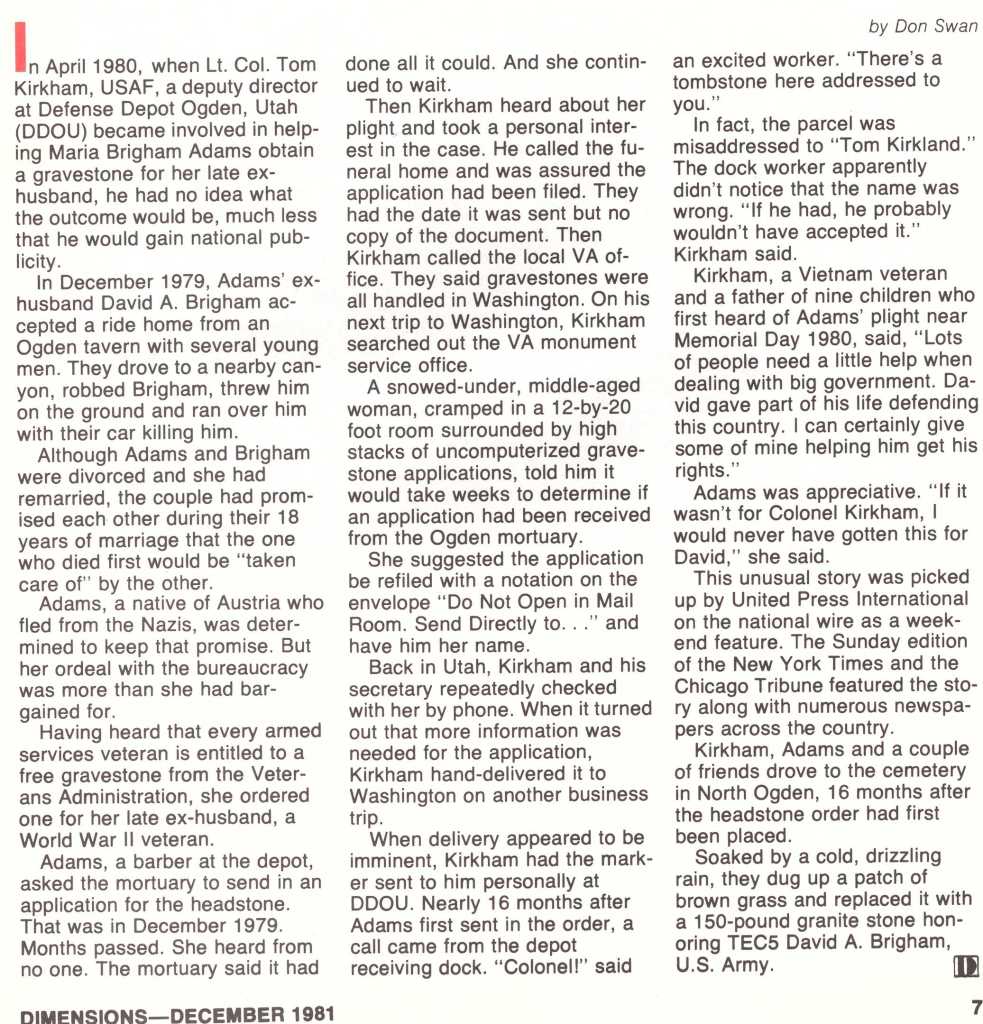
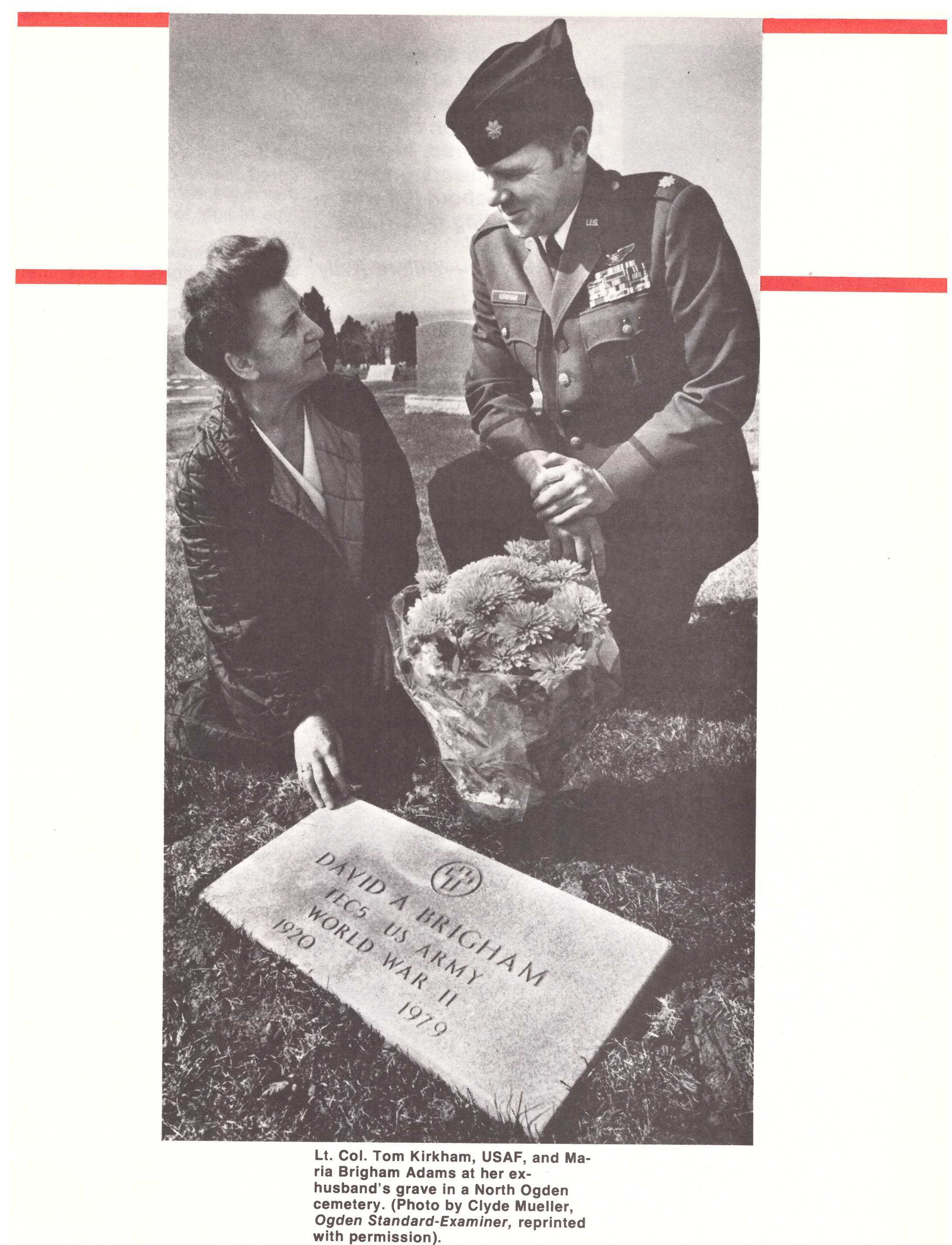
Col. Tom Kirkham was a practicing Mormon (and continues to be) who fathered nine children with his wife, Mary.  Tom is a Vietnam veteran of the U.S. Air Force and had some interesting assignments in Southeast Asian countries. At the time I met him, some of his clandestine operations were less than 10 years old and were still classified but downgraded from Top Secret SCI/SAR to Secret.  

All I can say about his missions (now fifty years past) is that they were extremely dangerous and daring. Don’t feel left out — you might be better off not knowing any details of those operations.

He had other jobs in the Air Force that might seem boring after his Southeast Asia adventures, but no less critical. Tom was a Battle Staff officer on Looking Glass (so nicknamed by the crew) an airborne EC-135C that would provide command and control of U.S. Nuclear forces if ground-based control of those weapons were destroyed or otherwise rendered inoperable.

The general officer on board Looking Glass would assume the role of (the) National Command Authority and have direct control of and capacity to launch nuclear weapons. You read that right; pretty heady stuff. One of these EC-135Cs (Boeing 707) Looking Glass jets was always in the skies over the U.S. from 1961 to 1992.

Tom made full colonel (less than 50% of the qualified lieutenant colonels do) before he left DDOU. He held command positions within DLA before his retirement in 1987.

I’m convinced Tom would have made an exceptional Brigadier General (the next grade above Colonel). Competition is fierce; records indicate less than five percent of eligible colonels make the grade of brigadier-general, and only then when an assignment is available for their rank. All general officer promotions require approval by the Senate and the President.

Tom and I have remained friends over the years, despite our assignments that didn’t coincide. We stayed in touch because our friendship is fervent, and we took pride in having served in the U. S. military before it became popular.

Tom is a great American to be commemorated for what he was: a guardian of our freedom, and for what he is:  a genuine patriot. In retirement, he continues his service as a leader in his church and community.  I hope that in some small sense, I am remembered that way as well.

HOW DO YOU SOLVE A PROBLEM LIKE MARIA’S?

Scan_20190412_131333_001

scan_20190412_133630.jpg

~~

Back to the reality of my new position at DDOU. The Commander, my boss, told me I had free rein on how to structure my job; good news, indeed. There were also some mandatory requirements I was responsible for which included publishing the monthly newspaper for our workers, keeping the media informed of our mission, and answering their queries. I also met and stayed in touch with community leaders, local and elected officials, which became more important than ever since DDOU was on the hit list for closure and the loss of 2,500 jobs, including mine.

On my way to visit the editor of Ogden’s Standard-Examiner, Kim Carnes’s Betty Davis Eyes reverberated from the small speaker on my staff car. On my annual year-end countdown, Hungry Heart by Bruce Springsteen was my #1 song of 1980.

Even with my responsibilities at DDOU, I managed to make time for teaching Public Speaking and other communication courses two nights a week at Ogden’s Weber State College (now University).

Just out of graduate school, I made a good impression on Senator Hatch when I was briefing him about DDOU. Keeping him and other Congressional delegates apprised of our specialized workforce, the unique service we provided the Department of Defense, and why we should remain open.

img776.jpg
img_5863-2.jpg
(Swan archives)
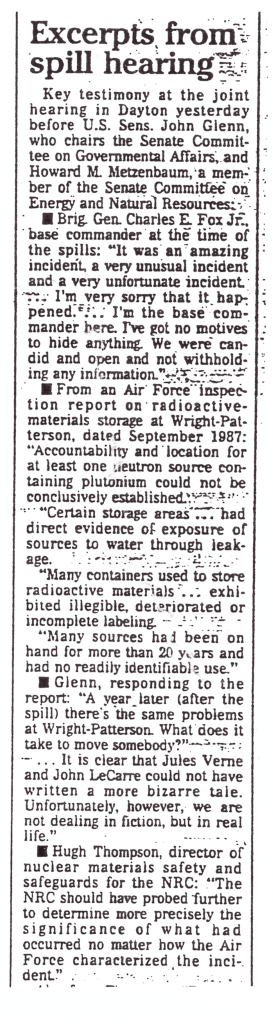
When the White House job didn’t come to fruition (see above), I was offered political appointment jobs in agencies like EPA and Agriculture at three grades above my present rank. But moving again so soon with the twins already in a good school with friends there and in the community, I choose not to accept. Had it been the White House, I would have made an exception.

U. S. Congressman Gunn McKay, (Ogden native) came to DDOU about two years after the announcement of the possible closure (and me becoming the Public Affairs Officer) with good news: DDO would remain open for the foreseeable future. In our depot newspaper,  I ran at 72pt headline DDO TO REMAIN OPEN for the accompanying story.

I was given some credit for the success of DDOU not closing because of my community involvement and my reports to the Utah Congressional delegation. Although I received top performance reviews, there was no promotion potential in my job. So, after two years as PAO, I began looking for a job with advancement possibilities.

I had enough connections at nearby Hill AFB to get a seat on a USAF T-39 (executive jet) flying to Wright-Patterson AFB near Dayton, Ohio, where I had a job prospect. After my interview with the lieutenant colonel, who was the Chief of PA for the 2750th Air Base Wing, I was offered the job as his deputy, GS-12, one step above my grade at DDOU. I accepted.

This would be the second move for the twins since they came to live with me in Colorado four years ago.


Chapter 35: Where the Wright’s Really Learned to Fly 2,082

Hulking F-4 Phantoms II’s streaked overhead at low altitude, went wet with  afterburners and quickly disappeared in the blue. Leaving their usual black smoke trail from their two turbojet engines, 17,000 lbs thrust from each.

Then, tiny by comparison, lethal single-engine, and generations newer, F-16 Fighting Falcons with 27,000 lbs thrust gracefully executed touch-and-goes. Returning minutes later, landing 50 yards before me while smoking their tires as I toured base operations. Impressive.

But after Utah, I found the flatlands in Southwestern Ohio and the dismal weather a big letdown. But to advance within the government, I went where the jobs were, where the action was.

~~

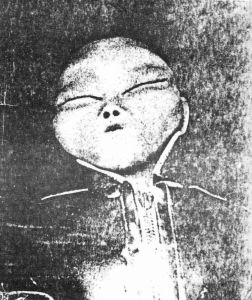
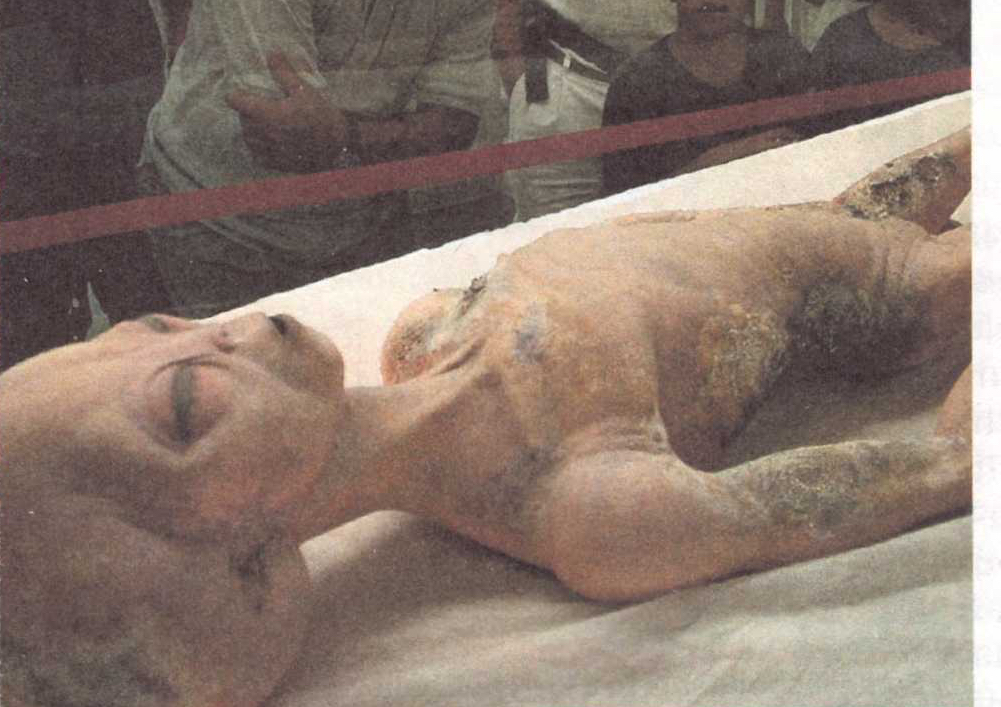
When I became Deputy Chief of Public Affairs at Wright-Patterson Air Force Base (WPAFB) near Dayton, Ohio, in 1982, it was the largest and one of the most important bases in the U.S. Air Force (USAF). WPAFB was by far the largest employer (at 32,000) in Montgomery County, with Dayton as its most populous city. No one had bothered to properly brief me on the Little Green Men (gray, actually) that were supposedly brought to Patterson Field (still part of WPAFB) after the UFO crash at Roswell, N.M., in 1947. (The year of my birth.)

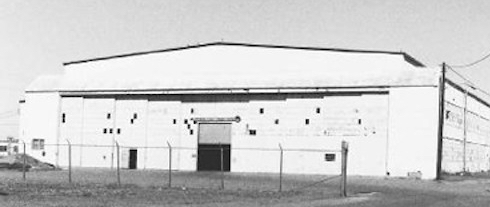
After I familiarized myself with the subject, the speculation, and so forth, I would answer five or six calls a month from the public about aliens rumored to be in Hangar 18 or Hangar 13, and I would deny that any were here or had ever been.

I took my job with the U.S. Air Force seriously, wore expensive suits, shoes, and a Rolex®. My physical condition was also critical, as I adhered to a vigorous workout schedule three times a week, alternating between the two fully outfitted gyms on base. Whether in my civilian attire or flight suit, I was representing the USAF and looked good doing it; serving with confidence, some might say smugly. My shoes were shined too.

You Were Always On My Mind–Willie Nelson, Empty Garden–Elton John, were popular on local radio.

Scan_20190704_143606
A leap of faith to say I was working in the Reagan Administration? Not for me,;it was a great time to be in DOD with a CCommander-in-Chieflike President Reagan. We finally met when he made a stop at Wright-Patterson AFB, Ohio, on October 8, 1984. (Swan archives)
Always cognizant of the USAF mission, well-informed about a subject that I’d likely be asked to comment on, and I was forthright when I didn’t know or couldn’t answer. As a Public Affairs Officer (PAO), I frequently represented the USAF with the media, community leaders, and perhaps a farmer when one of our planes crashed onto his property, scaring him and his livestock, or worse.

To advance within civil service, I took on extra activities; I did voice-overs for public service announcements for the Hippel Cancer Research Center. I gave accasional sspeech to community groups, was an elected member of the Dayton Priority Board, and was active in the Air Force Association.

I attended and excelled at Senior Public Affairs Courses during my tenure as PAO.  I was also Chair of the annual Festival of Flight, provided some peripheral support for the USAF Museum, and a member of the Officers’ Club at Wright-Patt. I was generous to the Combined Federal Campaign and supported my alma mater as a member of the University of Denver Alumni Association. I represented DU at college fairs in Dayton and Cincinnati. (Wow, isn’t Don remarkable?)

   Up Where We Belong-Joe Cocker, was played often on WTUE.

To prepare myself for more responsibility within the civil service. I volunteered and applied for upper management positions. The USAF sponsored advanced training at Stanford, Rensselaer Polytechnic, and others. In the one opportunity I had to apply for a special, limited program, my packet was endorsed by a three-star General and appeared very strong, but I didn’t make the cut. That (in my humble opinion) confirms the quality of the competition. The DOD, in General, benefited from a high-caliber and capable workforce.

~~

My first four years at Wright-Patt were occupied with the usual public affairs duties:media relations, community relations, and command information. Our weekly newspaper, the Skywrighter (Note spelling of writer, as in Wright Bros), was awarded best publication in the Air Force many times and once, the best in DOD. I narrated the multimedia Wright-Patt story for VIPs and was the primary briefer representing the 2750th Air Base Wing. I wserved asacting Chief (Pthe Positionwas a military billet) a few times while PAOs were reassigned or replaced.

The chief and I had a staff of sixteen well-qualified and competent workers, except one. Isn’t there always one? We also aaddressed noise complaints about our aircraft and responded to USAF plane crashes, usually within a 100-mile radius.

On one such occasion, I was at the scene of an A-7D Corsair II crash belonging to a reserve unit from Rickenbacker, AFB, Ohio. The pilot ejected safely. When I arrived, the attack jet was half-buried in the earth and still smoldering near a farmer’s house in an isolated area of Indiana. There were no injuries on the ground either, just a lot of curious cows.

Then came Indianapolis and the tragic crash of a  USAF A-7D-4-CV  into a Ramada Inn® in Indianapolis in 1987, killing 10 people. Trying to make an emergency landing, the jet crashed into the hotel near the airport, creating a fireball that burned much of the structure.

The pilot’s visibility was hampered by heavy cloud cover and fog on the morning he attempted to land at Indianapolis International (IAA). He radioed the tower that he was coming in  “Dead Stick” (when an aircraft loses all propulsion) and looking for a runway.  His only engine had flamed out, and he asked Indianapolis control if they could guide him to the least populated area should he have to ditch his crippled plane. He never received a response and overshot the runway. The pilot survived by bailing from the single-seat jet without serious injuries.

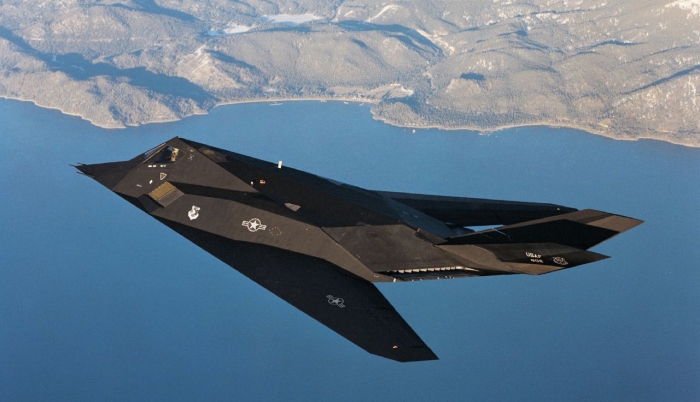
It was not the typical pilot flying that day. The USAF major was testing one of the 20 A-7Ds used as a surrogate for the super-secret stealth that he was to fly. Both the attack and stealth jets were single-seat and carried the exact payload requirements. His plane,s which crashed, was from the 4450th Tactical Training Group in the isolated Tonopah Test range in the Nevada desert. These A-7Ds were used for currency training for pilots destined to fly the revolutionary F-117 out of the Skunk Works®. The cover story for these aging Vietnam-era attack planes suddenly filling the skies, to and from the Nevada desert, was radar calibration.

4451st_Tactical_Squadron_A-7D_Corsir_II_69-6207.jpg

The A-7D Corsair II that crashed in Indianapolis in 1987. It was on a test flight for the forthcoming super secret Stealth and had a similar paint pattern, purposely making it difficult to read tail numbers and two letter designations.  Look closely on the tail for the "LV" letters.  (USAF photo)

The official cause of the crash, reported by the USAF, was engine failure while on a routine training flight. It was far from routine ,and the repeated testing, perhaps beyond the limits of the Vietnam era A-7D, may have comprised its single engine and airframe. Instruments in use were a prototype for the upcoming stealth.

Much of the Research and Development was conducted at Wright-Patterson labs, in advance of the operation and testing at the super-secret Area-51 and the Tonopah range.

Fastest-Aircraft-post-F-117-Nighthawk.jpg1_.jpg
Stealth F-117 was revealed in 1989. (USAF)

~~

I served as Public Affairs Officer at WPAFB for more than eight years. It was never boring.  In addition to the constant aliens stored at WPAFB question, there were many others as well.  As the largest employer in the county, the media were hungry for stories about the base. 

One of our base housing units was built on a former landfill that included hazardous waste. It was a significant story and generated lots of news and complaints from the residents. Naturally, I was the lead spokesman for the debacle. During this period, there was a radon scare that was in the news across the country, and of interest for a long while. Our residents were naturally concerned, and the media wanted to know about our testing procedures. And about any discoveries of the radioactive chemicals in our numerous housing units.

There were also a couple of hydrazine spills (potentially toxic) from some of the F-16 stationed at the base, that attracted media attention.

But we were just getting warmed up. I was about to be challenged with an incident that public affairs officers always have in the back of their minds, but never think it’s going to happen on their watch. Worse than the Indianapolis crash, where 10 were killed? Probably not, but people expect our jets to occasionally crash, and I was not a PAO for that event. Our incident lasted almost two years, and eventually involved the Secretary of Defense. That momentous event unfolds in the next chapter.

THE WRIGHT-BROTHERS

This is an ideal time to talk about those Brothers who, by learning to keep a  (not lighter than air) object airborne for twelve seconds, created possibly the greatest (non-medical) invention of the Twentieth-Century. And there was a lot of competition.

The Greatest of Inventions, Still Flourishing.
newsEngin.23902413_Air-Force-One-001
(USAF photo)
130607131706-wright-brothers-flight-1903.jpg
Very first flight, the Wright Flyer was aloft 12-seconds and covered 120 feet, at Kill Devils Hill, N.C.  December 17, 1903. (Wikipedia)

Most people know the Wright-Brother sold and repaired bicycles from a small shop in Dayton, Ohio, before the development of the Wright Flyer that first flew at Kill Devils Hill, NC, on December 17th, 1903.

Eight Things You Might Not Know About The Wright-Brothers: 

1) Thanks to a coin toss, Orville was the first brother airborne.
2) Neither brother received a High School diploma.
3) Neither brother ever married.
4) The Wright Bros. flew together just one time.
5) After the first day airborne, the 1903 Wright-Flier never flew again.
6) Orville was onboard the flight that caused the first fatal aviation accident.
7) Neil Armstrong carried a piece of fabric from the Wright Flyer to the moon.
8) The Wright-Bros said they really learned to fly at Huffman Prairie now a part of WPAFB. (List partially compiled from The  History Net)
250px-1904WrightFlyer
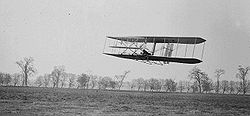
Wright II over Huffman Prairie at Dayton, Ohio, on November 16, 1904, where the Brothers “Really learned to fly,” now part of WPAFB, Ohio. (Wright Family collection)
880px-CatapultWrightFlyer1905
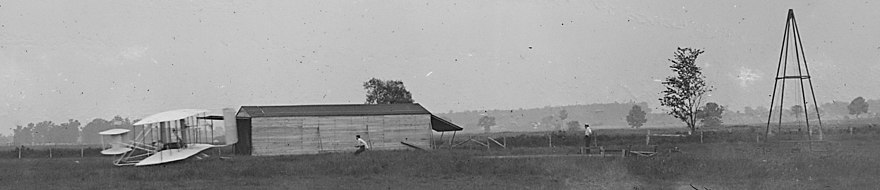
Wright Flyer III first flight June 23, 1905 at Huffman Prairie, Dayton, Ohio (Wright Family collection)

Wright Patterson AFB honors the Wright Brothers in an annual ceremony on the anniversary of their first flight at the monument to the Brothers, overlooking Huffman Prairie. In a short 66 years after their first flight, another Ohioan, Neil Armstrong, would walk on the moon.

                   DAYTON INTERNATIONAL AIRSHOW

For the annual Dayton International Airshow (DIA), there were hundreds of aircraft civilian and military from North America and some foreign countries. Our Public Affairs Office was heavily involved.

Lt. Col.  Kunkle was the Air Force man in charge of the military portion of the DIA, which covered pretty much all of it. He had been a guest at the Hanoi Hilton for a mind-boggling and unimaginable six years!

Not without good reason did the colonel seem to be one of the happiest people alive — enjoying every moment of his freedom.  Who then would-could possibly exasperate this bona fide hero? It was believed that I was the first and only person known to have pissed him off since he was repatriated and began serving at Wright-Patt several years ago.

There were a couple of golf carts assigned to PA for activities like buzzing around the grounds of the airshow with media. Mostly, however, the carts were reserved for VIPs and the disabled. His anger possibly had something to do with me riding in one of his golf carts, perhaps hooligan style, with a certain Ms. Dayton International Airshow. I don’t think he was mad at me for more than a couple of years, though.

MS458_Dayton-Air-Show-1992_Crowd-Watching-e1495563645773
Scanning the skies at Dayton Inter. Airshow (DIA)


MS458_Dayton-Air-Show_July-22-1992_Gold-Knights-e1495647319348
U.S. Army Golden Knight free-falling at Dayton Inter. Airshow (DIA)
US-Air-Force-F-22-Raptor.jpg
Recent Dayton International Air Show’s final act, with the F-35 demonstration. (DIA)


Chapter 36: The Spill Heard Across the Country. 608 plus articles

 Wish I didn’t know now what I didn’t know then. ~Toby Keith

 After boasting for several years that I had the best job at Wright-Patterson; There came a Spill, a Leak. (Spill & Leak capitalized by author)

FAKE HEADLINE

CITIZENS PANIC

MISSING AF NUKE FOUND SMOLDERING NEAR SCHOOLYARD

ACTUAL HEADLINE

OHIO GOVERNOR

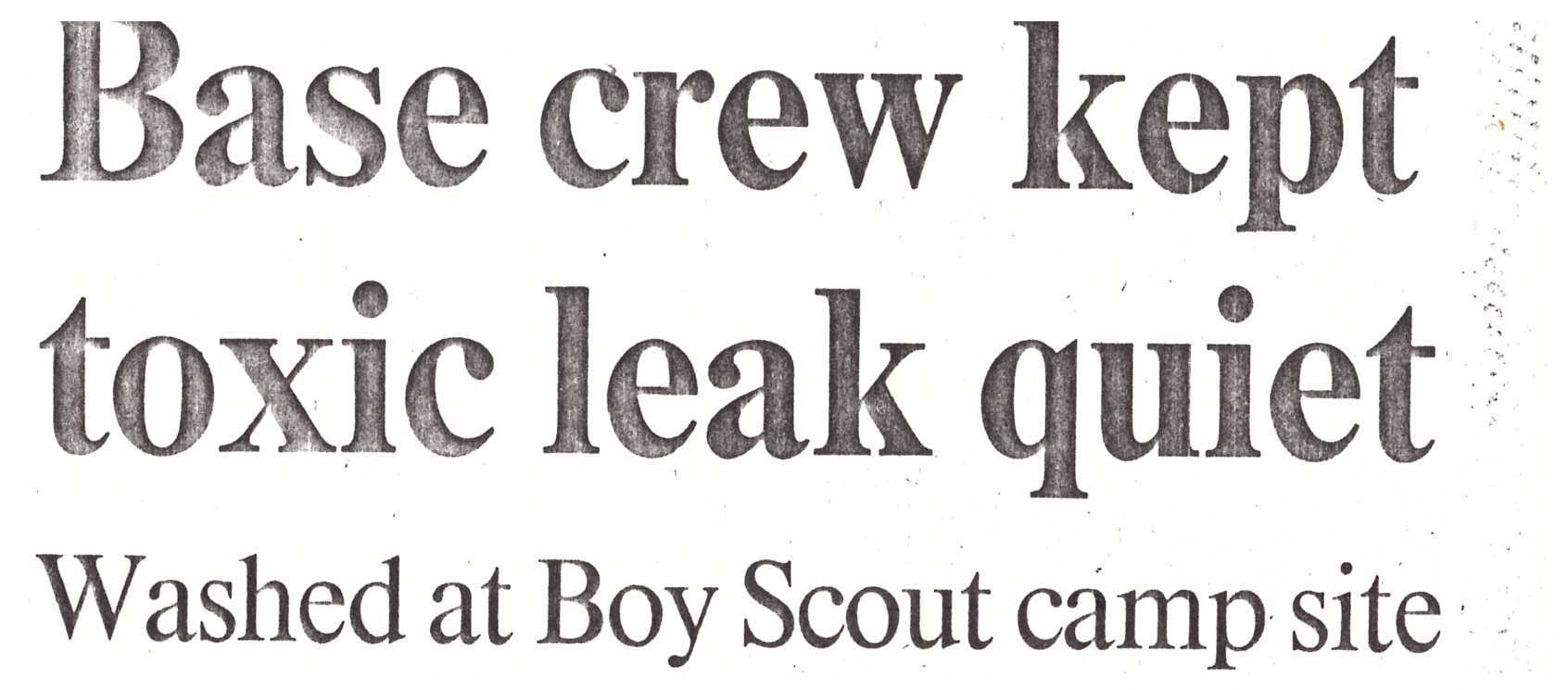
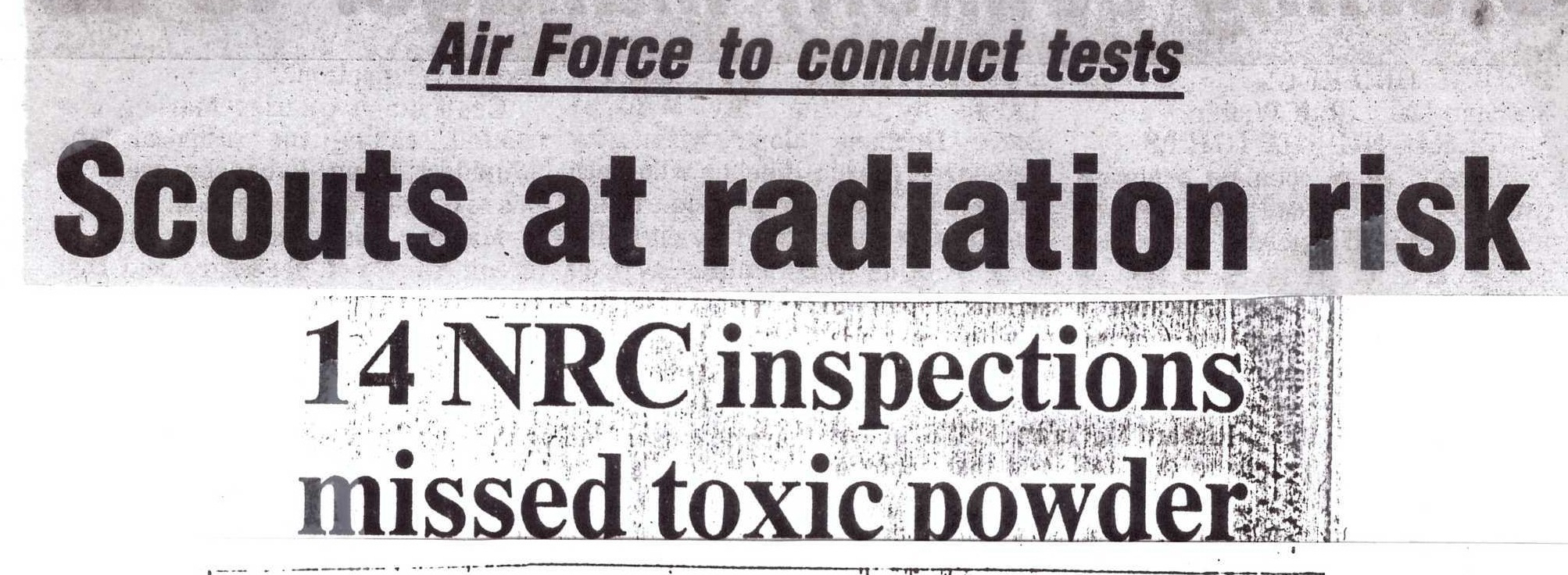
‘SCOUTS AT RADIATION RISK’ FROM W-P SPILL; AIR FORCE COVER UP ALLEGED

The headline on the bottom doesn’t sound so bad when compared to the fake one on top. Still, it’s the kind of stuff Public Affairs Officers lose sleep over.

Don’t Worry Be Happy–Bobby McFerrin, Don’t Mean Nothing–Richard Marx, Only In My Dreams–Debbie Gibson were filling the airwaves.

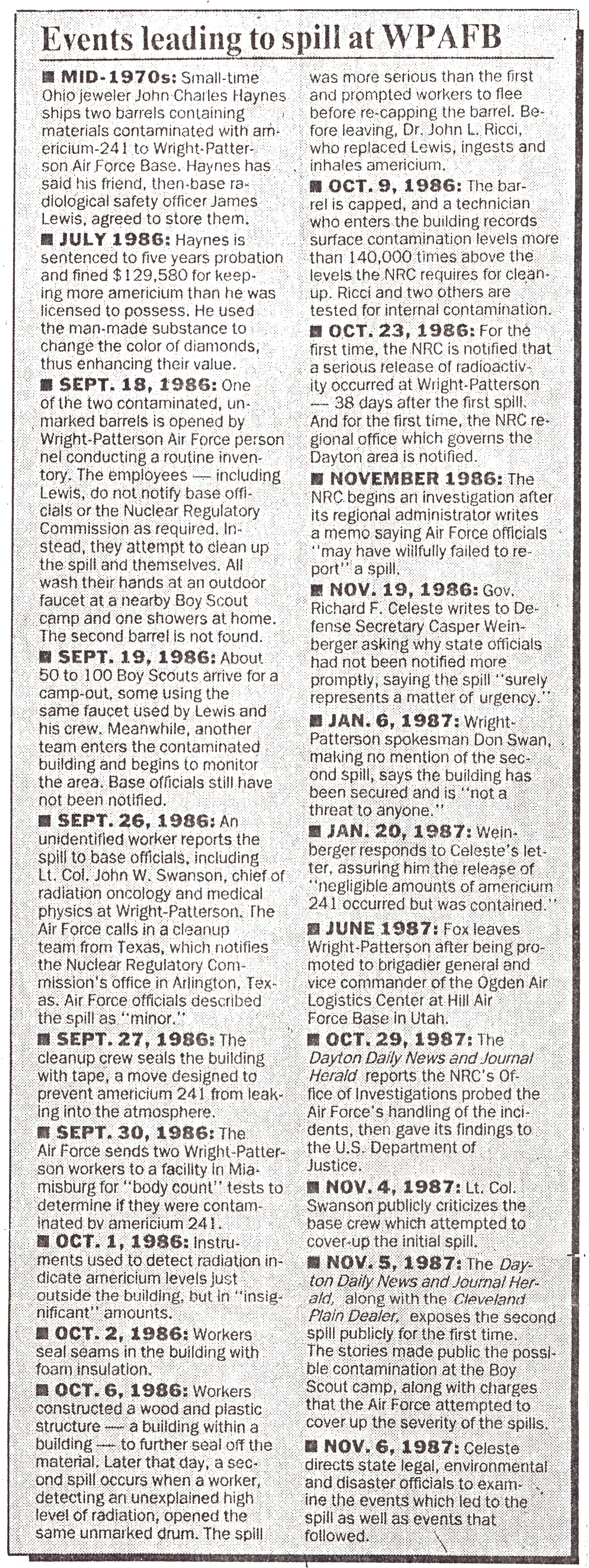
As the Senior Public Affairs Officer for Wright-Patterson’s Americium 241 Spill (a radioactive isotope with a half-life of 432.2 years, most prevalent in nuclear waste).  I was in the media center or on call 24hrs for weeks at a time answering questions or preparing Air Force members who spoke to the media. No hyperbole necessary; this was a major story covered by dozens of newspapers, radio, and TV across the country.

Sample headlines followed by a condensed version of the Spill.

September 1986

Scan_20190603_113216

October 1986

Scan_20190418_172834

November 1986 

Scan_20190418_172834

January 1987

Scan_20190418_172834

 October 1987

Scan_20190601_140345

Spill.jpg
I’m quoted in a document with Sec. Weinberger!

Our Spill was a significant news event covered by dozens of newspapers, radio, and TV across the United States. Newspapers covering the Spill included: New York Times; LA Times; The Plain Dealer (Cleveland); Columbus Dispatch; Cincinnati Inquirer; Pacific Stars & Stripes; Macon Journal (Michigan); Dayton Daily News (Ohio) and about thirty others.

Then came the Congressional Hearings in Dayton.

As the Senior Public Affairs Officer for the Spill, I prepared members of the Air Force who were to testify during the Congressional Hearings.

Scan_20190630_171319
Documents above from WPAFB archives.

Internally, Project 4060 was the code name for the Spills. (Building 4060 is where the Spills occurred).

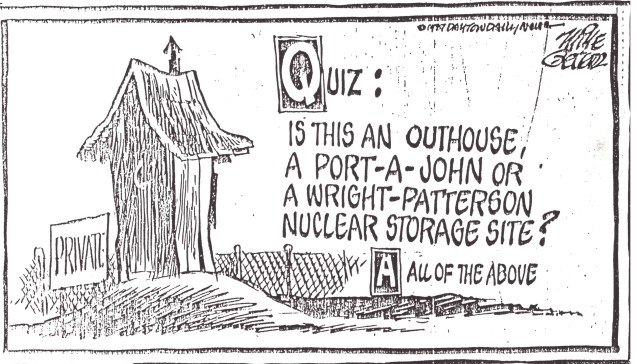
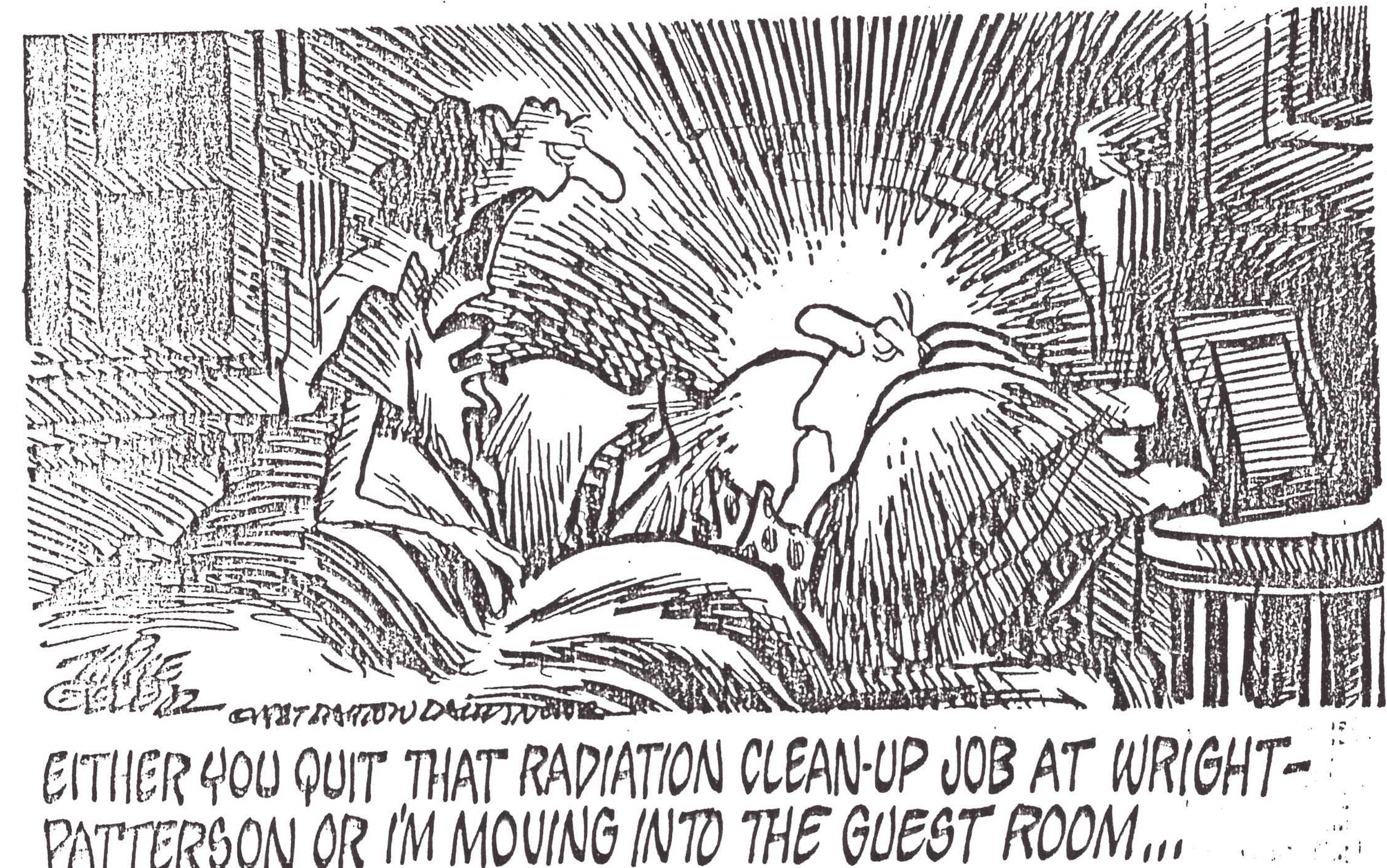
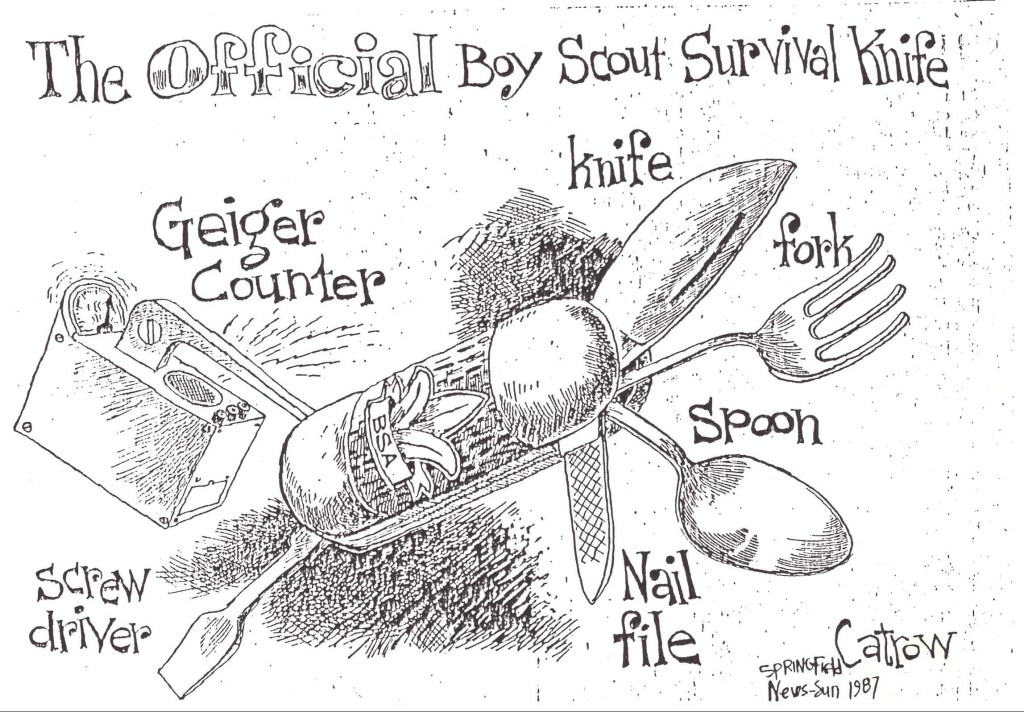
Newspapers had a little fun with our Spill.

Scan_20190412_135241

 Dayton Daily News Mike Peters (above & below) Reprinted with permission.

Scan_20190422_125118

Scan_20190422_123144

img766
Dayton Daily News

Springfield News-Sun (above) Cattrow. Reprinted with permission.

My advice and counsel to the base commander, it was believed, kept him from losing his job. Officials at Wright-Patt and other entities thought the fallout from the Spill could have been even worse. A case study of my performance (in the Spill incident) was included in the curriculum of the Senior Public Affairs Officer course. I was rewarded with a promotion to GM-13 for my “performance and professionalism.”

My extracurricular activities that resulted in goodwill for the USAF and the community at large (expressed in the previous chapter) and a spotless record was certainly another plus favoring my promotion.

True Colors–Cindi Lauper, Two Of Hearts–Stacey Q, Danger Zone–Kenny Loggins played on the radio.

Scan_20191202_105742
Relating to meeting about Project 4060, and the Congressional Hearings, Mike DeWine became governor of Ohio in 2019.  (Swan archives)

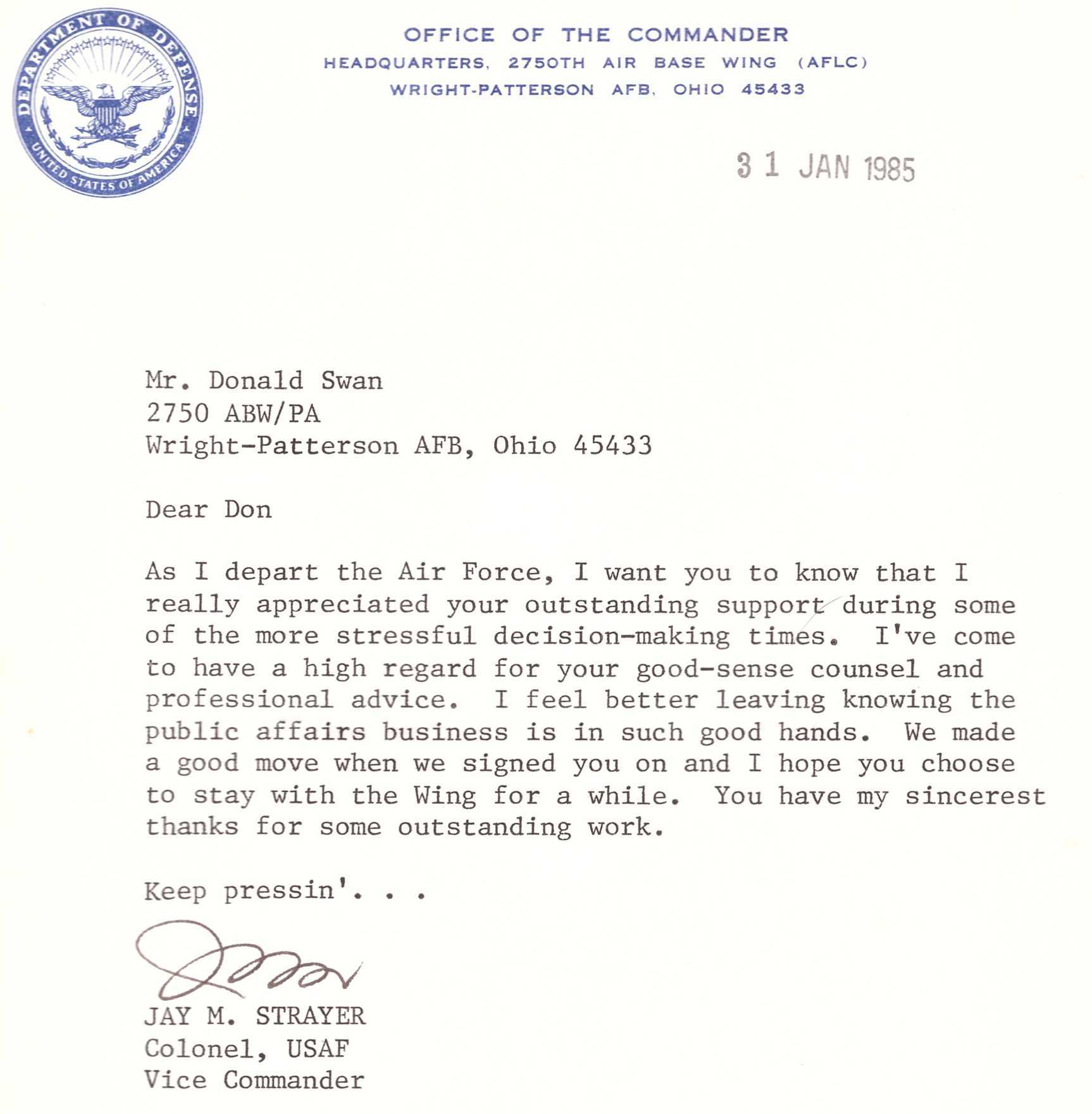
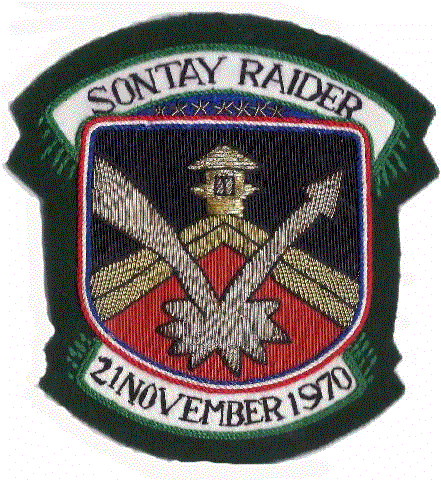
I include the letter below (not related to Spill) because, as a major, this man piloted a helicopter deep into North Vietnam on the Son Tay raid. Col Strayer received a Silver Star, the third-highest honor for valor. And it was an honor to have served with Col Strayer. He should have been promoted to brigadier-general.

Scan_20190626_205228

jaymstrayer.jpg
Colonel Jay M. Strayer. (USAF)

JayMStrayerRibbons
Col Strayer’s Pilot Wings and Medals.  Award at the top is Silver Star, the third-highest for valor. An oak leaf cluster denotes an additional award. A “V”  on the ribbon means it was awarded for Valor.

SonTayRaidersPatch.gif
                               (Swan archives)
Chapter 37: Aliens, Anyone? 1,425

There, comrades, is the answer to all our problems. It is summed up in a single word — man. George Orwell

Historic Wright-Patterson AFB, Ohio (Think: Wright Brothers) is one of the USAF’s largest and most important bases.  It’s a research and development leader and a major flight operations base.  But, despite its importance to the mission of the Department of Defense, it is also known to many for just one thing: storing, well, ETs.

Consequently, I would be remiss without addressing the aliens (sorry, undocumented beings) rumor. I believe most of my readers want to know what I know about the Little Gray Men, as no doubt tens of millions or more do too. I was, after all, the Public Affairs Officer with a TOP SECRET clearance, where they were said to have been stored.

“Over the past thirty-eight years, it has, from time to time, been rumored that the remains of extraterrestrial bodies are (or have been) stored at Wright-Patterson AFB, Ohio. However, there are not now, nor have there ever been, any extraterrestrial beings or any material related to the same at Wright-Patterson Air Force Base, Ohio. All records of the United States Air Force investigations “Project Blue Book”  into Extra-Terrestrial studies are contained in the National Archives.”

Pretty specific, huh? When I prepared that explicit proclamation in 1985 for the media and answering queries from the public, I believed it to be true. However, less than two years after I made that declaration, I discovered evidence that conflicted with my earlier denials.

There is just this one thing that gives me pause in confirming our discovery with the world: TOP SECRET/SCI/SAP-R* (sworn to secrecy for the rest of my natural life) for which the Department of Defense had entrusted me.

wpafb-hanger-18.jpg
The infamous hangar 18, circa 1947 at Wright-Patterson, no longer stands. Replacement building 18, below. Photo taken from a great distance? (Commons)
Unknown

080313-F-1234P-011.JPG.png
Long declassified VZ-9 Avocar saucer in 1961. Handling issues and a top speed of 35 mph ruined the debut, now at the Museum of USAF. (Air Force)
img-2
Looks dead to me. There are many who believe. (From Wright-Patt website)
Scan_20190605_173123

People in background (reflection) looking at "Alien," note wounds. (Reader's Digest)
ftd_wp_image
Purported encrustation of the anterior skull from an alien claimed to be the work of super-secret Foreign Technology Division (FTD)  at Wright-Patterson, as reported by  NOUFORS, who provided illustration.  (FTD denies any involvement)

With a Presidential Executive order for the USAF (as commander in chief) could order a search of WPAFB, Ohio. They could look for any evidence of extraterrestrial, where would they look? Wright-Patt sits on 8,000 acres, with thousands of buildings and an estimated 200 labs.

Would they search a nondescript building with warnings of contamination? They might search where there are warnings of from hazardous chemicals and radioactive substances. This could include bone-seeking (Americium-241) with a 432.2-year half-life?

Perhaps in an isolated building with no markings at all,  but underneath a bomb-resistant vault and tunnel, maybe containing a barrel or two?  Something inside those containers — with the best-known chemical cocktails, when pickled or in a cryogenic chamber — to preserve body parts indefinitely? Too delicate to move to Area 51?

With advances in technology not available in 1947, 1967, 1987, or anytime in the twentieth century. Advances in microbiological innovation and contemporary scientific protocols would permit a more definitive examination. And possibly with and less degeneration of cells.


~~

The super-secret USAF Foreign Technology Division (FTD) was,  maybe still, near the site, coincidently, I suppose. In 2018, the now-named Air and Space Intelligence Center (ASIC) was doubled in size to 58,000 square feet. More labs were added more at a cost of 29 million dollars. ASIC investigates and scrutinizes technical intelligence of (the) Air and Space Force(s) and scientific exploration. Separately, Wright-Patt is a significant research and development center.

planets_everywhere_artists_impressionjpg__1240x600_q85_subsampling-2.jpg__1240x510_q85_crop_subsampling-2.jpg
Planets orbiting Milky Way, out they somewhere, or some already here? (NASA photo)

Are those priceless, fragile, mysterious, amazing and otherworldly ETs, under study as I write, employing more precise instruction, sophisticated scientific innovations whose names we don’t know yet?

What  would the forensic pathologists, histologists, experts in micro astrobiology, fluorescence microscopy, and discovery-based scientists find? Have the researchers found or examined basal ganglia (contained in human brains) with transmission electron microscopes?

If these hypothetical researchers find that genome, pluripotent cell, or any evidence previously unknown about Extra Terrestrial life forms. Scientists would have a Nobel prize in Physiology for the taking; if only the judges knew. Would the Nobel Committee create a special category just for these women and men? Might the United States Government establish form of knighting similar to the UK, for these scientists?

But I’m getting ahead of myself, We Are The World-USA for Africa, Money For Nothing-Dire Straights, Separate Lives-Phil Collins, Suspicion-Elvis played on 104.7 WTUE.

What I found practically by accident — should I reveal the testament of data — would be a virtual tsunami of near Biblical proportions, probably for the entire planet. What proof do I have?  Should agents, producers, or publishers be reading my book — an advance of $10 million, with a money-back decree naturally, would be a good start. Otherwise, contacting me will not result in any information. Any confirmation of somatic corporeal evidence I have is not on my person or near my property.

Though I might be a cause célèbre to many, who judged my actions courageous, there’s still Ft. Leavenworth, Kansas; the infamous federal prison with its most secure facility now the innocence-sounding US Disciplinary Barracks(USDB).

Chelsea Manning (though not in max security) was confined at the Barracks, the same facility where Nidal Hasan awaits execution for the mass murders at Ft. Hood, Texas. As of this writing, four DCI (death cell inmates), including the despicable Hasan, were on death row at the USDB. In 2021 President Biden’s Attorney General placed a moratorium on Federal Death penalty.

But Trump’s back.
These Barracks, once a facility for prisoners sentenced to a life of hard labor — or death — remain a maximum-security prison. Although in ill health, such an institution (rarely allowing visitors) would probably not be the ideal sanatorium for me to live out my golden years, even in the medical ward. As long as I could maneuver by any means, I would surely be emptying bedpans and, when unable, restrained to my bed, in solitary, until death.

38171893201_e81c111577_bMaximum security US Disciplinary Barracks at Ft. Leavenworth, Kansas. (US Army)

As for my family, the Government would undoubtedly harass them more than CNN would badger Sarah Sanders (Trump spokeswoman) during a news conference.

Any money or assets gained from my story would probably end up in the U.S. Treasury to finance a grant for Progressives to study the prospects of legalizing NAMBLA and funding MAPs (minor-attracted persons). After all, it’s just sex, and Man-Boy, etcetera, is their sexual preference.

Never Mind.

You might consider the Drake equation by (a post-doctoral professor) from 1962, who studied how many planets could support alien civilization. It was quickly followed by a Harvard astronomy professor who created a formula for probable estimates of extraterrestrial life. (See  Are We Alone article from the National History Museum.) Then there’s Panpsychism to consider, as it relates to the entire universe and all things.

There is currently a “Search [for] Extra-Terrestrial Intelligence (SETI)” organization operated by prominent scientists active at a location (near me) in Northern California. (Think: Fermi paradox, biosignatures, tehnosignatures, or Dyson Sphere.)

Elon Musk believes “aliens or among us” and that he is not from earth.

In 2019, a group known as “Storm Area 51” encouraged festival goers to raid the classified Air Force Installation to “see them, aliens,” according to a Facebook post.

Last-Minute update: Just recently, after a FOIA request revealed footage from a U.S. Navy fighter showing UFOs, the U. S. Government began an official study of Unidentified Aerial Phenomenon (UAP.) Then, in 2022, the All-Domain Anomaly Resolution Office was established (ADARO).

*SCI, special compartmentalized information authorized.  SAP-R, special access programs eligible.

Chapter 38: Lisa & Laura, When I Lost My Ass & My Job 2,836

You don’t always get what you want, but if you try sometimes, you might just find,  you get what you need. From the Rolling Stones.

You’re probably familiar with those line charts people use to track their lives or finances that look something like an EKG reading. If I were using one to rate how my life was going (in the following chapter). My Chart would barely register above flatline, with two exceptions:

Lisa & Laura

Our family was one that showed emotion by hugging and verbally communicating our love. Lisa and Laura were doing well in Dayton, despite me frequently working late (or because of it).  

Lisa was on the varsity HS basketball team, and when she graduated in 1987, held the school record for the most rebounds. Laura played basketball as well but was more interested in dating and hanging out with friends.

Both got braces at my expense, of course. Lisa had bad acne, and I found a good dermatologist who successfully treated her. Each had part-time jobs when they didn’t interfere with sports or school. I bought both cars, mainly with the proceeds from selling my seven-year-old 18k Rolex® Datejust. 

We went on vacation to see their Grandparents every June and to other places like the 1984 World’s Fair in New Orleans. Great trip. We went to movies, plays, and amusement parks like King’s Island Cincinnati, Magic Mountain Columbus, and Cedar Point Sandusky (All great when we were there in the 80s).

We visited cities like Cincinnati, Indianapolis, Louisville, Lexington, Kentucky, and Columbus, Ohio, all within a hundred or so miles. Parks in the Dayton area, like Carillon, our favorite, included early technology displays, historic buildings, and lots of Wright Brothers Memorabilia. We also visited campuses of universities like Purdue, Ohio, Indiana, Xavier, and others to pique their interest in going to college.

Lisa and Laura graduated high school with good enough GPAs for university admission. They qualified for a VA program for their undergraduate studies and paid most of their fees because of my war record and disability. I sent them money for misc. expenses that the VA did not cover. Lisa chose the Ohio State University, where she graduated with a BA in Social Sciences.

Laura studied at Bowling Green State University, Ohio, and graduated with a BA in Criminal Justice. Both received their bachelor’s in four years. Lisa went on to earn a Master’s degree at OSU, also in the Social sciences.

Because of some lucky planning and a few connections, I had tickets well in advance of the second week in Sept. 1985. The Cincinnati Reds were playing a stretch of home games during that period.  It was believed that Pete Rose might break Ty Cobb’s record at Riverfront Stadium, and the twins and I were there to see him play on Sept. 10.

Luckily, I had tickets for the following evening as well. However, I had a prior out-of-state temporary duty engagement for the next several days.  I decided to trust the girls (shy of 17) to go to Riverfront the following evening.  The twins were two of the 50,000 screaming fans on Sept. 11, 1985, to witness Pete Rose crack a single to left-center (number 4,192) in person, breaking the record Ty Cobb held for almost 60 years.

We were fortunate to attend a couple of Cincinnati Bengals football games less than an hour south, also at Riverfront Stadium. They played in the Super Bowl the last year we were in Ohio. We were regulars at the University of Dayton Flyers basketball games, played in a first-class arena. They were an NCAA Division I basketball team that went to the Sweet 16 during the period we saw them in action

In addition to all the fun events the twins and I attended in Ohio, one was practically in our backyard.

Museum of the United States Air Force, Wright-Patterson AFB, Ohio 

The largest display of military aircraft in the world. Admission is Free

140425-F-IO108-006
The least intimidating aircraft ever, this O-1G Bird Dog?  The VC and others feared this little bird as Forward Air Controllers (FACs) searched for the bad guys and, when spotted, discharged smoke canisters, marking them for fighter jets and other aircraft. Also, it was dangerous for the pilot (219 killed in action in VN) in this slow and unarmed Cessna-TM of the early 1950s. (USAF)


190314-F-IO108-009.JPG
Killer Plane. B-29 Bockscar, which dropped the second nuclear bomb on Japan, August 9, 1945, is displayed at the Museum of the USAF. (U.S. Air Force photo by Ken LaRock)
gallery-1447258925-xb70-1.jpg
The futuristic-looking XB-70 at the Museum of the USAF at Wright-Patt was canceled in 1969 and never went into active service. Unbelievably, in my Village of Shelter Cove (pop. 803) lives 101-year-old Warren Helsley (regrettably, died in 2023), my friend, a WWII veteran and aeronautical engineer who worked on designing this very plane.  (US Air Force)

~~

Scan_20190427_204151After earning that Spill Promotion (Chapter 36) and my surgery (below), I rewarded myself in a Big Way. This leased ’88 BMW®325is was my track car and, eventually, my race car. (Swan Collection)

scan_20190517_104002.jpg
Destined for a public relations career? Shown at a community leaders gathering in a high-rent district of Dayton, circa 1988. (Swan archives)

~~

scan_20190517_102345.jpg
Inspecting Pantera engine at Mid-Ohio Sports Car Course in my flight suit, 1988. I had vigorous workouts three days a week; no fat on that body. (Swan collection)

Does anyone remember the Rantex™ wipes shortage in the mid-80s that I got caught up in? Probably not, unless you needed those as I did. They were the only thing that brought any relief to my anus and rectum. Inflamed from nineteen years of frequent and mushy stools. In my world, my anus felt like the nerve center of my existence.

For some reason, Air Force Rx couldn’t get enough of the wipes for me; then, they couldn’t get them at all. I was unsuccessful in finding any (no Google™). I began going to labs with restrooms that sometimes provided Rantex wipes for patients to clean their private parts before peeing in a cup. (Insert joke here.) When I found some, I would procure a handful. (I am not making this up.)

When Doves Cry–Prince, What’s Love Got To Do With It–Tina Turner, Like a Virgin–Madonna played on the Dayton stations.


Back in Mississippi in 1988, Dale had been caring for Momma and Daddy for several months, as best he could, while holding down a full-time job. Finally, he was able to get Momma into a nursing home nearby. Dale continued to care for Daddy and was spending all of his time off work doing so.

At the end of Dale’s work shift, he’d rush to relieve the people (who had been sitting with Daddy for eight hours). He remained throughout the night until his wife came the next morning with food for the day. Then he went to his regular job.

The next day, it was all the same.  And it continued for almost a year! My wonderful brother was holding out as long as possible to keep Daddy out of a nursing home, especially one in a different location from Momma.  (There were no vacancies at the facility where she was a patient.)


The twins and I went to Mississippi in June 1988 on our usual vacation, but this time I was looking for a nursing home for Daddy.  The twins and I wanted to give Dale relief from what had become a burden he couldn’t continue indefinitely.

Here I was on the scene, the educated world-traveler and younger brother in his new BMW®, who had never done a thing to care for either parent. Telling my brother what he should do: take Daddy away from the only home that he had ever known, to a nursing home, close by, or not.

I spent a week visiting every nursing facility within a hundred miles of Dale’s home, and I found one about 40 miles away with an opening. Naturally, I encouraged Dale to place Daddy there before the vacancy was filled.  My motivation and reasoning were to provide some relief for my brother.

The girls and I sat at Momma’s bedside in her nursing home for a long and sad farewell, although we shared some light-hearted moments from the almost four years she had so faithfully cared for them.

As for Daddy, we tried to convince him that Dale was running out of options and that if Momma could tolerate a care facility, he could too. We should have treated it more as a farewell, as this was the last time we would see Daddy alive.

I was confident that I had provided some help and had done the right thing; it was still up to Dale to make it all work.

The twins and I left for home, trying to put the stress of seeing Dale and my parents in this mess and the 95-degree heat and humidity in our review mirror. Heading north through Alabama, Tennessee, and Kentucky, we listened to I Want Your Sex–George Michael, Tell It To The Heart–Taylor Dane, and “Roll With It–Steve Winwood; each mile, bringing us closer to our comfortable lives in Ohio.


Several months later, Dale was able to get Daddy into the same nursing home as Momma. He visited them every day to make sure they were adequately cared for.

Daddy died in January 1989 in Amory, Mississippi (six months after being admitted to a nursing home) at age 83, from complications of a stroke. It was just a few miles from where he was born and grew up.

Soon after I returned to Wright-Patt from his funeral, I began having severe issues with Crohn’s Disease.

Within a week, I was lying on a single white sheet that scarcely covered a cold slab of shiny steel. Nurses lifted me onto the warm padding of a surgical table in what felt like a 58-degree Operating Room.

On a stool just inches to the right of my head, the anesthesiologist activated the roller clamp on the IV. Whoa! Propofol surged into my vein — warm, serene, celestial, heavenly — 3.5 seconds of ecstasy.

Advisory: Some paragraphs below contain graphic discussions of human anatomy, disease, and pragmatic surgical procedures. Those paragraphs are in a distinctive font. 

The surgeon held a #22 scalpel at an angle similar to a pencil just below my sternum. He pressed the blade to a depth of about two inches into my upper abdominal wall. Then he continued puncturing, slicing, and lacerating straight down through my rectus abdominus, all the way through the obliques and umbilical to just above my pelvis, about nine vertical inches.

Then, with a seven-inch Balfour spreader, the surgeons opened my belly to their satisfaction. Trading for a #15 scalpel, the doctors began the more meticulous and time-consuming operation of extricating my anus and rectum.*

Next, the surgeons permanently closed my anal and rectal cavity with mesh and sutures, then cut about a foot from my sigmoid colon.

The doctors continued by incising two holes, both about two inches in diameter, into the wall of my abdomen (an enterostomy).  One was for a mucus fistula, and with the other hole, the surgeon pulled about an inch of my sigmoid colon up through the opening and sutured it into the wall of my celiac. That’s called a stoma.  It would serve to discharge waste my erstwhile anus and rectum did.  (So much for me modeling underwear for Calvin Klein®.)
 
After 6 hours inside my abdominal cavity — slowly methodically, cutting-removing, rearranging-revising, and changing my life forever **— the doctors sutured my nine-inch wound. My proctectomy was complete.

A nurse pinched the doctor’s soiled surgical gloves at the top of their palms, gently pulled them away, and deposited them in the same red “medical waste” container where my decaying anus, rectum, and part of my colon had been trashed.

For the tired surgeons, their work was done. For me, it was just the beginning.

I came out of anesthesia sporting a new appendage, an irreversible colostomy! I would suffer from the effects of major-invasive surgery for a few more days before seeing or worrying about my new stoma. 

I was wheeled into a narrow hallway just outside the surgical suite, strapped to a gurney, feeling hollowed out and in significant pain.

I spotted a nurse or somebody, and in a voice weakened by six hours of surgery and General anesthesia, “Hey, I was supposed to be on a pain pump,” I pleaded.  “You’re on one,” she shouted and kept walking.

With my right hand, I fumbled for the button on the pump and clicked it two or three times*** with my thumb.

Lying there in front of a giant clock (The Chicago Lighthouse), time seemed to have stopped. What seemed like an hour was less than five minutes. “Somebody, please get me away from this clock,” I said to no one there. I tried to calculate how long the worst of the pain would last, five or six hours, I reckoned. 

During the worst of it, I was in and out of sleep, yet each time I awoke, I was distressed to see that only a minute or so had passed. I closed my eyes for a moment, but this clock was haunting me, and I kept staring, hoping, waiting, wanting that clock to speed up — just for me.

OK, I’ve never actually had a bowling ball fall dead center onto my lower abdomen from five feet up.  But I’m sure of the pain it would cause; the pain I was in right now! And it would not diminish anytime soon.

Eventually, I was rolled into the intensive care unit (ICU).  There was no clock in front of me, but, of course, I was still hurting. Then I got the hiccups, and although treated with shots, they agitated me for two days. Each contraction comes like clockwork — pulling at my stitches!

Finally, I fell into a deep, peaceful sleep; I thought: [Screaming] Help me, Chuck’s down, Help me! I’m bleeding out. Help me!  Help, Hagemeister’s down! Get me morphine; you’re the only one left. Call Dustoff. Help us; you’re our last hope and the only one left. Help . . .

I jerked awake when a nurse began shaking me from my nightmare of lying on the sandy field at the Ambush site (Chapter 17). The wounded were calling out to me, even those whose dog tags were anchored between the top and bottom of their front teeth. There was nothing I could do. I couldn’t help them. I was here in the ICU.

After a day or so, an ostomy nurse visited me in the ICU and explained how it all worked and what my daily routine would now be. She patiently instructed me and demonstrated how it would function. The nurse placed an adhesive wafer with a pre-measured hole on the skin around my exposed stoma. The bag she attached to it would collect my bowel movements. In my case, the bag (because of Crohn’s) would need frequent changing, and the “appliance” (no kidding, that’s what the wafer is called) requires replacement, care, and cleaning about twice weekly. 

Thank goodness for sick leave, stamina, a strong heart, and lungs going into the first surgery.

Every Breath You Take–The Police, Total Eclipse Of The Heart–Bonnie Tyler, Straight From The Heart–Bryan Adams played on WTUE.

I continued in my job as Deputy Chief of Public Affairs after a long recuperation, and I got some good assignments.

scan_20190702_161038-e1568523604885.jpg
A good assignment, eight months after my first surgery. (Swan archives)
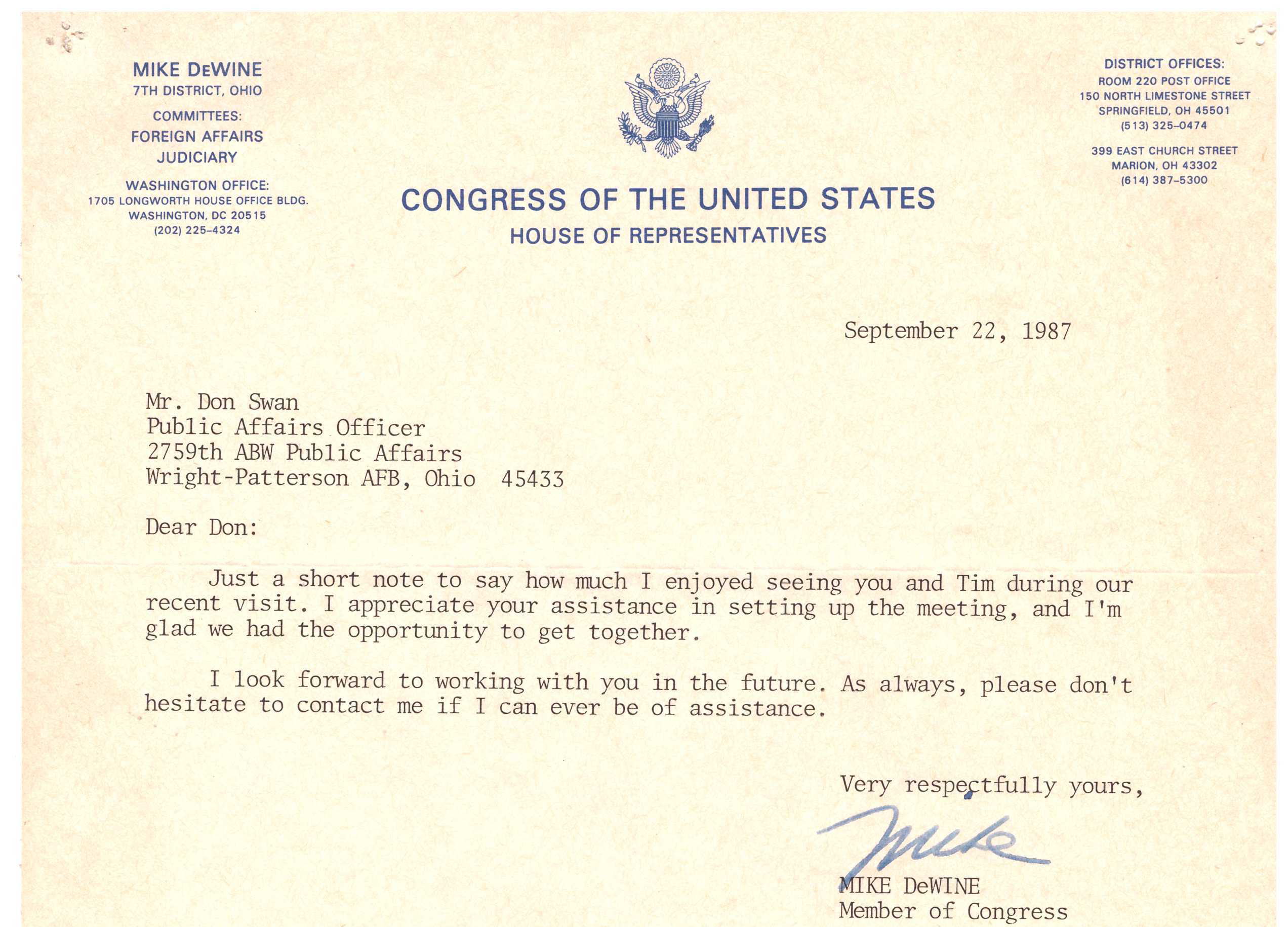
In the succeeding two years, I would be in and out of the hospital for three more surgeries. One to close the mucus fistula, one for a hernia around the stoma, and one for revision of the colostomy itself!  Two of the subsequent surgeries required slicing open my belly near the original nine-inch incisions. It never got any easier or less painful.

Love Shack–B-52s, Like A Prayer–Madonna, and From A Distance–Bette Midler filled the airwaves in Dayton.


I’d had a stressful job. But it was my job, my dream job, the best of the 32,000 at Wright-Patt, I believed. Now, it was no more. I was medically retired once again in early 1991 because of Crohn’s disease, leaving behind seniority and an annual salary of $119,000 in 2025 dollars.

Or, I could claim, in an alternate scenario, that my retirement was precipitated because my services were less critical, in that the Berlin Wall had recently come down.

*Unsurprisingly, several risks are involved in proctectomy surgery, including impotence, bladder incontinence, or both.

** In addition to the obvious maladies of having a colostomy, there were other anxieties: Like trying to explain to a potential sexual partner, never being able to unwind sitting on the throne reading, awaiting a BM, or taking a long shower without worrying about discharge from the stoma, and occasionally awakened by the smell of my own crap.

***It’s a time-release pump, so pressing the button more than once doesn’t increase the dosage.